Blog

University of Pennsylvania Wharton School Essay Analysis, 2020–2021

Wharton School at the University of Pennsylvania

In an unexpected (to us, anyway) move, the admissions committee at the Wharton School at the University of Pennsylvania has elected to change its essay prompts for the upcoming application season after all, though the adjustment is nuanced and, in our opinion, works in candidates’ favor. Taken together, the school’s prompts still essentially ask applicants to describe a kind of give-and-take with respect to their engagement with its MBA program. Question 1 asks what Wharton can do for you, and question 2 focuses on what you can do for Wharton. Your greatest assets in approaching both essays will be your knowledge of the school and the level of detail you infuse into your essays. Be knowledgeable, be authentic, and be thorough, and you should be well positioned to submit persuasive essays. Read on for more guidance on each question individually.

Essay 1: What do you hope to gain professionally from the Wharton MBA? (500 words)

In a mere 500 words, you must discuss your career goals—giving very brief context for why they are realistic for you—and illustrate how Wharton will help you pursue these goals by demonstrating a thorough understanding of what the school offers and a well-thought-out game plan for availing yourself of these offerings. To effectively do this and write a reasoned, nuanced essay, you must first familiarize yourself with Wharton’s various resources and pinpoint those that truly pertain to you and the direction in which you hope to head. Go the extra mile in learning about the school—connect with multiple students and alumni, attend admissions events in your area, and especially, visit the campus (if at all possible). This will provide the kind of in-depth insight that will show the admissions committee you are really serious about Wharton and are confident you belong there. Simply presenting a list of classes and clubs you think sound interesting will not suffice, and absolutely avoid vague, pandering statements about how great the school is. You must reveal clear connections between your aspirations, what you need to achieve them (e.g., skills, experience[s], connections, exposure), and what Wharton in particular can provide that will enable you to fill those gaps.

Note that Wharton asks you to address only the professional aspect—not the professional and personal aspect—of your business school goals. This means you should focus solely on sharing your career-related stories and ambitions here and then use the other essay(s) to discuss non-work aspects of your life, thereby providing a more complete and well-rounded picture of yourself for the admissions committee.

In many ways, this prompt is asking for a typical MBA personal statement. We therefore encourage you to download your free copy of the mbaMission Personal Statement Guide. This complimentary guide offers detailed advice on approaching and framing these subjects, along with multiple illustrative examples. Be sure to claim your copy today.

Essay 2: Taking into consideration your background – personal, professional, and/or academic – how do you plan to make specific, meaningful contributions to the Wharton community? (400 words)  

Although this prompt is clearly worded differently from the one Wharton posed last season, at its heart, the question is meant to elicit largely the same kind of information. By disconnecting your anticipated contribution from a specific “impactful experience or accomplishment” and what you learned from it, the school has significantly broadened the scope of material from which you can pull. This makes sense, given that in a recent blog post, Director of Admissions Blair Mannix explained, “Our main goal is to get to know you the best that we can, and the change to our second prompt was largely motivated by that desire.” The question’s increased breadth also allows you to provide a more rounded impression of yourself because you can discuss more than one aspect of or story from your life. However, the word count remains fairly restrictive, so you would need to be concise in doing so, without sacrificing effectiveness or thoroughness. 

We recommend using approximately one-half of your allowed word count to describe your chosen experience or quality, so that you will have sufficient space in which to then explain how it will enable you to contribute to the Wharton community in a meaningful way. Do your best to “show,” or really spell out, your story—rather than just flatly presenting or stating it—to give the admissions reader some perspective and context. You will then need to demonstrate both self-awareness and a thorough understanding of the Wharton MBA experience by drawing connections between this aspect of your background and what you can subsequently bring the school as a member of its community. For example, a past project may have given you some valuable insights and skills you could now pass on to your classmates in a related class or club. Or maybe a personal challenge gave you an interesting new perspective on commitment, determination, or other valuable quality. What is most important in this essay is conveying how you envision applying the knowledge or quality you can offer as a student in the Wharton program. 

Harvard Business School Essay Analysis, 2020–2021

Harvard Business SchoolAlthough Harvard Business School (HBS) has not made an official announcement about its 2020–2021 application essay question, the admissions committee has verbally shared that the program will be using the same prompt it has posed for the past few seasons. Candidates have incredible leeway (with respect to both topic and length) to share what they believe is most pressing for the school’s admissions committee to know about them, beyond what is captured in the other sections of the application. As we posited last year, HBS Managing Director of MBA Admissions Chad Losee must feel this approach and query do a good job of eliciting the kind of information he and his team find valuable in evaluating potential students. Our analysis of the prompt and advice on the best way to approach it likewise remain constant. (For even more targeted guidance on approaching and writing your HBS essay, download our free admissions guide, What Matters?” and “What More?”: A Guide to the Stanford GSB and HBS Personal Essays.)

“As we review your application, what more would you like us to know as we consider your candidacy for the Harvard Business School MBA Program?” (no word limit)

Take special note of the word “more” in this straightforward question. With it, the admissions committee is acknowledging that it already has a lot of information about you that it can and will use to get to know you better, including your resume, extracurricular activities, recommendations, short-answer question responses, academic transcripts, and GMAT/GRE score. You should therefore approach this essay by first thinking about what these portions of your application convey about who you are as an individual and candidate, so you can determine which parts of your profile still need presenting or could benefit from more detail. Now, some applicants may fret that this means they absolutely cannot mention anything that is included elsewhere in their application, for fear that this will annoy the admissions committee, leading to a rejection. However, HBS is not asking only for fresh information—it is asking for more, and specifically, whatever “more” you believe the committee needs to evaluate you thoroughly and fairly. So, even though a bullet on your resume may inform the school of a certain fact, if a profoundly important story lurks behind that fact that you feel effectively expresses a key part of your personality or skill set, you should not feel hesitant to share that story. That said, we are not advocating for you to explore your resume in depth, just trying to convey that “more” here does not mean strictly “thus far unmentioned.”

Before we discuss a few approaches you might take in framing this essay, we must note that your goal in writing it is sincerity. The admissions committee is not staffed by robots, seeking to detect a certain “type” of applicant. These are human beings who are trying to get to know you and really want to end up liking you! With this essay, you essentially want to forge a meaningful connection with a complete stranger, and if you try to present yourself as something or someone you are not, you will fail. 

You, like many other applicants, may worry that your sincere stories will sound clichéd. For example, if you want to write about making a difference, you may wince simply thinking those words: “making a difference.” But the power of your story does not lie in the theme you choose (if you choose to write thematically, that is) but in the manner in which you reveal your actions. If you have truly made a significant difference in the lives of others and can own that angle by offering powerful anecdotes and demonstrating a deep emotional connection to others and profound purpose in your acts, you can write on this topic. Although more than a few candidates will undoubtedly submit clichéd pieces on making a difference, if you can capture your admissions reader’s attention fully and make a strong enough impression, the cliché aspect will disappear, and he or she will be impressed by your actions and character.  

So, what approach might you take to this essay? The prompt is so open-ended that we cannot possibly capture all possible options, but here are a few:

  1. Thematic approach: You could write about a characteristic or attribute that has woven its way throughout your life or that you have woven into your life. Do some self-exploration and see if you can identify a thread that is common to your greatest achievements, thereby illustrating its importance in bringing you to where you are today. Simply stating that theme is not enough—you need to really guide your reader through the illustrative events in your life to show how and why this theme manifests. In the end, your values are what need to come to the fore in this essay, rather than just a series of discrete episodes. (Note that highlighting your values is necessary with any approach you take to your HBS essay.)
  2. Inflection points: Maybe the key events and aspects of your life cannot be neatly captured or categorized within a neat and tidy theme. People are complex, meaning that many are not able to identify a singular “force” that unifies their life experience. If this is you, do not worry—instead, consider discussing a few inflection points that were instrumental in shaping the individual you are today. This does not mean writing a very linear biography or regurgitating your resume in detail. The admissions committee does not need or want such a summary and is instead interested in your ability to reflect on the catalysts in and challenges to your world view and the manifestations thereof. Likewise, you do not need to offer a family history or an overarching explanation of your existence. Simply start with the first significant incident that shaped who you are as an adult, and again, ensure that your essay ultimately reveals your values.
  3. Singular anecdote: Although this is rare, you may have had a single standout experience that could serve as a microcosm of who you are and what you stand for. If this experience or moment truly defines you and strikes at the essence of your being, you can discuss it and it alone. You do not need to worry that offering just one anecdote will make your essay seem “skimpy” or present you as one-dimensional, as long as the story has inherent strength and power. You will need to delve into the narrative and let the story tell itself; if you are choosing to write a singular anecdote, the story should be sufficiently compelling on its own, without a lot of explanation.

April 13 Admissions Panel: Directors Discuss the New Round 3

Ask CBS, Kellogg, MIT Sloan, and Yale SOM Admissions Officers Your Application Questions on May 8!New and extended Round 3 deadlines? GMAT and GRE waivers? Taking the GRE—and soon the GMAT—at home? What does it all mean? The novel coronavirus/COVID-19 pandemic is changing the MBA admissions cycle, and as a result, admissions officers are offering flexibility as they seek to attract more late-round applicants.

It is not too late to submit a compelling Round 3 business school application! 

On April 13, 2020, join mbaMission President Jeremy Shinewald as he moderates a live discussion among admissions directors from Columbia Business School, the Yale School of Management, Northwestern University’s Kellogg School of Management, and the MIT Sloan School of Management. The directors will be discussing the new Round 3 and what it means for applicants—as well as answering your questions! The panel includes the following admissions directors:

  • Bruce DelMonico, Assistant Dean for Admissions at the Yale School of Management
  • Amanda Carlson, Assistant Dean of Admissions at Columbia Business School
  • Dawna Levenson, Assistant Dean of Admissions at the MIT Sloan School of Management 
  • Kate Smith, Assistant Dean of Admissions and Financial Aid at Northwestern University’s Kellogg School of Management 

The webinar begins at 5:00 p.m. (EDT). For those who cannot attend live, a recording will be sent to all registrants via email. 

Learn how to put your best foot forward in your Round 3 application. Register for free today! 

Testing Accommodations on the GMAT

With regard to the GMAT, raw intellectual horsepower helps, but it is not everything. Manhattan Prep’s Stacey Koprince teaches you how to perform at your best on test day by using some common sense.

Do you qualify for testing accommodations on the GMAT? Or do you think you might?

Broadly speaking, the term “accommodations” refers to altering the testing conditions for a particular student to “level the playing field” for that student. Someone with serious vision problems, for example, may need some kind of altered test format to read the test questions. These accommodations do not make the test easier for the student; rather, they make the test possible at the same level as for a regular student.

What is the process for applying for testing accommodations, and how are the decisions made? Glad you asked. I have spent the past couple months reading everything I can find and talking to representatives from GMAC. In addition, I spoke with a psychologist who deals with various kinds of learning disabilities.

All this research culminated in our unofficial GMAT Testing Accommodations Encyclopedia! I will give you the highlights here and then link to the full article at the end.

GMAC lists five main categories of issues covered and also offers an “other” category (if you feel your particular issue does not fit into one of these five areas).

The general application process is the same for all categories, but the material required to document your condition can vary, and the full article (linked to at the end) covers these details.

What qualifies… and what does not?

No easy answer to this question exists. The overarching issue, according to both neuropsychologist Dr. Teresa Elliott and private psychologist Dr. Tova Elberg, is a condition that results in some kind of impaired functioning in daily life that meets the criteria of the ADA (Americans with Disabilities Act) and the DSM-IV or DSM-V.

A diagnosis by itself is not enough, though. The condition must be shown to affect current functioning, and this impact must be documented carefully.

Everyone was very clear that a diagnosis does not necessarily mean that someone qualifies for testing accommodations. The diagnosis must result in functional impairment that has an impact on daily work and living situations in general, not just testing situations. This is precisely why the application asks you to explain how a particular issue or disability affects your current functioning across work and academic settings.

Many additional nuances must be considered, so dive into the GMAT Testing Accommodations Encyclopedia and let us know if you have any questions or comments!

When Will I Be Ready to Take the GMAT?

Trying to figure out when you should take the GMAT and how to fit studying into your schedule can be stressful. Manhattan Prep instructor Elaine Loh explains how to organize your study process to succeed. 

How long do I need to study for the GMAT? When will I be ready? How much time per week should I invest?

These are questions I get over and over and over, particularly from students who have not started studying yet. They are usually trying to figure out whether or not they can manage class, and they are on the verge of a mild freak-out.

You want the quick, bullet-point answer?

Okay, here you go. We offer a nine-session class (typically once a week), and we say you will probably want two to three weeks after the class to finish studying. That is assuming that you do all the homework, and that is also assuming that the homework takes you five to ten hours to complete between sessions.

Now, here is the longer answer that you are not going to like.

I cannot answer those questions for you. Like, at all. Everybody is different, and there is no magic bullet, one-size-fits-all plan to studying for the GMAT. I can make a prediction for you based on your current life schedule and your previous academic habits. But what it really comes down to is this: how much do you want it? Seriously. That is the number one determining factor of how long it will take. If you are not sure that you want to go to B-school, and you are just checking out your options, chances are, you will drop out of class. Truly. It happens all the time. And that is okay! But why invest a lot of time, money, and effort toward something that you maybe would give a three on a scale of one to ten? If that is you, that is cool. Stop reading now and go grab a latte with all the money you will save from not taking the class at the wrong time. We will be here for you when you are ready.

If, however, you know you want to make this life change, here are some questions to help you figure out when you will be ready:

Do you have a full-time job?

If so, it is going to be relatively harder for you to find time and energy. Therefore, it will take you longer to study. For example, you might study after work two to three times a week for an hour and a half, and once on the weekend. You must give yourself days off—from both work and studying—or you will burn out. You might end up needing several months after class is over to catch up on homework and feel ready.

Have you not done math since 11th grade?

If you are out of college and you have not done math for a while, it will take you longer to study. You will need to invest a lot of time up front learning foundational math skills. What I do not recommend is trying to study math on your own first before enrolling in a class or getting a tutor. I have seen people do that a million times, and 990,000 of them end up giving up and not taking the GMAT at all. (Figure out that percentage as a quick math check!) Math is too overwhelming and, frankly, too complicated to teach yourself! You need someone to guide you even more at the beginning. Once you have your foundation, you can work on it on your own. But that will take time.

Do you have family obligations?

Kids? Friends? Relationships? Refer to question #1. Life takes time and energy, so again, it will take you longer to study. But the good news is that these people who take your time and energy can also give you time and energy, through their love and support. Make sure you tell the right people what you are doing and how they can help. Very often, family members and friends do not even know what a challenge it is to go from a 560 to a 720, so they do not understand what you need. Spell it out for them. Set your study schedule and have them help you stick to it! And on the flip side, do not tell those family members or friends who will not actually support you. You know who those people are. Just be ready to sidestep them for the next few months.

Now, if you do not have a job, are independently wealthy, are a math genius, and do not have any obligations that eat up your time—tell me how you did that, because clearly, I am living the wrong life! The truth of the matter is that most of you reading this will answer yes to one (or more!) of these three questions, so take heart that you are all in the same boat. Thousands of people manage to find the time to study and do well on the test every year, and you can be one of them. Take the anxiety you feel about finding that time, and channel it into creating a study schedule that is realistic and that you can stick to. If you are not sure how to do that, start here. Know that the road will be at least several months long, possibly even a year long. And that is okay. But go into it with realistic expectations. This will be hard, and it will take a while. But if you really want it, it will be worth it.


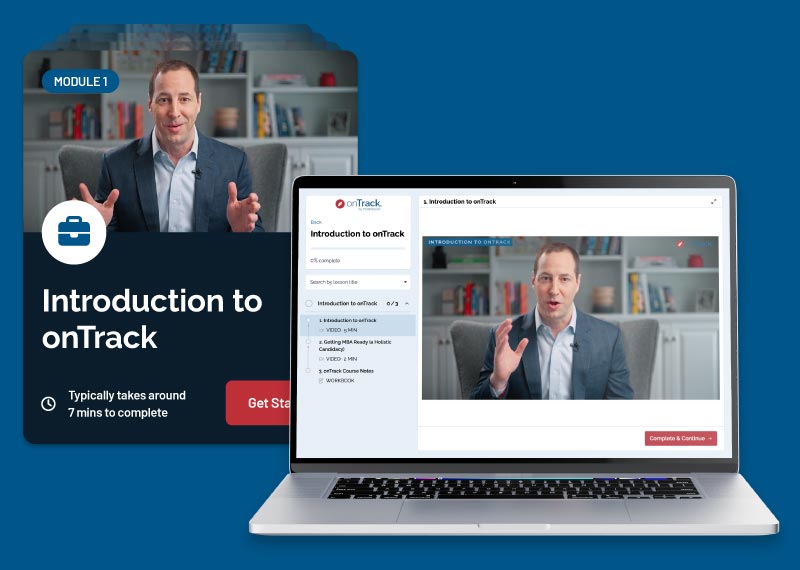
onTrack by mbaMission

A first-of-its-kind, on-demand MBA application experience that delivers a personalized curriculum for you and leverages interactive tools to guide you through the entire MBA application process.

Get Started!

2026–2027 MBA Essay Tips

Click here for the 2025–2026 MBA Essay Tips


MBA Program Updates

Explore onTrack — mbaMission’s newest offering allowing you to learn at your own pace through video. Learn more