Blog

How to Prep for Your HBS Interview the Right Way

Harvard Business School

Harvard Business School

Devi Vallabhaneni, a Harvard Business School (HBS) graduate and former HBS MBA interviewer, is mbaMission’s HBS Interviewer in Residence and conducts HBS Intensive Interview Simulations

Your Harvard Business School (HBS) application is in. Now, the waiting game for the interview invitation begins.

Predicting exactly what questions you will be asked in your Harvard Business School interview is impossible, given the dynamic nature of the meeting and the school’s individualized approach, but this does not mean you cannot prepare to navigate the interaction effectively and increase your chances of leaving your desired impression.

Prepare for Your HBS Interview with a Former HBS Interviewer: Devi Vallabhaneni, mbaMission

Devi Vallabhaneni, mbaMission Managing Director/HBS Interviewer in Residence

Join us for “Decoding the HBS Interview,” a free webinar hosted by mbaMission Managing Director/HBS Interviewer in Residence Devi Vallabhaneni (HBS Class of 1997, former HBS Admissions Board Candidate Interviewer) at one of the following times:

In this 60-minute workshop, you will learn:

  • What makes the HBS interview so different from all the other business school interviews
  • The philosophy behind the HBS approach
  • How to prepare for the interview

Coming out of the session, you will have a much better sense of what to expect in your HBS interview and how to prepare for it so you can approach your interview with competence and confidence.

Drawing on her six years as an interviewer at HBS, Devi Vallabhaneni shares a few helpful tips on how to properly prepare for your HBS interview, what to expect, and how to answer the questions you are asked.

Know what prepping really means.

No one perfect way of preparing for your Harvard Business School interview exists for all candidates. Feedback from my clients indicates that each person generally prepares multidimensionally.

Some people prep by writing. I have heard of applicants writing out talking points to remind themselves of important aspects of their stories. However, make sure that you indeed write talking points and not full answers that you will be tempted to memorize.

Some people prep by speaking in front of a mirror. Doing this allows you to hear and see yourself answering a question. It might feel awkward at first, but this method could be an important part of your “interview practice repertoire.” However, the potential downside is that sometimes, individuals who practice too much in front of a mirror end up editing themselves too much, so their answers sound less natural and authentic.

Some people prep by dialoguing back and forth with a friend or colleague. This method helps develop the ability to answer both anticipated and unanticipated questions naturally and spontaneously. The feedback you receive from dialoguing can then be incorporated into your next mock interview.

Yes, feeling nervous is okay.

Feeling your nerves kick in is totally normal, but would you believe that every time I interviewed an HBS prospect, I was just as nervous? You might find that hard to imagine, but it is the truth! I felt like I owed each and every interviewee the courtesy of bringing my best to them, really getting to know them, and working just as hard as they had to arrive at the interview. So, know that the person on the other side of your Harvard Business School interview is eager and sincere about wanting to know the real you.

You have to know your story cold.

Your story should be within you, right? Well, maybe you wrote about your love of Chinese cookery in the personal section of your resume, but since then, you have not given another thought to the last cooking class you took—which, by the way, was a good story two years ago! Although I was never specifically trying to find weak spots in interviewees’ stories, I would sometimes start by asking about interests and hobbies they had listed that sounded interesting, so I just might have asked you about your Chinese cooking. Before your interview, familiarize yourself with your entire application, even the parts you think are trivial.

The George Washington University School of Business Application Essay Tips, 2021–2022

The George Washington University School of Business (GWSB) - mbaMissionThe George Washington University School of Business (GWSB) demands just a single 500-word essay from its applicants, one that covers several key elements of a traditional personal statement. In fact, on its website, the school refers to the submission as a “Statement of Purpose.” To craft an effective response, candidates will need to spend time really getting to know the program in depth. Reapplicants are asked to explain how their profile has changed (and ideally strengthened) since they last applied—also a pretty standard and straightforward request. Our full analysis of both prompts follows.

Admissions Essay (MBA Program specific) – In no more than 500 words, tell us why studying at the GW School of Business (GWSB) is the program best suited for you and your academic interests, and explain how you will leverage both your past professional career and future academic experience at GW to achieve your post-MBA aspirations.

With this rather plainspoken and traditional essay prompt, the admissions committee is requesting fundamental information that will help it understand your motivation for pursuing an MBA, and specifically one from the GWSB. By not explicitly requesting that you present well-defined short- and long-term goals, the school leaves the decision of how to frame your motivation(s) up to you. Nevertheless, one or both goals will likely play a part in your essay response. After all, explaining why you feel you need an MBA without referencing what you expect to do with it after you graduate would probably be pretty difficult. The school is naturally assuming that if you have reached a point in your professional journey where you believe an MBA is necessary to move forward, you must have an understanding of why the degree is a critical part of continuing on that journey. This is simply your chance to outline your reasoning and needs for the admissions committee so it can be confident you have given this important step an appropriate amount of thought and are committed to your decision. 

To illustrate how the GWSB can help you, you must demonstrate a thorough understanding of what the program offers and a well-thought-out game plan for engaging with these offerings. Effectively doing this and subsequently writing a reasoned, nuanced essay requires that you familiarize yourself with the school’s various resources and pinpoint those that truly pertain to you and the direction in which you hope to head. Go the extra mile in learning about the program. If possible, given the ongoing pandemic, visit campus and sit in on a class, and/or at least attend an admissions event in your area. And connect directly with students and alumni (online or via phone, Skype, Zoom, etc.), read student blogs and the program’s recent press releases, and peruse the GWSB’s YouTube channel. This will provide the kind of in-depth insight you will need to be able to show the admissions committee you are serious about the school and are confident you belong there. Simply presenting a list of classes and clubs you think sound interesting will not suffice, and absolutely avoid vague, pandering statements about how great the school is. You must reveal clear connections between what you need to learn or experience (with respect to skills, network, experiences, exposure, and/or knowledge base) to be able to reach your aspirations and the specific resources and opportunities at the school that you believe will allow you to do so. Your goal is to convince the admissions committee that the GWSB is the missing link between who and where you are now and who and where you envision yourself in the future. An effective response will provide evidence that you (1) have done your research as to what is required to attain your goals, (2) understand where you are on that trajectory (what skills and experience you already possess that are key to success in your envisioned future), and (3) why/how attaining an MBA from the GWSB will move you further in the right direction. 

Although this prompt does not encompass all the elements of a standard personal essay, it does involve certain core ones, so we encourage you to download a free copy of the mbaMission Personal Statement Guide, which could be helpful in crafting your response. This complimentary guide offers detailed advice on approaching and framing these topics, along with multiple illustrative examples. 

Re-Applicant Essay: Please describe any actions you have taken to strengthen your candidacy since your last application. Focus on any steps you have taken toward professional and personal growth. Maximum of 500 words.

Thankfully, this essay is pretty clear-cut. Whether you have improved your academic record, received a promotion, begun a new and exciting project, increased your community involvement, or taken on some sort of personal challenge, the key to success with this essay is conveying a very deliberate path of achievement. The GWSB wants to know that you have been actively striving to improve yourself and your profile, and that you have seized opportunities during the previous year to do so, because an MBA from the school is important to you. The responses to this essay question will vary greatly from one candidate to the next, because each person’s needs and experiences differ. We are more than happy to provide one-on-one assistance with this highly personal essay to ensure that your efforts over the past year are presented in the best light possible.

To Keep or Cancel Your GMAT Scores?

With regard to the GMAT, raw intellectual horsepower helps, but it is not everything. Manhattan Prep’s Stacey Koprince teaches you how to perform at your best on test day by using some common sense.

The GMAT offers various kinds of flexibility around your decision to keep or cancel your GMAT scores—but also some restrictions. It is important to understand your options so that you make the best decision for you!

How Does It Work?

At the end of the test, you will be shown your scores (for everything except the essay), and you will then be asked whether you want to keep or cancel your GMAT scores. If you keep them, they will go on your official record. If you cancel them, they will not; the schools will not see those scores, nor will the schools even know that you took the test that day.

Right at that moment, you will have two minutes to decide whether to keep or cancel your GMAT scores. Later, you can change your mind—but you will have to pay a fee to change the status of your scores. So let us first talk about how to make the best decision during those first two minutes.

In short, you need to have an idea of what you would want to do before you even walk into the testing room.

What Do Your Schools Want to See?

First, what kind of program do you want? MBA programs generally care only about your highest score. Other kinds of programs, such as PhD programs, may look at all your scores. So it is important to find out how your schools are going to use the data.

If you are applying to an MBA program, you can assume that they do not care if you take the test multiple times. They are just going to use your best score, and that is that. If you are applying to a PhD program or another type of master’s program, ask the schools directly whether they care about multiple tests and, if so, how they use the multiple data points.

(By the way, for any school communication, I highly recommend attending one or more of the various MBA tours that travel around the country, giving you an opportunity to meet representatives from different schools. There are a bunch of different ones, some of which are tied to specific groups of people, such as women or other underrepresented groups. Ask your questions directly, make some connections, and get the ball rolling!)

What Is Your Goal Score?

Based on where you want to apply and how those schools use GMAT scores, you will come up with a goal score for yourself. Broadly speaking, you can classify the programs into one of three categories:

Professor Profiles: Luigi Zingales, the University of Chicago Booth School of Business

Luigi Zingales, Chicago BoothMany MBA applicants feel that they are purchasing a brand when they choose a business school. However, the educational experience you will have is what is crucial to your future, and no one will affect your education more than your professors. Today, we focus on Luigi Zingales from the University of Chicago Booth School of Business.

Luigi Zingales is known on the Chicago Booth campus for his charm, sense of humor, and humility. But students with whom mbaMission spoke also call him an innovator, citing as evidence his perspective on the discount rates used to evaluate the future cash flows of new and risky ventures (i.e., his ability to mathematically explain why some firms deserve a 30%–50% discount rate). Zingales’s novel approach to solving the mortgage crisis has been profiled in The Economist, and Bruce Bartlett of the National Review Online called his book Saving Capitalism from the Capitalists: Unleashing the Power of Financial Markets to Create Wealth and Spread Opportunity (coauthored with Raghuram G. Rajan; Crown Business, 2003) “one of the most powerful defenses of the free market ever written.”

Zingales is currently the Robert C. McCormack Distinguished Service Professor of Entrepreneurship and Finance at Chicago Booth and faculty director of the school’s Stigler Center for the Study of the Economy and the State. During the 2020–2021 academic year, Zingales taught such courses as “The FinTech Revolution” and “Crony Capitalism.” His students call him an “emerging finance superstar”—significant praise, considering the company he keeps at Chicago Booth.

For more information about Chicago Booth and 16 other top-ranked business schools, check out our free mbaMission Insider’s Guides

Understanding Number Properties on the GMAT

With regard to the GMAT, raw intellectual horsepower helps, but it is not everything. Manhattan Prep’s Stacey Koprince teaches you how to perform at your best on test day by using some common sense.

Is the GMAT topic of number properties driving you crazy? This concept covers things that we often call “basic”—topics that we learned in middle school (or earlier), such as divisibility, factors and multiples, odds and evens, positives and negatives, and so on. I assure you, though, that number properties questions on the GMAT are anything but basic.

I strongly urge you to develop a solid grounding in this topic, particularly because the test writers are so good at disguising what these problems are really testing.

You will need some kind of book or e-book that covers this topic thoroughly, but I have some resources to help you get started.

Start with this article, “Disguising—and Decoding—Quant Problems.” We talk about how the test writers disguise material that you probably do already know, and how we can learn to “decode” the problem or strip away the camouflage.

If you feel good about the concepts discussed in that article, and you are at a higher math level, try out this challenging problem next.

In the article “Patterns in Divisibility Problems,” we examine two GMATPrep problems that share some interesting characteristics. In this article, we discuss some interesting topics related to prime numbers.

Many questions address basic characteristics of numbers, such as whether they are positive or negative, odd or even, integer or fraction/decimal. These can be disguised in various ways; two of the most common are inequalities and absolute values (which we normally associate more with algebra).

Here are two that use inequalities as a disguise for number properties concepts, one in this article and another from this article, as well as a third one that plays around with absolute value. All three of these are generally hiding issues that deal with positive and negative properties of numbers.

And finally here are two more: a number line problem and one dealing with consecutive integers. The former tests positive and negative properties, as well as some others, and the latter covers a less-commonly-tested but still important number properties category.


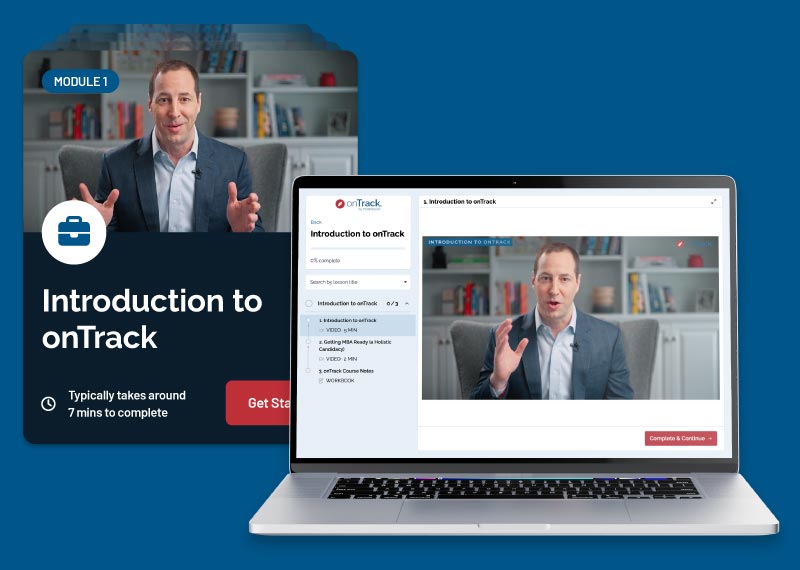
onTrack by mbaMission

A first-of-its-kind, on-demand MBA application experience that delivers a personalized curriculum for you and leverages interactive tools to guide you through the entire MBA application process.

Get Started!

2026–2027 MBA Essay Tips

Click here for the 2025–2026 MBA Essay Tips


MBA Program Updates

Explore onTrack — mbaMission’s newest offering allowing you to learn at your own pace through video. Learn more