Blog

How to Analyze Your GMAT Practice Problems

With regard to the GMAT, raw intellectual horsepower helps, but it is not everything. Manhattan Prep’s Stacey Koprince teaches you how to perform at your best on test day by using some common sense.

Did you know that, on any particular problem, roughly 80% of your learning comes after you have picked the answer? Turns out, we do not learn much while in the process of doing a problem, especially when the clock is ticking. We are just trying to remember (and use!) everything that we learned before we started working on that problem.

Afterward, though, we can take all the time we want to figure out how to get better—that is where we really learn. Did I understand what they were asking? Did I know how to do the math or reasoning necessary to get to the answer? Is there a more efficient way to do that work? Did I make any mistakes or fall into any traps? If so, which ones and why? How could I make an educated guess?

In a nutshell: if you are not spending at least as long reviewing a question as you spent doing it in the first place, then you are not maximizing your learning.

Take a look at this article: How to Analyze a Practice Problem. It contains a list of questions to ask yourself when reviewing a problem. Take note of a couple of things:

– Yes, you still ask yourself these questions even when you answer the question correctly.

– No, you do not need to ask yourself every single question for each problem you review; choose the most appropriate questions based upon how the problem went for you.

Want some examples of how to do this? Glad you asked. Below, you will find links to articles containing an analysis of a sample problem for each of the six main question types. Happy studying!

How to analyze the following:

Sentence Correction

Critical Reasoning

Reading Comprehension

Data Sufficiency

Problem Solving

Integrated Reasoning Table

Professor Profiles: Ramon Casadesus-Masanell, Harvard Business School

Professor Profiles: Ramon Casadesus-Masanell, Harvard Business School - mbaMission

Many MBA applicants feel that they are purchasing a brand when they choose a business school. However, the educational experience you will have is what is crucial to your future, and no one will affect your education more than your professors. Today, we focus on Ramon Casadesus-Masanell from Harvard Business School (HBS).

Ramon Casadesus-Masanell has been a member of the Harvard Business School faculty since 2000 and is currently the Herman C. Krannert Professor of Business Administration. His “Competing Through Business Models” course is an elective that, according to a student we interviewed, is typically oversubscribed. They noted that students must rank it among their top five course choices to have a shot at getting in, adding, “People enjoyed him so much they were willing to sign up for his 8:30 a.m. class.” As a part of the course, Casadesus-Masanell teaches cases on many industries, including airlines, consumer packaged goods, and manufacturing. A recent graduate we interviewed mentioned that Casadesus-Masanell keeps cases fresh and has included interesting business models such as Betfair (an online betting website), Greenpeace, and Osho (the spiritual guru). He also teaches the RC “Strategy” course.

Students told mbaMission they love Casadesus-Masanell’s teaching style, which they describe as incredibly engaging and high energy—sometimes he even jumps up on tables or runs quickly around the classroom. He pushes students in a good, even-tempered way and leverages technology well, incorporating video and game simulations into case discussions. Casadesus-Masanell also serves as co-editor of the Journal of Economics and Management Strategy, which his faculty profile describes as “the leading academic journal on the economics of strategy.”

 For more information about HBS and 16 other top-ranked business schools, check out our free mbaMission Insider’s Guides.

Ten Essentials for a Successful MBA Application

After reflecting on your career amid the constant shifting in today’s business landscape, you now have three letters on your mind: M. B. A. You know the degree is key to developing the foundation you need to successfully navigate the current dynamic reality of business, but what does being admitted to a top MBA program require? What are the core elements of a successful MBA application? How much time do you really need to dedicate to it? One thing is certain, you cannot pull off a successful MBA application overnight, in a week, or even in a month. An effective strategy involves ten essential elements:

  1. Soul-Searching: First, you will need to do some soul-searching and ensure that you understand your personal “why” for pursuing an MBA. Business school is a transformative experience by most counts, but it also requires sacrifices, not the least of which is financial. You must have clarity as to why you want to earn an MBA and how it will be beneficial in achieving your future career goals. Due diligence related to your desired career path is critical to properly assessing the necessity of an MBA and what is most important to consider in narrowing your school choices.
  1. Self-Reflection: Think deeply about what is most important to you in a business school. There are so many factors beyond rankings to consider! Fit is critical, and whether you genuinely feel excited about a specific school will come through in your essays and interview—and also influence your ultimate experience, should you attend. Make sure to check out mbaMission’s business school Insider’s Guides, which assess the leading MBA programs across eight key criteria: location, class size, curriculum, teaching style, academic specialization/recruitment focus, alumni base, faculties, and rankings and reputation. Carefully consider your personal learning style and what type of program would best fit your personality and overall profile.

You also need to think about your personal “tipping point.” Where do you draw the line regarding schools you would not attend, even if admitted? This is a very personal decision; some applicants want an MBA regardless of program, whereas others will enroll only if they are admitted to a select handful of schools. The admissions process is arduous and time-consuming, so ensuring that you have carefully vetted your final application list is an important step. Leverage the expertise of mbaMission’s consultants, who can help you on this journey by pointing you in the right direction via a free consultation call or dedicated purchased time.

  1. Admissions Criteria: What are the admissions committees looking for in applicants? In broad strokes, they assess candidates across three key evaluation pillars: (1) academic track record, which includes test scores (GMAT, GRE, or Executive Assessment), GPA, and the academic rigor of undergraduate major/coursework; (2) professional experience, which includes accomplishments, history of progression, value provided to places of employment, career goals, and whether an MBA is necessary to advancement or success; and (3) engagement and community, which includes activities and commitments outside of work, community contributions, and personal interests and how those have been pursued.

The admissions committee’s ultimate goal is to bring together a diverse group of individuals who will thrive in a business school setting, be active members of the student body, and reflect positively on the school in the future. They want you to be successful both while you are pursuing your degree and after you graduate and are looking for signs in your application that this will be the case. Of course, the specifics of what each school is looking for are somewhat nuanced. Leverage multiple sources to fully understand the evaluation criteria and what is most important at each program; online research, school-produced and third-party webinars, and networking are all helpful sources. Also, be sure to check out mbaMission events for helpful perspectives and insight provided by experienced admissions advisors.

  1. Timeline and Process: The MBA admissions process is definitely not something that can be completed in a few days or even a few weeks, if you want to put your best foot forward. Make sure you understand everything involved in the process, the various elements of the application, and the ideal timeline to position yourself for success. Check out the helpful timeline provided in the mbaMission Complete Start-to-Finish MBA Admissions Guide, which offers detailed explanations of each step, or this summary blog article. Ideally, you should plan to dedicate at least six months to ensure you have adequate time to submit the absolute best representation of yourself and your potential to the admissions committee. An admissions consultant can be helpful in keeping you on track and providing accountability at each step along the way.
  1. Testing: Most MBA programs require applicants to submit scores for either the GMAT, the GRE, or the Executive Assessment (EA), though testing waivers have become more common. Testing is one of the first steps of the application process you should complete to help you refine your list of target schools. Your academic track record is a key element in the schools’ evaluation of you and is assessed based on your test scores, along with your GPA, major, and undergraduate institution. Depending on how long you have been out of school, your natural test-taking abilities, whether English is your native language, and the test you take, you will most likely want to devote a few weeks to a few months to studying for the exam of your choice. Although test scores are only part of your overall profile, they are an important component, and depending on which schools you are applying to, you might want to take the test more than once to submit the strongest possible score. Additionally, you might way to try more than one test type to determine which one is a better fit for your strengths. This YouTube video offers a helpful comparison of the GMAT, GRE, and EA.

Questions to Ask MBA Admissions Consulting Firms

Getting into a top business school has only gotten more challenging over the years. The competition can be fierce, so many candidates turn to MBA admissions consultants to help them prepare their best possible application. As you speak with different MBA admissions consulting firms to determine which one to work with on your applications, here are a few important questions you should be asking:

1. What is your firm’s hiring process like?

Can anyone become a consultant with the firm? Must they have certain qualifications, such as an MBA degree themselves or writing/editing experience? At mbaMission, we hire approximately one out of every 200 job applicants. After submitting a resume and cover letter, some applicants are invited to interview. Those who do well in that initial interview are then interviewed by at least two additional consultants on our hiring committee. If all three interviewers agree to move forward with the applicant, the candidate completes several writing and editing exercises to demonstrate their skills in those areas. The hiring committee reviews the competed exercises, and applicants who perform well are then interviewed by our CEO. If he and the hiring committee agree on a promising applicant, that individual is invited to join our firm. We are committed to hiring only highly qualified consultants, and in fact, applicants who have not fulfilled our exacting standards have sometimes gone on to join our competitor firms, whose hiring processes are not as rigorous.

2. What kind of initial training do your consultants complete? How long after a consultant is hired do they begin working with clients?

Once hired, do new consultants undergo any sort of training? Do they begin taking on clients right away? At mbaMission, our admissions consultants complete a three-month, closely supervised training program that addresses how to evaluate, craft, and edit all components of an MBA application and involves learning thoroughly about the admissions field. During these three months, the new hire does not work on or interact with any real, current clients. At the conclusion of the training phase, the new consultant must complete a capstone exercise that is reviewed by a committee. They can start accepting clients of their own only after they successfully pass this review, and for their first full year, they have a dedicated mentor who reviews their essay edits and feedback before they are returned to the client.

3. What ongoing training does your firm offer its consultants?

This question will reveal whether a firm’s consultants are up-to-date on admissions trends and the characteristics of the current applicant pool. The admissions process changes constantly and has especially done so in recent years, which means that if your consultant is not constantly learning and growing with the field, their advice might be stale. At mbaMission, we have a staff meeting every two weeks to share updates and discuss concerns and trends that consultants are hearing from their clients. Twice a year, each consultant is responsible for conducting a “teach-in” through which they explain and explore a particular aspect of admissions consulting for their colleagues. Pre-COVID, mbaMission held an annual in-person conference, bringing together all our admissions consultants from around the world to meet in person and participate in targeted workshops and exercises. (We will resume this yearly conference when conditions allow.)

4. What is the background of the consultant I will be working with? What kind of admissions experience do they have?

Make sure you find out who exactly would be your dedicated consultant and what their background is. Have they gone through the MBA admissions process themselves? Did they graduate from a top business school? How long have they been in the admissions field? Do they have experience working with applicants like you? Are you able to choose the consultant you will work with, or will you be assigned someone?

All mbaMission consultants are graduates of elite MBA programs and have therefore gone through the same application process you will be going through. We have profound writing and editing experience, which makes us especially qualified to guide you in crafting your application essays. All of our consultants are listed on the mbaMission web site, and you have the freedom to choose which one you work with, provided your preferred consultant has availability. As we explained earlier, every mbaMission admissions consultant undergoes a comprehensive hiring and training process, and our team stays constantly up-to-date on the admissions process.

Setting Realistic and Reasonable Career Goals 

This post was written by mbaMission resident Career Coach Elissa Harris. To sign up for a free 30-minute career consultation with Elissa, please click here.

Identifying the right career path for you requires time to reflect and research—and then reflect again. 

Looking at your career goal, can you answer “yes” to each of the following questions? If so, mbaMission’s experience indicates that your career goal is likely to be a realistic one. 

  • Have you demonstrated passion and a foundation for your career goal (e.g., relevant functional/industry experience, exposure, or knowledge)?
  • Do you have a clear understanding of the role (e.g., qualifications, tasks, responsibilities, outcomes) and the recruiting process for it?
  • Do you have evidence of relevant and transferable skills for the role as well as required educational pedigree (e.g., undergraduate major, GMAT, GPA) and/or experience in similar work environments on your resume?
  • Are there available jobs in your target area? Do many companies hire for your target role? 
  • Does your target MBA program have resources (through the career center or student clubs/conferences) and academic courses available to support your area of interest?

If you are stuck with respect to identifying a career goal, we recommend reviewing your interests, evaluating your skills/background, and assessing the marketplace realities. As you can imagine, admissions committees and recruiters want candidates who will be successful within their organizations—those who demonstrate that they really want to be there and who articulate how they will contribute.  

Although uncovering your target career path can be time-consuming and iterative, having a structured approach will make the process easier and more productive. To get started, try the following steps:

  1. Ask yourself the following questions (and write down the answers, so you can go back and identify themes):
  • Why did you go into industry X? Has it met your expectations? Why or why not? 
  • What is the work culture like in your current role? In past roles? Do/did you like or dislike it?
  • What words describe you at your best? What compliments do you hear most often?
  • What makes you feel valued at work? Why? 
  • What do you really love to do at work? What really drains/frustrates you at work?  
  • What articles do you stop and read in the Wall Street Journal (or other business publications)?
  1. Deepen your knowledge about potential MBA career paths. 
  • Review the mbaMission Career Guides. Read target job descriptions on LinkedIn. 
  • Identify post-MBA opportunities for people with backgrounds similar to yours. 
  • Talk with three to five people who work in roles of interest to you. Be thoughtful about the types of questions you ask; make sure you are gathering information to determine your potential fit with the role.
  1. Synthesize your reflections and research to confirm or redirect your career goal.  

Bottom line: The insights you obtain from following these steps can help you develop an authentic and compelling story through which you can connect your experiences to your career goal.


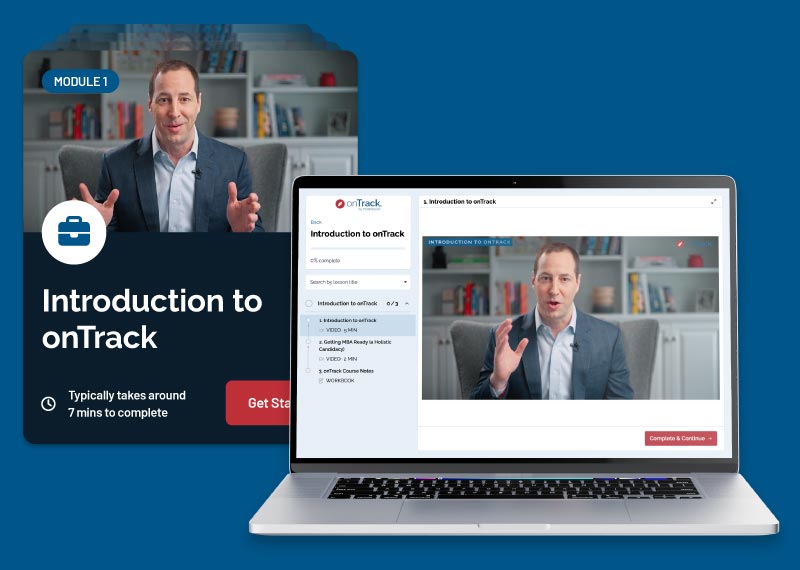
onTrack by mbaMission

A first-of-its-kind, on-demand MBA application experience that delivers a personalized curriculum for you and leverages interactive tools to guide you through the entire MBA application process.

Get Started!

2026–2027 MBA Essay Tips

Click here for the 2025–2026 MBA Essay Tips


MBA Program Updates

Explore onTrack — mbaMission’s newest offering allowing you to learn at your own pace through video. Learn more