Wondering whether you are too young or too old to pursue an MBA? In this post, we discuss what business schools really think about younger—and older—candidates.
Does Age Matter When Applying to an MBA Program?
Here at mbaMission, one of the most common questions we are asked is “Am I too young [or old] to pursue an MBA?” Most applicants to traditional two-year MBA programs have between three and seven years of full-time work experience by the time they matriculate. For example, the average number of years of professional experience for the Class of 2026 at Harvard Business School and The Wharton School is five (5.1 at the Stanford Graduate School of Business). Schools typically publish this stat as part of their class profiles, so you can check your target programs to see how you measure up.
The path to an MBA tends to be a demanding and expensive one. The MBA programs of top-ranked U.S. business schools come with a hefty price tag, not to mention the intensive workload that students navigate throughout their education. For many aspiring MBAs, the end result is what makes it all worthwhile: MBAs are known to earn notably high salaries, starting immediately after graduation. The average post-graduation salaries at all top-ranked business schools are high, but which schools offer the most lucrative financial prospects?
Did you apply to business school in the 2025–2026 application season and were released from further consideration, otherwise known as “dinged”?
If so, we want to help you improve your chances of success in the coming application cycle.
Now through May 19, 2025, “dinged” applicants who plan to reapply have a chance to win an mbaMission “reapplicant strategy” service for a fraction of the typical cost. If selected as a winner, you will be able to sign on for our comprehensive (a $925 value) for just $100! And if you subsequently purchase one of our application packages, that $100 is applied to your costs—making the reapplicant strategy service totally free!
So, you are considering applying to an MBA program this year but wonder whether investing the time, money, energy, and everything else required for the endeavor is truly worthwhile. The easy answer is yes—go for it. Chances are high that after you earn your MBA, you will make more money, possess a better knowledge base that will propel your career forward, and have connections that will position you for success. But an MBA is not for everyone, and it is definitely not for anyone who is unsure about what is driving them to pursue the degree. Before you head down this road, think about why you want an MBA and where you want it to take you.
Salary and Career Outlook for MBAs
If you are thinking about pursuing an MBA, chances are you are weighing the degree’s return on investment (ROI). You are certainly not alone. An MBA will propel your salary higher than a mere bachelor’s degree. A 2021 study conducted by data analytics company PayScale for Poets&Quants found that graduates of the leading 50 U.S. business schools are expected to earn a median total of $5.7 million in cash compensation after 35 years of post-graduate work just in terms of salary (i.e., excluding bonuses, stock options, health care benefits, and other forms of remuneration), “a premium of $2.3 million over those with just an undergraduate degree.” Alumni of the MBA programs at Harvard, Stanford, Berkeley, Dartmouth, and the University of Virginia vault to the top with more than $8 million in earnings over that 35-year period, according to the study. Those kinds of numbers certainly make an MBA degree sound worthwhile!
We at mbaMission often tell candidates, “You cannot turn a bad idea into a good essay.” We insist on taking our clients through a lengthy brainstorming process—starting with a thorough questionnaire—to discover the stories that make them distinct. As you uncover your stories, consider each one from as many different angles as possible. Doing so will not only help ensure you understand the various “weapons in your arsenal” but also provide you with maximum flexibility, considering that MBA admissions committees ask questions that vary dramatically from school to school.
For example, an experience coaching a baseball team at an underfunded high school may have multiple dimensions, such as the following:
Creatively motivating an underachieving team and changing attitudes, despite losses
Initiating and leading fund-raising efforts so that each player could afford proper equipment
Mentoring struggling players and seeing an improvement in their on-field performance
Helping a player deal with a family issue off the field
Recruiting other coaches and then working to improve a team’s on-field performance
These are just a few of the stories that could be gleaned through brainstorming, proving that considering your experiences from various angles can help you discover multiple unique approaches to your essays.
In addition, many MBA candidates—whether they work as bankers or lawyers, in internal corporate finance or corporate strategy—feel they must tell a “deal story” in their application essays. Although discussing a deal can be a good idea, what is vital is showing your distinct impact on the deal in question. You are the central character, not the deal. A straightforward story about how you dutifully completed your work and steadily supported others as a deal became a reality will not likely be very compelling. Further, the important thing is that the admissions committee gain insight into your personality, not your spreadsheets.
Ask yourself the following questions to ensure your story is truly about you:
What did you do that was beyond expectations for your role? Did you grow into additional responsibilities at a crucial time?
Did any particular interactions take place in which you used your personality to change the dynamic, thereby ensuring the deal’s progress or success?
Did you need to take a principled stand at any moment or speak out on behalf of a needful party?
Did you help others overcome any corporate or international cultural barriers?
These questions can get you started, but the point remains: do not simply offer any deal; instead, provide insight into your deal.
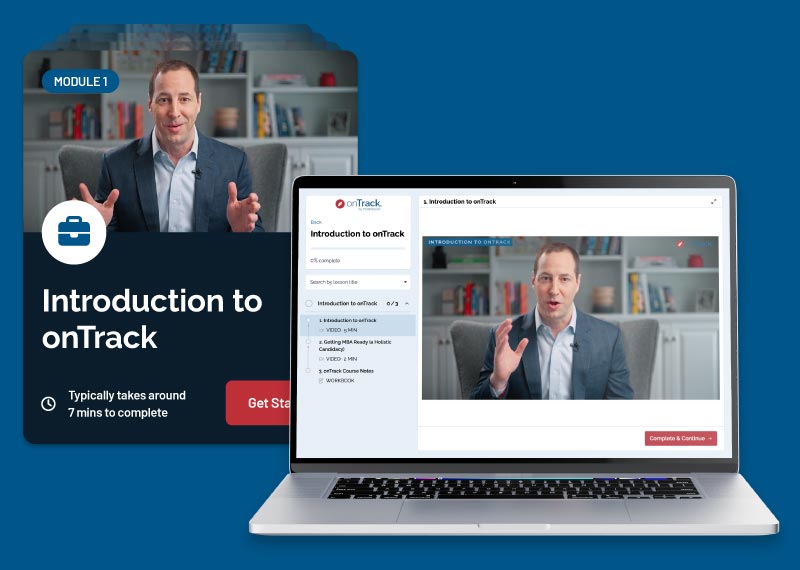
A first-of-its-kind, on-demand MBA application experience that delivers a personalized curriculum for you and leverages interactive tools to guide you through the entire MBA application process.