Blog

How to Approach Freelance Work and Layoffs in Your MBA Application

If you do mostly short-term, project-based work, you might struggle with how to structure your resume so that it does not give the impression that you switch jobs every few months. If you list each job separately, not only will your resume be too long, but you also run the risk that your reader will think you have not had a stable career—when in fact, if you are a successful freelancer or contractor, the opposite is the case. So, how can you organize your resume so that it showcases the strength of your work and avoid having the variety and number of your work experiences come across as a weakness instead?

The key here is “clustering.” Rather than listing each short-term job separately, cluster them all under one heading, such as “independent contractor” or “freelance project manager.” Next to this heading, note the time range (i.e., start and end dates) during which you have worked for yourself. Then, using bullet points, list the individual projects you completed as a freelancer, noting your primary accomplishments for each one, followed by the related company/organization name and dates. The goal is to keep the focus on your accomplishments.

Similarly, many business school applicants—especially during these turbulent times—worry about the impact having been laid off might have on their candidacy. Do the admissions committees view a layoff as a sign of failure?

One thing to remember is that many MBA candidates share this worry—thousands of them worldwide, in fact, if not hundreds of thousands. For the admissions committees to dismiss all such applicants outright would simply not be practical. Moreover, the admissions committees know that the novel coronavirus outbreak and its repercussions are at the root of the problem, not necessarily the individual candidate’s performance. Indeed, layoffs and firings are not the same thing, so admissions committees will examine your application with that in mind, seeking your broader story.

If you find yourself in this situation, what is important is that you show that you have made good use of your time since the layoff by studying, volunteering, seeking work, enhancing your skills, etc. Each candidate will react differently, of course, but you need to have a story to tell of how you made the most of a difficult situation.

MBA Admissions Myths Destroyed: Why Worry? I Volunteered!

Some MBA applicants mistakenly view community service as simply a prerequisite for getting into a top program and sign up for volunteer opportunities without considering whether the organization or cause they are choosing is actually a reasonable fit for them. Community service is generally something positive to highlight in your application, given that it demonstrates altruism and frequently indicates leadership skills as well as attributes that may not be revealed in your work experience. However, it is not a panacea or a mere box to be checked. As you contemplate your involvements, be aware that hours served are not as important as the spirit of your participation and the extent of your impact.

We encourage all MBA candidates to carefully consider their community experiences in the same way they would examine and evaluate their professional or entrepreneurial opportunities. Although people can sometimes make mistakes in their career path, most gravitate toward areas where they can excel, justifiably to further their own interests. So, for example, if you do not enjoy one-on-one interactions, you likely would not consider a position in sales, because you could never thrive in such a position. In contrast, if working in sales were to bring out the best in you, you just might earn promotions, think of new sales techniques, train others, etc. Success stories develop as a by-product of performance.

This reasoning also applies to community service. For example, if you have always enjoyed a particularly close relationship with your grandmother and want to share this kind of positive experience with others, you might decide to volunteer at a retirement home, spending time with seniors. If you became quite passionate about your work there, you might then get others involved, expand the volunteer program at the home, take greater leadership in the program, and demonstrate your initiative and enthusiasm in other ways. However, if you are not that passionate about spending time with the elderly, but you happen to live near a retirement home, volunteering there just for convenience would probably be a mistake. In such a situation, you would lack the spirit of commitment/adventure necessary to ensure that you make an impact—and therefore have a story worth telling the admissions committees.

Whether you are already committed to an activity or are just considering becoming involved in one, carefully determine whether you have the mind-set and personal interest necessary to truly commit yourself to your chosen cause and make a difference. If putting in hours is the only commitment you can make, you will just be wasting your time.

If you have questions about your application essays or wonder which schools you would be competitive at, sign up for a free 30-minute consultation with an mbaMission consultant.

The mbaMission Podcast: How Should You Use AI in Your MBA Applications?

How might AI tools such as ChatGPT make the MBA application process easier? Can you use ChatGPT for your business school research? Can you use it to help you brainstorm for your essays? How about for actually writing your application essays? And should you use AI for your application at all? In this episode of the mbaMission Podcast, Harold Simansky, Jessica Shklar, and Jeremy Shinewald discuss when you should—and should not—get assistance from AI with your business school applications, and how to do so effectively.

Each week, Senior Consultant Harold Simansky takes a deep dive with some of his mbaMission colleagues into various aspects of the business school admissions process, from how to select the right schools to choosing and managing your recommenders to drafting compelling application essays and preparing for MBA interviews. A brand new episode of The mbaMission Podcast is released every Tuesday, and you can find it on all the major podcast streaming platforms, including Spotify and Apple Podcasts. More of a visual learner? Check out the mbaMission YouTube channel for full episodes. 

Harold Simansky: Hello, Jeremy. Hello, Jessica. Let’s talk about artificial intelligence. First, a disclaimer: this podcast is not created using artificial intelligence. This is natural intelligence right here. [Laughs] Okay, Jessica, I’m going to throw it right to you.

Jessica Shklar: I think when you think about it from an admissions perspective, from the applicant perspective, AI is a tool—or maybe a better way to say it is it’s a really good starting point, or it can be a good starting point, but it should never be the ending point. And by that I mean you can use AI to help you come up with ideas, to help you get started with a draft, to help with some editing, to find interview questions, to do basic research.

Harold Simansky: Yeah, do basic research.

Jessica Shklar: But if you stop with what AI does for you, you’ll never, well, I think you have a phrase that says, “AI can help you be mediocre.” 

MBA Admissions Myths Destroyed: I Do Not Have to Rework My Resume

Many MBA candidates do not thoroughly consider and revise their resumes for their applications, often dismissing this element because an existing version may already be saved on their computer. We strongly caution you not to underestimate the value of this document—the admissions committees, in fact, review applicants’ resumes carefully because they serve as a road map of each candidate’s career.

In the past, we have highlighted that your resume is not the place to “stuff” all of your life experiences. Somewhere between the two extremes—cramming your resume with information and ignoring it altogether—lies the ideal: a clear, easily scannable, action/results-oriented resume that tells a story that will capture the attention of an admissions officer who has reviewed hundreds of similar files.

One of the most common errors candidates make is leaving their resume in an industry-specific format, filled with jargon and acronyms recognizable only to an expert in their field. Remember, the admissions committee is not hiring you for a task but is trying to understand your progress, your accomplishments, and even your character. Each bullet point in your resume needs to highlight achievement more than positional expertise.

As you prepare your resume to be included in your application, think about your audience, and recognize that your resume can be a strategic tool to reinforce certain characteristics that are important to you—characteristics that may complement information provided in other parts of your application. For example, if you aspire to a career that is international in nature, you may place more emphasis on your international experience in your resume. Or, if you come from a field that is not known for its management orientation—you were a teacher who administered a school’s $50,000 student activities budget, for example—you may use your resume to emphasize disciplines that are important to an MBA admissions audience.

Some candidates are surprised to realize that one page can communicate so much and therefore deserves a significant level of attention, but investing some time in this short but crucial document is definitely worth the effort.

Get an Early Start on Your Resume and Personal Goals

We at mbaMission try to encourage business school candidates to get as much “noise” out of the way as possible before they begin working on their official application(s) and essays, even several months in advance. We want applicants to have the freedom to reflect on their experiences, formally and thoroughly brainstorm, choose ideas, prepare outlines, and then focus on crafting powerful essays. Essentially, we want them to be unfettered as they engage in what is, for many, one of the most significant creative challenges they will ever face.

If you are targeting Round 1 deadlines this fall, using this time to address a task such as preparing your resume—a process that often requires several rounds of revisions—will allow you to focus better on the other elements of your application later. By revising your resume now, you can dedicate the time needed to do so at a more leisurely pace, before “crunch time” hits. Further, you will lay the foundation for brainstorming for your essays by reminding yourself of your most significant accomplishments.

If you prepare your resume now, you will definitely thank yourself later for having completed this task early. Note: We recognize that you may achieve additional accomplishments before applying. We nonetheless suggest that you update your resume now and then revisit and amend it as necessary one to two weeks before your application deadlines.

A similar message applies to personal leadership—you always have time to take steps to bolster your chances of admission. Many candidates completely ignore the personal side of their candidacy. But if you have, for example, completed a triathlon, learned a language, published an article, or simply been an inordinately dedicated neighbor/sibling/mentor in an unofficial capacity, your story can provide an interesting point of differentiation.

So, if you have an activity or adventure in mind that you would otherwise complete later anyway, we recommend pursuing it now. We are not suggesting that you start writing poetry tomorrow in hopes of getting something published, for instance, but if you are a dedicated poet and have verses that you have long intended to submit, do so now. If you can run 20 miles and have always planned to run a marathon, do it now. These kinds of personal stories can help set you apart from your fellow applicants.


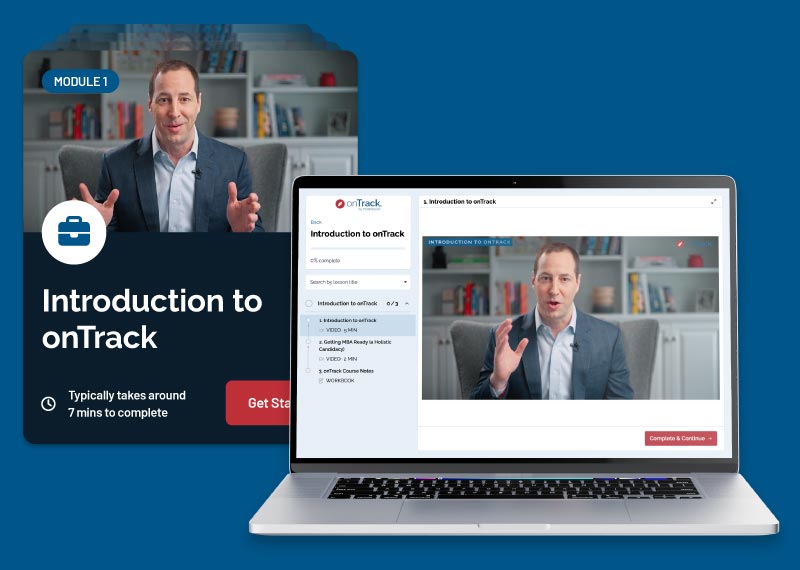
onTrack by mbaMission

A first-of-its-kind, on-demand MBA application experience that delivers a personalized curriculum for you and leverages interactive tools to guide you through the entire MBA application process.


Get Started!

2026–2027 MBA Essay Tips

Click here for the 2025–2026 MBA Essay Tips


MBA Program Updates

Explore onTrack — mbaMission’s newest offering allowing you to learn at your own pace through video. Learn more