Blog

Multidimensional Brainstorming for Your MBA Application Essays

We at mbaMission often tell candidates, “You cannot turn a bad idea into a good essay.” We insist on taking our clients through a lengthy brainstorming process—starting with a thorough questionnaire—to discover the stories that make them distinct. As you uncover your stories, consider each one from as many different angles as possible. Doing so will not only help ensure you understand the various “weapons in your arsenal” but also provide you with maximum flexibility, considering that MBA admissions committees ask questions that vary dramatically from school to school.

For example, an experience coaching a baseball team at an underfunded high school may have multiple dimensions, such as the following:

  • Creatively motivating an underachieving team and changing attitudes, despite losses
  • Initiating and leading fund-raising efforts so that each player could afford proper equipment
  • Mentoring struggling players and seeing an improvement in their on-field performance
  • Helping a player deal with a family issue off the field
  • Recruiting other coaches and then working to improve a team’s on-field performance

These are just a few of the stories that could be gleaned through brainstorming, proving that considering your experiences from various angles can help you discover multiple unique approaches to your essays.

In addition, many MBA candidates—whether they work as bankers or lawyers, in internal corporate finance or corporate strategy—feel they must tell a “deal story” in their application essays. Although discussing a deal can be a good idea, what is vital is showing your distinct impact on the deal in question. You are the central character, not the deal. A straightforward story about how you dutifully completed your work and steadily supported others as a deal became a reality will not likely be very compelling. Further, the important thing is that the admissions committee gain insight into your personality, not your spreadsheets.

Ask yourself the following questions to ensure your story is truly about you:

  • What did you do that was beyond expectations for your role? Did you grow into additional responsibilities at a crucial time?
  • Did any particular interactions take place in which you used your personality to change the dynamic, thereby ensuring the deal’s progress or success?
  • Did you need to take a principled stand at any moment or speak out on behalf of a needful party?
  • Did you help others overcome any corporate or international cultural barriers?

These questions can get you started, but the point remains: do not simply offer any deal; instead, provide insight into your deal.

Choosing the Right Business Schools

Choosing which MBA program(s) you should apply to is one of the most important—and certainly one of the earliest—decisions you need to make in the application process. Yet we often see candidates who have not fully thought through their options before targeting business schools. These applicants typically end up in one of the following predicaments:

  1. They selected schools based solely on rankings and thus applied to programs where they were not competitive, ending up with no options at all.
  2. They applied to a range of schools, but after they got in, they realized they did not actually want to attend any of them.

So, how do you avoid these mistakes?

First, you should compare the possibility of going to business school with your other options, rather than looking at it in a vacuum. In other words, rather than asking yourself, “Where do I want to go to business school?,” ask, “Where would I want to go to business school more than I would want to stay in my job (or look for a new job)?” Or, phrased differently, which MBA program is the “worst” one that would still be better than remaining at your current job, and which is the “best” one that would be worse than staying where you are? Note that “worst” and “best” here do not refer to a school’s objective quality; we are referring to how well—or not—a program matches your specific personality and needs. Once you have identified these two schools (the “worst” one you would go to and the “best” one you would not go to), you will have positioned yourself not only to be accepted to business school (by applying to “safer,” more appropriate options) but also to be accepted at programs that you would actually want to attend.

The next step is to factor in other criteria that matter to you. Our Insider’s Guides address and explore nine key factors to consider when selecting schools, such as location. Would you prefer to live in a city, where you will have easier access to recruiters but less of a community feel on campus and potentially higher living expenses? Or would you want to be in a college town, where the community and network are strong, but fewer resources are available off campus?

Another factor to consider is a program’s primary teaching method (pedagogy). For example, Harvard Business School and the University of Virginia’s Darden School of Business both use the case method exclusively. The case method requires a tremendous amount of reading and problem-solving, both alone and as part of a group, before you even get to class. This appeals to some learners but not to others. By contrast, the University of Michigan’s Ross School of Business is very hands-on, with students required to complete a Multidisciplinary Action Project in which they solve a real-world problem for a company. As you narrow down your school list, think about whether you prefer to learn via traditional lectures, the case method, or a more hands-on, project-based approach—or a combination of these.

You should also consider whether a school offers career opportunities and academic specializations that align with your goals and will therefore help you more easily advance professionally. A truly thorough exploration of an MBA program involves at least nine main criteria, and we have mentioned only a few here. Download our Insider’s Guides to the programs you are considering for more information, insight, and advice.

Wharton Tops U.S. News 2025 Ranking for Second Year in a Row

After sharing first place with the Stanford Graduate School of Business (GSB) last year, the Wharton School of the University of Pennsylvania remains at the top in the recently published U.S. News & World Report 2025 national ranking of business schools. The GSB was ranked second this year, in a tie with the Kellogg School of Management at Northwestern University. The rest of the top ten is largely similar to last year, as the University of Chicago Booth School of Business was ranked fourth and MIT Sloan stood steady at fifth. The UVA Darden School of Business fell from its tenth position in 2024 to 11th place, while Columbia Business School rose from last year’s 12th spot to ninth this year.

A recent survey, conducted by Poets&Quants and the University of Miami Patti and Allan Herbert Business School, revealed that many business school deans consider the U.S. News annual ranking to be the most influential of its kind. The survey, which gathered responses from 75 business school deans around the world, reported that 74% of respondents saw the U.S. News survey as the most notable one, with such other rankings as Financial Times and Poets&Quants quite far behind with 21% and 13%, respectively. The Economist’s MBA ranking, which was widely considered influential throughout its publication history, was discontinued in 2022.

Mission Admission: Resume Part 1 – Accomplishments, Not Responsibilities

In your resume, you want to make sure that you are showcasing your accomplishments, not merely stating responsibilities. When only your responsibilities are presented—with no accompanying results—the reader has no understanding of whether you were effective in your position. For example, consider the following entry, in which only responsibilities are offered:

2020–Present 
Household Products Group, Flocter & Gramble Cincinnati, Ohio
Brand Manager

  • Responsible for managing a $10M media campaign, supervising a staff of five junior brand managers, monitoring daily sales volumes and ensuring the consistent supply of product from five production facilities in three countries

The reader is left wondering, “Was the media campaign successful? Did the staff of five progress? Did sales volumes increase? Did the supply of products reach its destination?” When this one large bullet point is instead broken down into individual bulleted entries that elaborate on each task and show clear results, the reader learns not just what the candidate did but also how effective they were and where they succeeded:

2021–Present 
Household Products Group, Flocter & Gramble Cincinnati, Ohio
Brand Manager

  • Initiated $10M television/Internet “Island Vacation” promotion introducing new Shine brand detergent, surpassing first-year sales targets within three months
  • Mentored and supervised five Junior Brand Managers, each of whom was promoted to Brand Manager (company traditionally promotes 25%)
  • Analyzed daily sales volumes and identified opportunity to increase price point in Midwest, resulting in 26% margin improvement and $35M in new profits
  • Secured “safety supply” of vital chemicals from alternative suppliers, ensuring 99% order fulfillment

By comparing the first version of this Flocter & Gramble entry with the second, you can see how much more effective an accomplishment-driven resume is than one that simply presents responsibilities.

Mission Admission: What Is Your Tipping Point?

This scenario might be difficult to imagine when you are still in the process of applying to business schools, but every year, we see applicants who have worked hard to get accepted to an MBA program suddenly realize that they do not actually want to attend the program after all. And occasionally, we see candidates who are not accepted to any of the schools they targeted and must face the fact that they now have to remain in a job that they had been more than ready to leave.

So, how do aspiring MBAs end up in these kinds of situations? In both these scenarios, the applicants chose and applied to schools without first taking an honest look at their candidacy, goals, and alternatives. The key is to very thoroughly consider where your true “tipping point” lies in terms of attending business school. In other words, compare how you feel about attending a particular school to how you feel about your other alternatives—staying in your job or looking for a new one. At what point would not going to business school at all be preferable to going to X school? Some candidates feel that if they do not go to Harvard Business School, they might as well not go to business school at all. Others believe that they must attend a top-ten school. Still others think, “I’d really like to go to a top-ten program, but I’d be happy going to any school in the top 30.” Having a frank discussion with yourself (or an mbaMission consultant) on this topic could help you pinpoint where this cutoff point is for you.

Start by researching all the MBA programs at which you believe you would be competitive, and organize them into three categories: dream schools, reasonable schools, and safer schools. Then, take a closer look at each of the schools you deemed “reasonable” and “safer,” and ask yourself, “Would I rather be at this school next year or not be in school at all?” Essentially, take a moment and imagine your worst-case scenario—not getting into any of your dream schools—and decide what you would do in that situation.

Then, in addition to applying to your dream programs, apply only to those reasonable and safer schools for which you felt going would be preferable to not attending any MBA program at all. This way, you can avoid finding yourself in either of the situations we described at the beginning of this post and should instead be well positioned to embrace the choices you ultimately have.


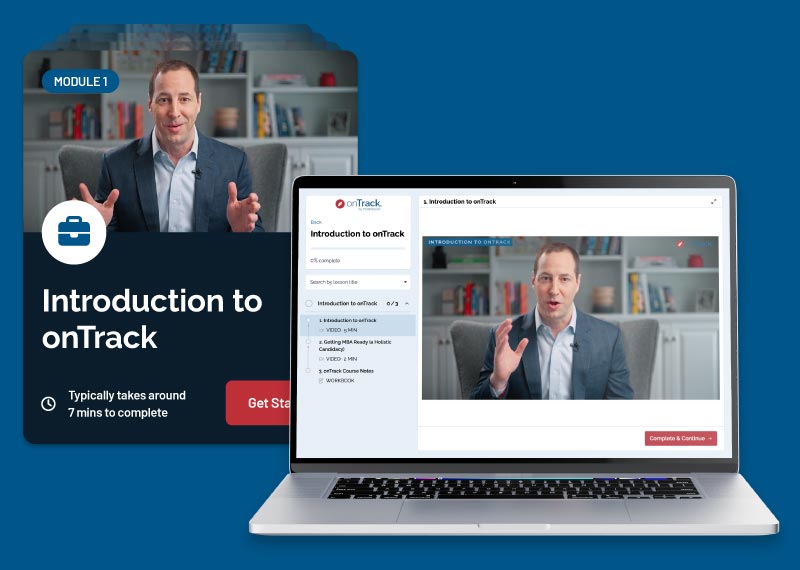
onTrack by mbaMission

A first-of-its-kind, on-demand MBA application experience that delivers a personalized curriculum for you and leverages interactive tools to guide you through the entire MBA application process.

Get Started!

2026–2027 MBA Essay Tips

Click here for the 2025–2026 MBA Essay Tips


MBA Program Updates

Explore onTrack — mbaMission’s newest offering allowing you to learn at your own pace through video. Learn more