Blog

Four Key Qualities of a Successful Job Seeker

We have all been reading about how the economy is affecting job availability, especially for MBAs, and although this is true, we also need to acknowledge that candidates are still landing (great) jobs. And regardless of the state of the economy, the core principles of job searching remain the same. In this post, we discuss four key qualities that can make you a more successful job seeker in any job market.

Generosity (definition: the quality of being kind) – In the context of a job search, generosity means making introductions, building genuine relationships, and expressing sincere appreciation for help. 

  • Take the call. When someone affiliated with your undergraduate or graduate institution reaches out for advice or guidance, respond. Offer feedback on the skills required to land a specific job, make introductions, and share the individual’s resume with relevant hiring managers.
  • End every networking interaction with appreciation. In addition to saying, “Thank you for your time,” make sure to extend an offer like “If you think anyone in your network who would benefit from my areas of expertise, please feel free to make an introduction.” You could also ask a more direct question like “Is there anything I can do to help you?” Write a customized thank-you email after each interaction. 
  • Share open positions at your company on LinkedIn as well as with people in your network. 
  • Keep your network updated. Let your contacts know what actions you took based on their advice. 

Resilience (definition: the capacity to recover quickly from difficulties) – At times in life, and especially while job searching, you are going to face rejection, so always remember the importance of believing in yourself.  

  • Learn from each conversation. Take notes on what you felt you could do better in the conversation, and find ways to improve. Think of new questions to ask networking contacts based on previous conversations. Rejections do not mean that you are not qualified or that you will not find another opportunity of interest.
  • Focus on your transferable skills and functional expertise, not just your industry knowledge. Reframe your goals: perhaps you need to take a baby step before landing your dream job. Find ways to secure a role in the short term that will keep you on your dream job trajectory.
  • Demonstrate comfort with ambiguity. Hiring processes can be slow. Remember that even though landing a job is your number-one priority, your hiring manager could have more pressing priorities. 
  • Give yourself permission to be frustrated when an opportunity of interest does not come to fruition, but do not spend too much time dwelling on it. Find time for self-care; reenergize and celebrate mini milestones. 

Curiosity (definition: a strong desire to know or learn something) – Learning should not stop when you graduate.    

  • Develop and share your perspective on an industry of interest—including products, business models, innovations, and disruptions—and use it as a basis for networking conversations. Post about it on your LinkedIn newsfeed.
  • Take online courses to build skills or gain expertise on new technologies. Learn by following your target companies on LinkedIn and other social media platforms. 
  • Ask your network for help. Brainstorm questions to use in networking conversations that will solicit robust conversations, show the depth of your passion, and offer actionable next steps. Seek guidance from your contacts on courses to take or free resources to tap into.

Preparation (definition: the action or process of making ready or being made ready for use) – The job market is full of qualified candidates; find ways to stand out.  

  • Set realistic role and timeline expectations. Have a Plan A and a Plan B (and even a Plan C). Craft a larger than usual target company list (approximately 25 organizations). Double (or even triple) your efforts. Do not settle for one or two networking calls a week; aim to conduct three to five each week. 
  • Focus on how you will help your target employer; check out our blog post on building your career narrative. Be clear with your value proposition, and connect the dots between what you have done and the needs of your target audience.
  • Optimize your resume and LinkedIn profile. Ensure that your marketing documents are tailored to your audience (and are Applicant Tracking System compatible), and demonstrate the impact you have had in prior roles.

How to Assess and Fortify Your Academic Record for MBA Applications

As you contemplate your MBA candidacy, you might wonder, “Is my academic record strong enough to get me accepted to my target programs?”

For context, admissions committees evaluate your academic record because it is an important predictor of your ability to handle the rigors of an MBA program. Standardized testing is another essential component in this evaluation, but in this post, we focus on the academic record from your undergraduate studies and any other graduate programs you have already pursued. 

Stanford Graduate School of Business Application Essay Tips

Stanford Graduate School of Business

The Stanford Graduate School of Business (GSB) requires only two essays of its candidates, though its long-standing first essay question—about “what matters most” to applicants—is one we have seen many people struggle with over the years. The largely open-ended nature of the prompt often stymies candidates, who understandably want to avoid making any wrong moves in their application. The GSB’s second essay question is comparatively straightforward, asking applicants to explain why they have chosen the school for their MBA, but crafting the best possible response will demand some thorough research into what the institution offers and an ability to clearly show a connection between certain resources and the candidate’s unique personality and needs. With a word limit of 650 for the first required essay, and only 350 for the second, applicants need to be judicious in selecting their desired messages and succinct in conveying them. That said, the admissions committee does provide three other opportunities for candidates to share additional information (in 1,200-character increments) about themselves and their background, about instances of positive impact they have had, and about any confusing or potentially problematic elements of their candidacy. Read on for our full analysis of the GSB’s essay and optional question prompts. 

NYU Stern School of Business Essay Tips

NYU Stern

The two application essay prompts for the New York University (NYU) Stern School of Business demand that candidates tap into their personality and character and convey a bit of their creative side. But first, the school poses a straightforward and rather traditional question about applicants’ short-term professional aspirations, limiting the response to a succinct 150 words. For the first full essay, candidates must develop a personal tagline in the style of NYU Stern’s (“Change: Embrace it.”), discuss its significance, and explain how they would act on it as an NYU Stern student. For the second required essay, applicants face the school’s challenging but very revelatory “Pick Six” submission, which might be less intimidating for today’s candidates than it was when it was first introduced in 2017, given the ubiquitousness of social media. Together, Stern’s essay questions should allow you to present a good balance of your professional and personal sides for the admissions committee, though the optional essay is also on the table if you feel strongly that a vital part of your candidacy has not been covered by one or the other. Read on for our in-depth analysis of all Stern’s prompts for 2025–2026.

Are You Too Young (or Old) to Pursue an MBA?

Wondering whether you are too young or too old to pursue an MBA? In this post, we discuss what business schools really think about younger—and older—candidates. 

Does Age Matter When Applying to an MBA Program?

Here at mbaMission, one of the most common questions we are asked is “Am I too young [or old] to pursue an MBA?” Most applicants to traditional two-year MBA programs have between three and seven years of full-time work experience by the time they matriculate. For example, the average number of years of professional experience for the Class of 2026 at Harvard Business School and The Wharton School is five (5.1 at the Stanford Graduate School of Business). Schools typically publish this stat as part of their class profiles, so you can check your target programs to see how you measure up.


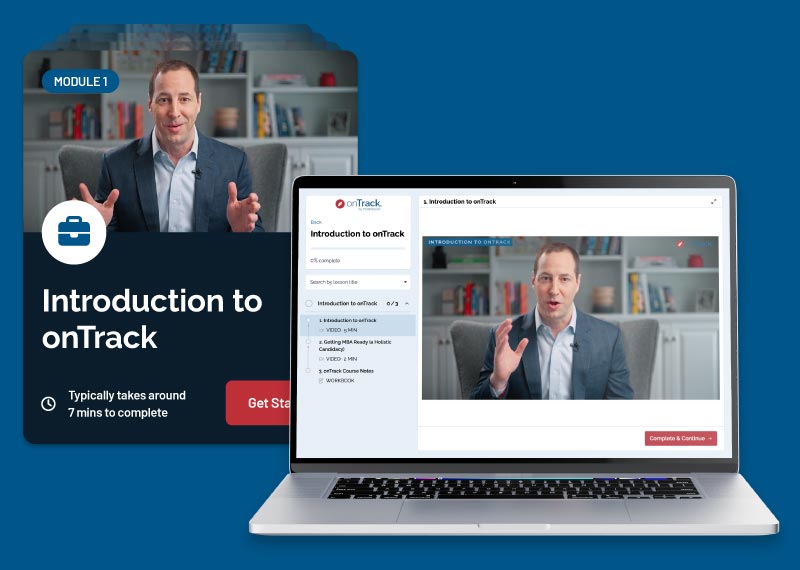
onTrack by mbaMission

A first-of-its-kind, on-demand MBA application experience that delivers a personalized curriculum for you and leverages interactive tools to guide you through the entire MBA application process.


Get Started!

2026–2027 MBA Essay Tips

Click here for the 2025–2026 MBA Essay Tips


MBA Program Updates

Explore onTrack — mbaMission’s newest offering allowing you to learn at your own pace through video. Learn more