Blog

Northwestern University (Kellogg) Essay Analysis

Note: The following essay questions pertain to the previous academic year. This section will be updated when the new question are released in early to mid-July of 2008.

Kellogg has just released its 2007-2008 essay questions, and changes are afoot. At last, the school has eliminated its (now former) essay three, a request for applicants to evaluate themselves. Our guess is that the Admissions Committee was tired of reading one essay after another exclaiming “admit!” Further, Kellogg has reduced the demands of its short essay section, now only requiring that you answer two of three choices (not including the fourth, which is required for reapplicants), instead of three of five, as in past years.

Note: Because Kellogg’s essay questions are so broad and flexible, it is important that you map your ideas before you attack these essays. By doing so, you will avoid repetition and ensure that you will be able to play to your strengths.

All applicants are required to answer questions 1, 2 and 3 in addition to 2 of the optional essays in question 4.

1.) All applicants must complete A OR B as appropriate:

A – Master of Business Administration applicants only: Briefly assess your career progress to date. Elaborate on your future career plans and your motivation for pursuing a graduate degree at Kellogg (one to two pages double spaced).

B – Master of Management and Manufacturing applicants only: Briefly assess your career progress to date. How does the MMM program meet your educational needs and career goals? (one to two pages double spaced)

Because of significant overlap from one MBA application to the next, we have produced the “MBA Mission Personal Statement Guide.” We offer our guide to candidates free of charge, via our online store.  Please feel free to download your copy today.

2.) Each of our applicants is unique. Describe how your background, values, academics, activities and/or leadership skills will enhance the experience of other Kellogg students. (one to two pages double spaced)

This essay is broad and sweeping in nature so it allows you to strategically showcase a mix of your greatest strengths – professional, community, academic and personal. You should attempt to select a diversity of experiences and present them in such a way that you will be able to relate them back to your ability to contribute in a variety of areas – for example, the classroom, your study group and the community at large. A successful essay will be one that not only details unique personal strengths, but also clearly illustrates how these strengths will be put into action at Kellogg, meaning that you will have an opportunity to show your intimate understanding of and connection to Kellogg.

Please see our Monday Morning Essay Tip: Your Contribution.

3.) How have your past and current leadership experiences prepared you for Kellogg? What leadership areas are you hoping to develop through your MBA experience?

In essay two, you needed to consider how your experiences enabled you to contribute to Kellogg. Similarly, in essay three, you are not just to consider how your experiences have made you a better, more capable person, but how they have prepared you for Kellogg itself. Further, this essay has a critical component in terms of how you intend to develop going forward. This does not mean that you should deride your existing skills, but it does mean that you should be open and honest in discussing areas that you need to bolster in order to become a more complete leader (which can and should be entirely positive and constructive). Because this question asks how you will develop at Kellogg, it is important that you show an intimate understanding of the Kellogg experience in order to write a successful essay.

4.) Applicants must answer 2 of the below essays. (Reapplicants must answer question 4D and 1 other essay).

4A – Outside of work I…

4B – I wish the Admissions Committee had asked me…

Essays 4A and B are essentially free opportunities for you to discuss anything vital — compelling stories or differentiators — that you have not yet showcased. Basically, you could not ask for a better opportunity to show the Admissions Committee how you are unique. Many candidates use these essays to discuss a hobby or interest. It is important that, if you make this choice, you express an inordinate passion — otherwise you are offering a boring window into your life. Ask yourself, “How can I show that I take this passion further than others?” If you are going to answer both of these questions, it is a bad idea to answer them in a similar way – two passions, for example. If you can offer dramatically different experiences, then proceed with both essays. This should not be a default option, but an opportunity to offer something new and different in each essay.

4C – Describe the most challenging professional relationship you have faced and how you handled it.

In only a few short paragraphs, you need to capture the imagination of the Admissions Committee with a story of the difficulties that you encountered. Because of the space limitations, you will need to start the essay in a detailed and descriptive way to help convey the intensity of the experience. Then, you will need to transition quickly and analyze the actions that you took to diplomatically navigate this situation. As the reader completes this essay, he/she should understand that you exercised discretion and judgment. Implicitly, the reader should understand that if you are in a study group at Kellogg, you will be sensitive to others, even if they are out of line.

4D – (Required essay for reapplicants only)—Since your previous application, what are the steps you’ve taken to strengthen your candidacy?

Whether you have improved your academic record, gotten a promotion/taken on a new and exciting project, increased your community involvement or taken on a personal challenge of sorts, the key to this essay is that you convey a very deliberate path of achievement. Kellogg wants to know that you actively strived to improve and that you seized the opportunity during the past year, because your Kellogg MBA is vital to you. This essay question will be vastly different from candidate to candidate. We are more than happy to provide one-on-one-guidance to ensure that the above agenda is met.

University of Chicago (GSB) Essay Analysis

Note: The following essay questions pertain to the previous academic year. This section will be updated when the new question are released in early to mid-July of 2008. 

This year, Chicago continues with its “offbeat” approach to essays, incorporating a 4 page PowerPoint presentation that will challenge candidates’ creativity. Our analysis of its essays and presentation follows:

1. Why are you pursuing an MBA at this point in your career? Describe your personal and professional goals and the role an MBA from the University of Chicago GSB plays in your plans to reach these goals. (1,500 word maximum)

Because of significant overlap from one MBA application to the next, we have produced the “MBA Mission Personal Statement Guide.” We offer our guide to candidates free of charge, via our online store.  Please feel free to download your copy today.

2. If you could step into someone else’s shoes for a day, who would it be and why? (500 word maximum)

Chicago offers this “wide open” and unorthodox question, not as an opportunity to find out which celebrity you admire, but to understand your personality through the eyes of another. While the individual that you choose is quite important, the reasons why you chose him/her are even more crucial to the essay. As absurd as this may seem, the essay, while about someone else, is still fundamentally about you. When approaching this essay, you should challenge yourself to consider the vicarious experiences that you would need to grow professionally, personally and/or spiritually — but we would have a bias toward the personal/spiritual sides. By “becoming” this person for the day, you will need to show significant learning and a potentially enduring impact on your life.

An important note: this is not an opportunity for you to praise Warren Buffet or admire Steve Jobs. Unless you are very careful or have an inordinate personal connection to this individual, picking someone who is quite famous can often be no more than a descent into cliché.

3. We have asked for a great deal of information throughout this application. In this portion of the application, we invite you tell us about yourself using a non-traditional application format–a PowerPoint presentation. In four slides or less, please provide readers with content that captures who you are. Given that this is a new section we have set forth the following guidelines for you to consider when creating your presentation. The content is completely up to you. There is no right or wrong approach to the way you construct your slides or answer this question. There is a strict maximum of 4 slides. Slides will be printed and added to your file for review; therefore, flash, hyperlinks, embedded videos, music, etc. will not be viewed by the committee. You are limited to text and static images to convey your points. Slides will be evaluated on the quality of content and ability to convey your ideas. You are welcome to attach a Word document of notes if you feel a deeper explanation of your slides is necessary. If you do not have access to PowerPoint or a similar software application, you can contact the admissions office at [email protected] for alternative methods.

At mbaMission, we are quite excited about this essay, as it represents a blank slate. Thus, it is an incredible opportunity for candidates to create presentations that are entirely distinct from all others. What is great about this essay/presentation is that in a traditional essay, it is your task to differentiate yourself via your content, but in this presentation, you can showcase your unique attributes via content and also captivate via your design.

Because this presentation is so open, we would need to meet with candidates one-on-one to devise personal strategies. Still, as a general rule, we recommend that candidates consider their content first and then devise a design that will allow them to communicate all of the important attributes that they have identified. You do not want to make the mistake of choosing a distinct and captivating method of presentation that limits your ability to tell your story in its entirety. Choosing to understand your content first will prevent this from happening and start you on the right track.

Long Term MBA Planning: Informational Interviews and Job Shadowing

Virtually every MBA program (with the notable exception of HBS, whose career-goals question is now optional) requires that candidates write an essay on short- and long-term career goals. We find that many candidates truly need an MBA to advance in their careers, but they still struggle to identify their personal post-MBA path(s). However, even those who are determinedly pursuing a specific position can still benefit from an informational interview or job shadowing — especially those entering competitive fields, such as banking or consulting. Because many candidates aspire to careers in these fields, the sincerity of your interest can make the difference.

So, what is an informational interview? Essentially, it is an interview arranged through your network, with someone who is in your proposed field of career-interest and in a post-MBA position. It can be as causal as a coffee or as formal as a meeting in the person’s office. Regardless of the venue, it is your mission to get to know the nuances of the position and gain a more profound understanding of what this person does each day, each month, each year. Further, your session should give you an opportunity to discover more about their industry and its hiring needs. Hopefully, you will end up not only understanding what you like/dislike about such a position, but will also be able todetermine whether you would be a fit for it.

So, what is job shadowing? Job shadowing is essentially a long informational interview, where you not only ask questions, but also follow the individual throughout the course of a half-day or a day to truly experience his/her position. Via this hands-on experience, you should have an even more nuanced view of your target position and thus should be able to write your essays with depth and confidence.

Long Term MBA Planning: Short Answer Completion

Throughout this series, we have focused on freeing candidates from all other constraints so that they can pay careful attention to their essays as the questions are released. Short answers – the small sections within the application forms themselves that pertain to your work history, community accomplishments, scholarships and criteria, etc. – do not change much from year to year. While many choose to put off these “details,” you can rid yourself of a headache now by taking the time to complete these sections. Furthermore, similar in benefit to your resume, by completing this step early on, you may contemplate and discover stories that will be quite useful in writing your essays. An abbreviated version of HBS’s short answer on work history follows:

Job Description:

Job Title:

Your Responsibilities: (200 characters only)

Key Accomplishments: (200 characters only)

Most Significant Challenge: (200 characters only)

Reason for Leaving: (200 characters only)

Again, if you need to complete these forms thoughtfully for several positions and then complete several other similar sections for your volunteer and extracurricular experiences, this can be time consuming as you approach the deadlines. By completing them now, for all of your applications, you will have a brainstorming tool in hand and a small obstacle out of the way.

Harvard University (Harvard Business School) Essay Analysis

As announced by HBS’s Director of Admissions and Financial Aid, Deirdre Leopold, in an online chat with BusinessWeek in late May, HBS’s essays have indeed changed. Whereas HBS previously did not offer its candidates any flexibility in its six required essays, the admissions office will now only ask candidates to complete two required essays and then to select from three of six optional essay topics. Beyond these structural changes, most notably, HBS has added questions on global/cultural experiences and dropped its question on ethics.

Our analysis of each essay follows:

What are your three most substantial accomplishments and why do you view them as such? (600 word limit)

This mainstay of the Harvard application challenges the reader to display depth of experience. Generally, the candidate should be showcasing different dimensions within the three subsections of this essay; a selection of professional, community and personal accomplishments (not all need to be represented) is important. While this is the longest single essay in terms of word limit, many treat it as three mini essays, so it is actually quite challenging to construct it within these confines. Further, it is important that you remember that the experiences themselves are not everything. Indeed, there are two elements that need to be addressed — the story of your accomplishment itself and then a reflective element (“why do you view them as such?”). The second half of this question cannot be ignored; your personal thoughts are no one else’s and can differentiate you from the pack.

What have you learned from a mistake? (400 word limit)

As noted above, HBS has dropped its question on ethics and may have replaced it with this essay, which is a different test of character. What is interesting about this question is that AdCom is not asking you for a failure or a setback (both of which allow you to shift the blame to others or to circumstances) but for a mistake (where there is no avoiding responsibility). Simply put, mistakes are due to decisions, not circumstances. Thus, candidates are forced to be much more honest about their experiences and either take or place responsibility. Of course, this essay is not just about the mistake itself, but is about learning from the mistake. So, you will need to be introspective and show that learning led to tangible change in thought or action.

Please respond to three of the following (400 word limit each)

Discuss a defining experience in your leadership development. How did this experience highlight your strengths and weaknesses?

With HBS’s emphasis on leadership, it is unsurprising that this essay remains from last year. However, the keyword is not “leadership,” but “defining.” Clearly, there needs to be a climactic moment in your story in which your philosophy changed or was revolutionized. Thus, strong momentum in a single direction is crucial, and then this transitional event needs to stand out and show its force. It is important to note that this essay does not need to come from your work experience; the magnitude of the event is more important than the “locale.” Again, the second aspect of this essay demands introspection. You cannot merely trot out clichés about strengths and weaknesses, but should reflect and try to get to the core of your leadership style. You might find it difficult to be forthright about your weaknesses, but by identifying those that are not damning (meaning those that will not undermine your ability to succeed at HBS) and explaining what you learned from them, you will get the credit that disingenuous statements (i.e., “My weakness is that I am too passionate about my work…”) will only undermine.

How have you experienced culture shock?

As mentioned above, this is a new essay question and one that seeks to explore how you can relate to others or a new environment, amid significant change. Many will restrict their thinking to international experiences, but you may have experienced a new culture in your home country or backyard. In this essay, the key is to show that you are adaptable and embrace change with ease. For you to write a solid essay, you will need to discuss a moment/experience in which you were well outside of your comfort zone, and then reveal your ability to create a new comfort zone or accept another’s.

What would you like the MBA Admissions Board to know about your undergraduate academic experience?

This question is quite open-ended, so you are not constrained to a discussion of your entire academic career; you can be selective and showcase the aspects that put you in the most positive light. This is an opportunity to explain your choices (school/major) and show intellectual vitality, not to review your coursework (the AdCom has your transcript) or explain bad grades. While “academic” is the operative word in this essay question, it can be interpreted broadly. Your academic experience can extend beyond the classroom and into vigorous discussions with professors during office hours, for example. The idea is to show that while you were an undergraduate, you were seizing opportunities to explore ideas and then develop your own interests, thoughts and world view. You should try to create momentum and show that you seized the opportunity to discover your passions and commit yourself to a course of study (regardless of whether your major was electrical engineering, history, management, etc.). Still, this does not mean that you can only discuss your major; that quirky “surrealist cinema” or fascinating “modern architecture” course that was well outside of your major might be the perfect fodder to prove your intellectual growth. Even if your time was not academically fulfilling, it is important that you show that such experience gave you a clear direction. Finally, it is almost a cliché, but HBS is looking for leadership in everything that you do. So, if you can illustrate that you aided others in learning or expanding their horizons (peer tutoring, facilitating a conference, etc.), then this part of your academic experience could be an implication of future contributions at HBS, which could be quite appealing to the AdCom.

What is your career vision and why is this choice meaningful to you?

This question offers you flexibility in discussing your career path, which is almost unheard of amid the top-ten schools. Still, just because there is no blatant request for short- and long-term goals, you still cannot afford to be whimsical. You need to be focused in your ambitions and ensure that your path flows from an existing foundation to ensure credibility. HBS wants to be sure that they restrict the illustrious HBS experience to those with clear vision, potential and purpose. The latter aspect of the question (“why is this choice meaningful to you?”) places the onus on you to explore your own motivations. The structure of this question prevents superficial answers and forces you to show a fundamental understanding of your choices going forward.

What global issue is most important to you and why?

We start our analysis of this essay with a cautionary note: this is not the place to voice your political views or air grievances. In this essay, you have the opportunity to show that you are keenly aware of the world – not preachy — and that you take personal ownership of issues that are affecting your conscience, community and beyond. So, you should not just attack a political or social issue, but must consider your personal connection with it. An excellent essay will show an unusually strong “relationship” with the matter and prove that you are deeply affected by its implications. Further, it will hopefully showcase more than your emotional reaction to it, but also show that you have been active in raising awareness or taking steps to address it.

What else would you like the MBA Admissions Board to understand about you?

Last year, HBS stopped offering a place for “additional information” in its application, likely frustrated by how many candidates used the space to make excuses about their GMAT or grades. By creating this essay, HBS essentially forced candidates to make choices about how they would use their precious essay space and therefore mitigated those who were justifying that which did not need to be justified. Regardless of the history of this essay, if you have an unusual problem within your profile, this is the place to discuss it. If you do not, this question allows you to creatively highlight an experience that did not fit neatly into your other essays. Keep in mind that — after four other essays – the challenge will be to offer an entirely new dimension of your personality.


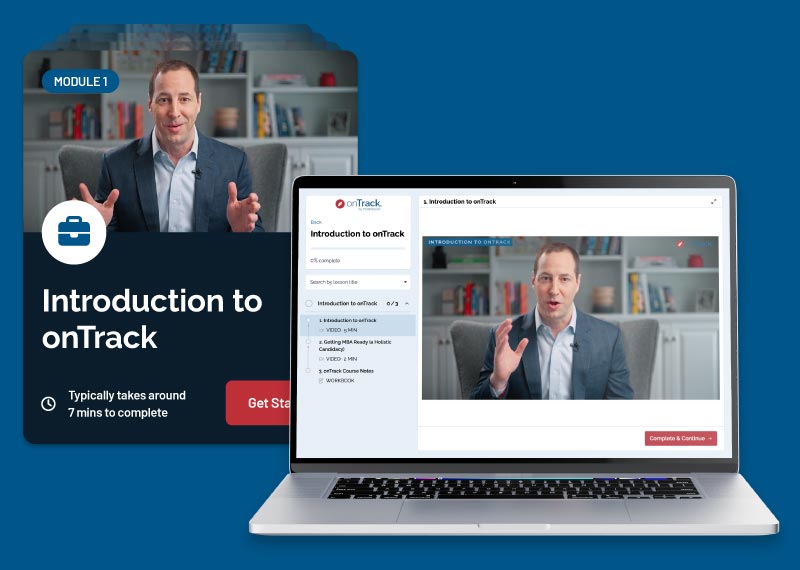
onTrack by mbaMission

A first-of-its-kind, on-demand MBA application experience that delivers a personalized curriculum for you and leverages interactive tools to guide you through the entire MBA application process.

Get Started!

2026–2027 MBA Essay Tips

Click here for the 2025–2026 MBA Essay Tips


MBA Program Updates

Explore onTrack — mbaMission’s newest offering allowing you to learn at your own pace through video. Learn more