Blog

New York Times Article: Making a Hard-Life Story Open a Door to College

The New York Times recently published an article (“Making a Hard-Life Story Open a Door to College“) on College Summit, a non-profit organization dedicated to helping under-privileged candidates excel in the admissions process.

What is noteworthy in this article, beyond the benevolence of the non-profit itself, is the organization’s powerful belief in each candidate’s story as a differentiator.  As the New York Times writes, “The workshop is intended to help them discover — and prove to college admissions officials — that their life stories can be as powerful as high SAT scores and stellar grades.” Indeed, the MBA Admissions process is no different. Your personal story can and will make the difference.

Manhattan GMAT Opens Washington, D.C. Location

If you are an MBA applicant in the Washington, D.C. area, your chances of gaining admission to the school of your choice just got better. Our friends at Manhattan GMAT just opened their downtown Washington, D.C. location. At MBA Mission, we recommend Manhattan GMAT, because of their willingness to pay more to attract and retain top-teachers and because of their profound commitment to educating students, not just teaching “tricks.”

If you are not in one of the six cities where Manhattan GMAT has a “bricks and mortar” location, you need not worry. You can still take advantage of their self study and virtual classroom options.

Columbia University (Columbia Business School) Essay Analysis

Note: The following essay questions pertain to the previous academic year. This section will be updated when the new question are released in early to mid-July of 2008.

Once again this application season, essay two is the only CBS essay to change significantly. Gone is the essay question about an effective manager — an outward-looking question that confounded many applicants who were unsure how the essay reflected their own experiences. Now, CBS offers a question that is about candidates themselves but is largely about the future – a question sure to be equally confusing to some who lack direction. Also, notably, CBS has dropped one of its traditional options in essay four, now only offering candidates a question on a passion.

Essay 1: What are your short-term and long-term post-MBA goals? How will Columbia Business School help you achieve these goals? (Recommended 750 word limit)

Because of significant overlap from one MBA application to the next, we have produced the “MBA Mission Personal Statement Guide.” We offer our guide to candidates free of charge, via our online store.  Please feel free to download your copy today.

Essay 2: In a recent speech delivered to the Association to Advance Collegiate Schools of Business, Dean Glenn Hubbard discussed the new, essential elements of the 21st century MBA. How will your MBA prepare you for a rapidly changing business environment? (Recommended 500 word limit)

Whereas the first essay demands that you discuss the specific skills that you will need to acquire in order to advance along your professional path, this essay is more philosophical – it asks that you consider how your MBA will prepare you to deal with change. Because this question is so broad and open-ended, you will need to personalize your response and discuss change, not within a generic context, but as it pertains directly to situations that you anticipate in your career. This essay will require that you express a vision for the future and an understanding of how your MBA (and thus CBS’s resources once again) will enable you to adapt and excel.

While you should read Dean Hubbard’s speech and might even reference some of his thoughts, you should not model your answer after his text. Your answer should be just that – your own.

Essay 3: The entrepreneurial mind-set is an integral component of the Columbia Business School MBA. Please discuss a time in your own life when you have identified and captured an opportunity (Recommended 500 word limit).

The key to understanding this question is to recognize that entrepreneurship is not narrowly defined to mean “creating a business” but is more broadly defined as “capturing an opportunity.” Your example certainly could come from within the confines of the typical definition, but it could also come from innovating within your existing company, expanding the role of a community organization or from your personal sphere (if you seized a remarkable growth experience), etc. The bottom line is that there are many “right” answers for this question, and you need not be intimidated if you have not started a company from scratch.

Further, in this essay, your choice of language will be key to emphasizing that you did something creative in order to identify the opportunity. (Even if the idea was near or at the surface, you still possessed vision that others did not.) After telling the story of how you identified the opportunity, you should explain the process of capturing the opportunity, focusing on the tangible impact that you had on this process and on how you helped bring the idea to life. Finally, you should briefly reflect on your accomplishment and key learnings. While CBS does not explicitly ask for such analysis, it is most often helpful, as it shows a humility and appreciation for the experience, not just the results.

Essay 4: Please tell us about what you feel most passionate in life (Recommended 250 word limit).

Because CBS’s previous questions might not allow you to discuss a full range of personal, professional and community experiences, you should approach essay four with caution and consider ways in which you can diversify the Admissions Committee’s understanding of your profile. Whether you intend to discuss a hobby, idea, ethereal experience, activity, event or moment, it is crucial that you show an inordinate commitment via your actions in order to convey true passion. Remember, the reader will not be captivated by experiences that lack intensity or emotion. Only by showing how your relationship to this passion is unique will you truly stand out.

University of California, Berkeley (Haas) Essay Analysis

Note: The following essay questions pertain to the previous academic year. This section will be updated when the new question are released in early to mid-July of 2008.

Haas leaves its essays relatively untouched this year – maintaining its demanding four short essay/two long essay format. The only change is a new short essay question, which, like its predecessor, tests the writer’s creativity. Other than that, the application remains the same, challenging the writer to consistently offer new experiences in order to hold the attention of the Admissions Committee.

Short Answers:

1. If you could have dinner with one individual in the past, present, or future, who would it be and why? (250 word maximum)

In this essay, it is vital that you remember that this is not about the individual that you select, but is fundamentally about you — the Admissions Committee will get a sense of who you are through your choice. Thus, you will need to carefully consider this individual, explore your connection with this person and clearly understand the impact that this hypothetical encounter would have on each or both of you.

Some questions that you might consider asking yourself:

What will you learn from this person?
How will your experience benefit you and others?
(In some cases) What might you persuade this individual to do and why?

A word of caution: this is not an opportunity to fawn over a successful business person or celebrity. This is an opportunity for you to show that you are a creative and intellectual individual, interested in your own growth and others’.

2. Tell us about your most significant accomplishment. (250 word maximum)

Your most significant accomplishment can be from any sphere –professional, community, academic, personal– but you should try to maintain a balance and represent as many dimensions of your candidacy as possible through these short answers – meaning that you will have to exercise judgment. Even in 250 words, you can tell a brief story or state your accomplishment and explain why you view it as such. The key to this essay is to choose an experience that is simple but powerful – one that speaks for itself and draws the reader in, allowing the reader to come to a clear conclusion about your capabilities.

3. At Haas, we value innovation and creativity. Describe an innovative solution you have created to address a specific challenge. (250 word maximum)

If you have not yet offered a professional experience at this point, now is the time – for the sake of balance. Your example of innovation or creativity need not be earth-shattering, but can simply be the story of you thinking differently or making a unique choice. In this essay, you will notice the word “demonstrated”; the committee wants to learn about you through your experiences. You need to be telling a story, not stating facts. When telling a story, even in 250 words, you still need to provide a discernible beginning, middle and end, which in this case probably will be your discovery of the idea, actions you took to implement and clear results brought forth by your actions.

4. What steps have you taken to learn about the Berkeley MBA program, and what factors have influenced your decision to apply? (250 word maximum)

Quite simply, Haas wants to know that you are applying for the right reasons – for the program’s brains (academics, environment, etc.), not its beauty (rankings). You need to explain your connection with the program and show that you have engaged in a process of discovery and self-evaluation in coming to the conclusion that Haas is for you. The more personal and detailed you are in your approach, the more compelling your answer will be.

A good test of your sincerity is deleting any reference to Haas and inserting the name of another school. If your essay still makes sense with another school’s name inserted, the odds are that your response is too generic. If it your statement becomes nonsensical because you have another school’s name relating to Haas-specific resources, you have done your job (and should reinsert Haas!).

Required Essays:

1. Give us an example of a situation in which you displayed leadership. (500 word maximum)

You might feel relieved to find a 500 word maximum at this point. However, by now, your depth of experience might be challenged; some find it difficult to offer a strong answer to this question, after discussing their most significant accomplishment in short answer two. Clearly, you should reserve a story that is more complicated for this essay and one in which your actions are methodical. Whereas the short essay demands an impressive “blast” of experience, in this essay the AdCom is more interested in understanding your leadership style and thus your process orientation. Your results are still quite important, but the characteristics that you display on the path to these results should be revealing.

2. What are your short-term and long-term career goals? How do your professional experiences relate to these goals? Why do you want an MBA from Berkeley at this point in your career? (1000 word maximum)

Haas inverts the traditional structure of this essay question, placing your goals before your career experience. You too can invert your answer or you can begin with your career context; it does not really matter, as long as you answer the question in full.

Because of significant overlap from one MBA application to the next, we have produced the “MBA Mission Personal Statement Guide.” We offer our guide to candidates free of charge, via our online store.  Please feel free to download your copy today.

Yes, but can your consultant do this? (Part II)

A few months ago, we published a “cheeky” blog entry, “Yes, but can your consultant do this?,” highlighting an article that MBA Mission Founder, Jeremy Shinewald, had just published in an award winning literary magazine. Today, we are pleased to announce Part II of this series. Senior Consultant, Grainne Fitzsimons, has just published, “What You See Affects What You Get,” in the MIT Sloan Management Review.

At MBA Mission, we pride ourselves on each consultant’s unique MBA experience and profound communication skills. When applying to a top-business school, you cannot settle for a mere MBA, but should insist on having a published-author on your side to help you showcase your distinct attributes and experiences. 


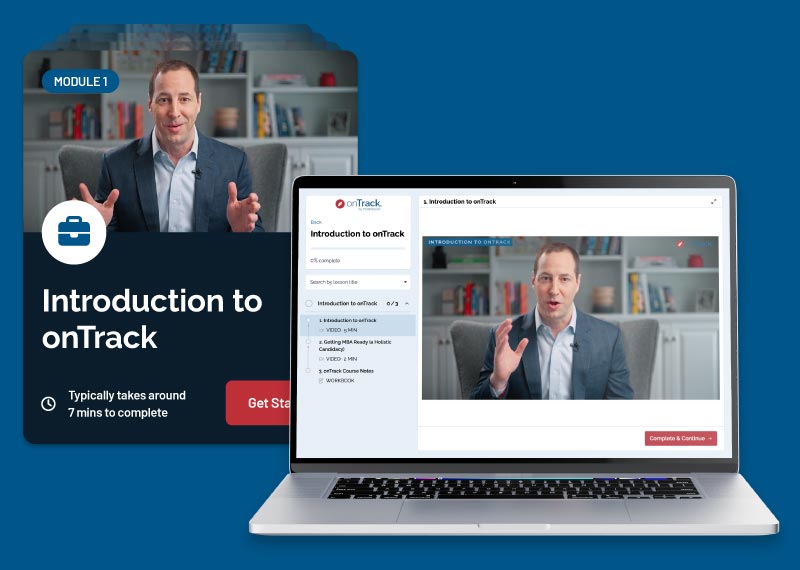
onTrack by mbaMission

A first-of-its-kind, on-demand MBA application experience that delivers a personalized curriculum for you and leverages interactive tools to guide you through the entire MBA application process.

Get Started!

2026–2027 MBA Essay Tips

Click here for the 2025–2026 MBA Essay Tips


MBA Program Updates

Explore onTrack — mbaMission’s newest offering allowing you to learn at your own pace through video. Learn more