Blog

Manhattan GMAT’s 5 Tips for 1st year MBA Students

Our friends at Manhattan GMAT have prepared a helpful set of tips for those who have made the successful leap to b-school. It isn’t too early for you to start planning for that enviable day… 

We get a lot of good news here at Manhattan GMAT from students who have been accepted into the MBA program they had their sights set on.  Now, as many of them are packing their bags to get settled into their new environment, here are some words of wisdom compiled from some of our Instructors who have been through it themselves. 

So you’re about to start business school – congratulations! As you hit your first orientation events and get to know your companions for the next couple of years, here are a few things to keep in mind to make the most of the experience:

1. Networking: Depth as well as Breadth.  The message about networking is ubiquitous in business school, and for good reason.  Chances are you’ve already witnessed how important it is to build relationships and make connections in the world of business.  A good portion of your classmates will be movers and shakers in their respective industries, so it’s a wise investment to network with them at every opportunity.  But one thing to keep in mind is that effective networking is not about collecting a stack of business cards during orientation weekend and accruing hundreds of connections on LinkedIn.  It’s okay to have a fair number of “weak ties” in your network, but also strive to cultivate strong, meaningful relationships along the way.  Ask yourself, “Could I really call this person a couple of years from now and have them lend me a hand?” These types of relationships take time to develop, so start early and make it a priority.

2. Make use of Clubs and Groups. Maybe you weren’t a big club person in college, and you made friends in other ways. Well, business school groups ought to be a different story. This is especially true if you’re interested in switching careers and/or industries. Clubs can often be a crossroads for cutting-edge ideas, speaker events with industry leaders, and job opportunities. Listing significant involvement in one or two clubs on your resume can make all the difference in your job search.  And participating in groups is a great way to build networks outside of your graduating class.

3. Stay Current.  The case method employed by most b-schools is about looking into the past to discuss key dilemmas and decisions that managers have faced.  But that does not allow you to lose sight of the present business landscape.  Consider your daily business newspaper/periodical/website reading a critical part of your coursework.  Not only will it contextualize and enhance your coursework, but it’ll help you understand the environment when you’re looking for a job.

4. Mix It Up.  You probably crafted an articulate and convincing argument about your short- and long-term career goals in your application essays.  But rest assured that no one will hold you accountable to anything you wrote or said during the admissions process.  Don’t be afraid to deviate from the path you envisioned for yourself. Take some electives outside your comfort zone and try new things, even consider registering for a course in one of the non-business schools of the university (e.g. law, public policy, etc.).  And while you’re mixing up your course plan, also avoid grouping up with the same three or four people project after project.  It would be a shame to miss out on the different talents and backgrounds of your classmates, and you could make a new friend or two.

5. Explore your idea.  There are not that many times when you’ll be free of the demands of a full-time job and surrounded by smart people with a natural interest in helping you flesh out that business idea you’ve had rattling around your head. Business school is a fantastic opportunity to give an idea a try in a supportive, relatively risk-free environment. Enlist support from classmates. Ask a professor what he or she thinks. Build or join a team. Think of it as yet another part of your education. At a minimum, it’ll make a great story for your job interviews down the road.

Duke University (Fuqua) Essay Analysis, 2009-2010

1. Describe your vision for your career, your inspiration for pursuing this career path, and the role of The Duke MBA in achieving your goals. If you are interested in a specific concentration or joint degree program, please discuss in this essay.

Because Personal Statements are similar from one application to the next, we have produced the “MBA Mission Personal Statement Guide.” We offer this guide to candidates free of charge, via our online store.  Please feel free to download your copy today.

2. Discuss a person, event, or experience that has significantly shaped your life and explain why.

Duke leaves open a variety of possibilities via their request for a “person, event or experience.” You should ensure that you are not just offering an interesting biography or the history of an event, but that you apply the focal point of this essay to yourself. Indeed, the “shaping” aspect needs to be clear and the reader needs to understand the tangible impact that this person, event or experience has had on you. A good test of whether you are answering this question would be to consider whether you have presented a “before and after” scenario. Indeed, the reader will understand the impact if he/she can identify a clear change in your behavior and values after this life experience.

3. Individuals choose a business school for many different reasons. Through your research, what attributes or characteristics of The Duke MBA program have most resonated with you and why? How do you plan to contribute to the strengthening and enhancement of those attributes and characteristics during your time at Duke and beyond?

Many MBA candidates will struggle with this question, concerned that this response is not sufficiently differentiated from the one offered in question number one. Question three does not really ask you how you will advance professionally via the MBA program, but more so how you identify with the nature of the MBA program and then subsequently use that strong identification to contribute.

In short, this question asks you to look within and identify common values that you and the program both uphold (details of your preferred learning style and its commonalities with Duke, for example) and then look outward and show how these values and experiences will manifest themselves via your distinct contribution. You cannot merely state, “I will contribute through my leadership and team skills,” but must apply your experience to Fuqua, showing where and how that contribution will be made. This question is an excellent opportunity for you to show self awareness and to reveal that you have truly done your homework before in applying to Fuqua.

mbaMission Releases MIT-Sloan Insider’s Guide, 10th Guide in Series

We are pleased to release our new mbaMission Insider’s Guides to MIT-Sloan.

Through our guide, you will gain a powerful understanding of MIT-Sloan, learning about the school’s unique attributes:

  • Defining characteristics of each school’s location, class size, curriculum, teaching methods, facilities, alumni base/involvement and rankings
  • Courses, experiential opportunities, faculty and clubs related to MBAs’ most common career areas: Consulting, Finance, Marketing, Entrepreneurship, Venture Capital/Private Equity, InternationalBusiness, Health Care, Nonprofit/Social Entrepreneurship and Real Estate (where applicable)
  • The Admissions Committee’s stance on such elements as GMAT/TOEFL scores, layoffs/unemployment, recommendations, the waitlist and more
  • Notable professors, classes and social and community events
  • Admission and employment statistics

University of Michigan (Ross) Essay Analysis, 2009–2010

The University of Michigan’s Stephen M. Ross School of Business has released its application essay questions for the 2009–2010 season, with no changes from the previous year. Thus, we have made only slight updates to our original analysis of the questions, which follows.

Long Answers

Essay 1: Briefly describe your short-term and long-term career goals. Why is an MBA the best choice at this point in your career? What and/or who influenced your decision to apply to Ross? (500 words max)

The first two parts of this question cover elements that are standard for a Personal Statement essay (short- and long-term goals, why an MBA and wny now). Because Personal Statements are similar from one application to the next, we have produced the “mbaMission Personal Statement Guide,” which we offer to candidates free of charge, via our online store. Please feel free to download your copy today.

An important element to note in this first question is Ross’s inclusion of the query “What and/or who influenced your decision.” Increasingly, MBA Admissions Committees (e.g., NYU, Haas) want to know that candidates have completed a priori research on their school and are not just applying to the program capriciously, based on rankings. In this essay, you should go a step beyond highlighting the resources Ross offers that appeal to you and also explain how your interest was generated—such as via interactions with alumni, faculty members, students, admissions officers and possibly even knowledgeable outside parties.

Essay 2: Describe your most significant professional accomplishment. Elaborate on the leadership skills you displayed, the actions you took and the impact you had on your organization. (500 words max)

This is a relatively straightforward essay, but you should take care to offer more than just the basic story of your accomplishment to the MBA Admissions Committee. Ross is seeking to understand the “leadership skills you displayed, the actions you took”; a solid essay will reveal your leadership skills via your actions. Thus, it is vital that you have a process orientation in your writing, as this will ensure that the committee will truly experience, and thus develop a more complete understanding of, your leadership style. If you take the time to tell the full story of your accomplishment by creating a narrative structure within your essay, the committee will have a window into your personality and recognize not just that you are effective, but how you are effective.

Short Answers

Essay 3: If you were not pursuing the career goals you described in Question 1, what profession would you pursue instead? (for example, teacher, musician, athlete, architect, etc.) How will this alternate interest contribute to your effectiveness in solving multidisciplinary problems? (300 words max)

Through this essay, Ross is attempting to understand alternative aspects of your character. Indeed, the examples in the question are telling because “teacher, musician, athlete” are not typical post-MBA careers. Thus, being creative in your response is important, but you must also ensure that you demonstrate a clear connection between your response (i.e., your proposed alternative) to personal and/or professional experience you already possess.

For example, if you have no background as a teacher or simply do not have the personality for it, you will have a much harder time convincing the Admissions Committee that this hypothetical career is an appropriate, or even attainable, one for you. Further, if you are not profoundly connected to this alternative career option, you will have difficulty explaining how you will use this interest to attack multidisciplinary problems. Moreover, when you write about your proposed career, make sure to strike a balance in your tone—you cannot afford to be too whimsical, yet you also cannot afford to be dull.

Essay 4: Describe your experience during a challenging time in your life. Explain how you grew personally, either despite this challenge or because of it. (300 words max)

With this question, Ross substantiates the point we made in our Monday Morning Essay tip entitled “Conflict is Good” that reading about someone’s smooth and easy road to success is not really all that interesting. Indeed, the school wants to hear that you have faced obstacles and that you possess the strength of character to overcome them. While you are free to draw from personal as well as professional experiences, take care to avoid “sympathy plays” and clichés about “learning resilience.” Write with candor and honesty, and discuss the abiding impact that a challenging experience has had on your life. A successful essay will show that the experience substantively changed your mentality or actions and had an enduring and positive effect.

University of California Los Angeles (Anderson) Essay Analysis, 2009-2010

GENERAL INSTRUCTONS: Please be introspective and authentic in your responses. We value the opportunity to learn about your life experiences, aspirations, and goals.

1) Describe the ways in which your family and/or community have helped shape your development. (750 words)

As UCLA Anderson notes in its general instructions, it is interested in learning about your “life experience, aspirations, and goals,” and what better place to start than with your upbringing? This definitely represents a contrast from the usual “personal statement” type of query that typically begins a business school application. This question is intended to reveal the key elements of your development, allowing you to recognize and give credit to others for where you now find yourself in the world, both personally and professionally, or perhaps even to spotlight your own strength and resiliency, if you had a difficult family dynamic or one that offered little or no support. Candidates should definitely avoid beginning their essay with a statement such as “I was born in St.Louis, Missouri, on April 1, 1979” and proceeding chronologically from there. This essay will need to be more thematic and conceptual, rather than a timeline.

In this essay, you can freely provide more information on your personal background than is typically acceptable or possible in MBA application essays. How you answer the question can give the school some insight as to where you feel you fit in the world as well as what kind of life you might create going forward. For example, if you experienced support, encouragement and positive challenge from your family and/or community, you may strive to recreate this kind of experience for others so that they may benefit as you have. Conversely, if your developmental years were trying and marked by negative input, you may be inspired to create a better atmosphere for others by forging a new and different path. These revelations in turn might help reveal what kind of a leader you would be both in the classroom at Anderson and later, in the “real world.” The key to success for this essay will be in honestly revealing yourself and your influences as fully as the word count will allow—and not trying to guess what the school might be looking for and bending your story to fit.

2) Describe the biggest risk you have ever taken, the outcome, and what you learned in the process. (500 words)

One thing to note about this question is that, below the surface, it is not just about the risk you undertook, whether you were successful in your efforts and how you reacted, though these will obviously be central elements of your essay. What will also be revealed in your answer is what kind of risk taker you are (Are you a slow and steady planner or an edgy, “out of the box” thinker who is ready to go for it?) as well as your level of risk tolerance (i.e., what you might consider a risk may be standard protocol for someone else, or vice versa). Stories of success are good for obvious reasons, but really plumb your past and examine all possibilities for this one to ensure that the story you tell reveals the most about yourself in all these different areas. It may be that an instance in which you took a huge risk and failed has since proven more influential on you and your development as a leader than one in which you were successful—perhaps you learned a valuable lesson or were subsequently inspired to try something new or different. Again, as Anderson’s intro to the suite of essay questions states, the school wants to know about you as an individual, beyond just the quantifiable aspects of your experiences thus far.

3) Describe your short-term and long-term career goals.  What is your motivation for pursuing an MBA now and how will UCLA Anderson help you to achieve your goals? (750 words)

This question represents a relatively standard Personal Statement essay question—short-term goals, long-term goals, why an MBA now and why UCLA—so we encourage candidates to consult our “mbaMission Personal Statement Guide,” which we offer free of charge, via our online store.  Please feel free to download your copy today.

Do not use up precious word space here detailing your professional career and accomplishments to date, but do include some general reference to your past work experience to frame why you need an MBA education to attain your stated goals. You must then clearly explain what UCLA offers in particular that will help you. As always, avoid telling the school what it already knows about itself and instead strive to demonstrate links between specific offerings at the school and you and your aspirations. You will need to do your research to best identify direct ties between what Anderson offers and your professional goals, personal beliefs, study style, etc. The more in depth your knowledge of the school, the easier pinpointing specific resources will be in the context of your future success and thus the more effective your essay will be. Take time to go beyond the school’s view book and Web site and contact students, alumni and faculty members, and, ideally, visit the school and attend a class.

An important element of personal statement essays that can sometimes get lost in the shuffle is the “why now” aspect. Be sure to not gloss over or sacrifice this information, believing it is not as important as the other elements of your candidacy that you wish to express—the school asked for a reason, so commit yourself to developing a clear, fitting answer to this portion of the query.

4) Select and respond to one of the two following questions. We would like you to respond to the question by recording an audio or video response (up to 10Mb maximum) for upload in the online application. (The supported file types for audio files are:  .avi, .wav, .mp3, .wmv, .midi, .wma, .aiff, .au, .mp4; the supported file types for video files are:  .mov, .avi, .wmv, .mpeg) If you are unable to submit your response via audio or vido, then please prepare a written response, instead. (250 words) 

a) Entrepreneurship is a mindset that embraces innovation and risk-taking within both established and new organizations. Describe an instance in which you exhibited this mindset.

This first option is a slight revision of last year’s question, in which UCLA asked candidates about entrepreneurial “spirit” rather than “mindset.” As most MBA candidates likely already know, you do not have to have started a company (or be making plans to do so in the future) to exhibit the mindset (or spirit) of an entrepreneur, so those applicants who are not currently considering starting their own venture down the road need not—and perhaps should not—shy away from this question.

Start by defining for yourself what an entrepreneur is to you, beyond the most basic description (i.e., someone who starts a new venture). Identifying opportunities for advancement, fulfilling a need and putting a creative or innovative twist on something that is already available are all aspects of the entrepreneurial approach, for example. If you look at the question closely, you will note that it does not stress the need for an example of a new businesses or product that you spearheaded but rather for a description of a time when you “exhibited” the entrepreneurial “mindset.” So your story should focus primarily on the forces within you that inspired you to speak up or act. The central theme should be your demonstration and application of entrepreneurial qualities. Given that entrepreneurship is such a key topic at Anderson, take steps to understand the school’s attitude and approach to the subject before you begin writing and, wherever possible, show why or how the school will either help you further your entrepreneurial spirit or give you the opportunity to cultivate it.

b) What is something people will find surprising about you?

This question is the only one left over word-for-word from last year’s application. Generally, this option can be used to add “spice” to your profile and enable you to quickly differentiate yourself from others. For this essay to be effective, you need to draw a stark contrast between the “surprising” aspect and what is expected of you, and of course, the greater contrast, the better. If you are having difficulty measuring this, you may want to try out your ideas on friends and coworkers to see what they find most unexpected.

Once you have identified a possible topic, compare and contrast your obvious persona (e.g., entrepreneur, banker, philanthropist) with your proposed “surprising revelation” for this essay. If you can list as many, or more, similarities as dissimilarities between the two, you should likely keep brainstorming. As an example, for someone who works within a rigid structure for their job function, such as an accountant, having a hobby or other interest that is also highly structured, such as doing puzzles or assembling models, may not seem that surprising. By contrast, an accountant who loves to participate in improvisational poetry jams—which involve almost no preparation or structure and instead rely heavily on creativity and spontaneity—would catch the Admissions Committee’s attention much more readily. If possible, going one step further and revealing an accomplishment or recognition in this surprising area would be ideal.

(Essay #5: Optional) Are there any circumstances in your profile about which the Admissions Committee should be aware? (250 words)

The optional essay is for discussing unique circumstances in your candidacy, not for elaborating further on your career or an interesting personal accomplishment. If you feel you have something vital that must be discussed, we suggest you be as brief and direct as possible in doing so. Otherwise, approach the optional essay with caution.


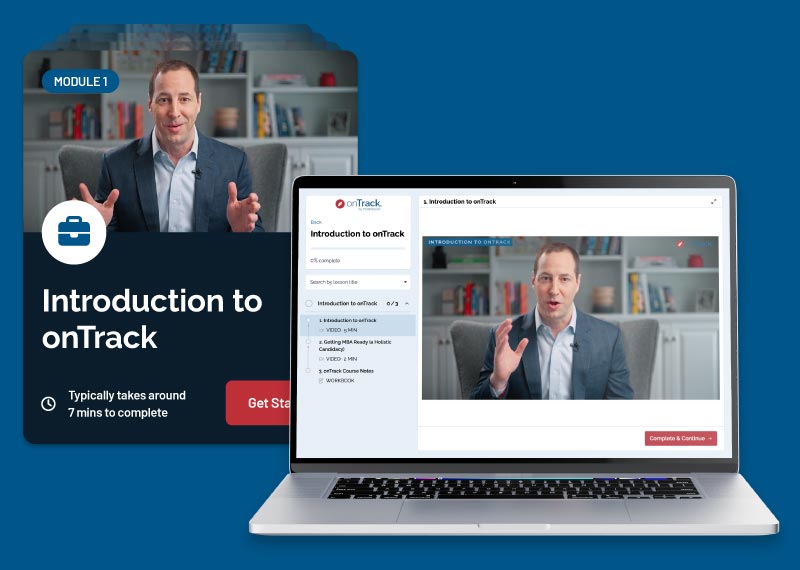
onTrack by mbaMission

A first-of-its-kind, on-demand MBA application experience that delivers a personalized curriculum for you and leverages interactive tools to guide you through the entire MBA application process.


Get Started!

2026–2027 MBA Essay Tips

Click here for the 2025–2026 MBA Essay Tips


MBA Program Updates

Explore onTrack — mbaMission’s newest offering allowing you to learn at your own pace through video. Learn more