Blog

mbaMission’s Exclusive Interview with Dartmouth-Tuck’s Former Director of MBA Admissions Dawna Clarke

Update: Dawna Clarke is no longer the Director of Admissions at Dartmouth Tuck. After briefly serving as mbaMission’s Chief MBA Strategist, Clarke back at the admissions helm for the University of Virginia’s Darden School after almost a decade and a half since her previous tenure there.

We were quite fortunate to have some time to speak with Dawna Clarke, Director of Admissions at Dartmouth-Tuck. Ms. Clarke shares her thoughts on a variety of topics:

  • Tuck’s desire to remain a smaller program, despite economic pressure to grow its class size
  • The unique nature of Hanover, New Hampshire and the importance of interviewing
  • Tuck’s adherance to an open interview policy and how to interview successfully at the school and more…

mbaMission: I’ll start with my usual first question, which is what should Tuck be known for that it’s not known for? What do you think is the hidden gem of the school that people overlook?

Dawna Clarke: I’ll answer this from the perspective of someone who has already done their research and knows what a special place it is in terms of the community and the focus on the two-year MBA program. One is the uniqueness that Tuck focuses exclusively on the two-year, full-time MBA program, and I see that as a huge differentiator for us in terms of the fact that if a student comes to school here, there’s roughly 240 to 250 students in each entering class. The sole focus of the entire community is on the two-year, full-time program, so you’re not sharing resources at all, with faculty who are also teaching in a part-time program or a weekend program or a global program. The fact that Tuck has that unique focus on the two-year, full-time program is extremely distinctive.

I would say in an even more hidden way, when people research Tuck, I think that they know it’s a good, solid MBA program. It’s a great general management program, but it is a rigorous program. I mean, academically it is quite rigorous. It’s a really serious place in terms of academics, and our dean has really worked hard over the years on faculty having dual excellence in both research and teaching, and there are a lot of opportunities in the second year to take what we’re calling these “deep-dive electives” to very specific areas. And also I would say that [something] people don’t affiliate with Tuck is that it’s a great school for finance. We are a general management program, but if you looked at the number of people who come here as students who are interested in finance versus the ratio of recruiters, it’s very strong. So I think we place students in careers in finance equally strong as the finance schools. And that is something that is not as well known as I would like it to be.

mbaMission: We know that these days, some schools’ endowments are shrinking, and because of that, the schools are increasing their class sizes or adding programs. Is Tuck facing any of these kinds of pressures? Is the school considering adding a part-time program or an executive program?

DC: It is something that we are definitely seeing in the industry, that many schools are expanding or offering spin-off programs and things. I will say that I’m sure that the Tuck administration feels the pressure, but there are no plans currently to expand the Tuck School or to offer part-time programs. When I came here in 2005, they were wrapping up a study looking at the feasibility of the advantages and disadvantages of offering a part-time program, but in a different location.

We’re in New Hampshire; 80% of New Hampshire is wooded. It’s a beautiful, beautiful place, but it’s not logistically the best location for a part-time program. I think it’s a fabulous location if you want to relocate here and stay for a few years, but the school did undergo a process of evaluating the advantages and disadvantages of offering some kind of part-time or executive program and decided against it. So, I think the school has done a great job in terms of asking us to look at our budgets really, really carefully and scale back in a way that would enable them to not lay off people and not have to expand the class by 30% or something like that. Our class size should be about the same as last year, which was 252.

mbaMission: So no plans to expand the class size?

DC: No.

mbaMission: You mentioned that Tuck might be considered a little more remote or relatively remote. Do you place any particular emphasis on the class visit for that reason? Does it indicate to you that people are more serious about Tuck when they make the trip?

DC: I think the fact that we are remote plays into our admissions policies a little bit in that we’re fairly unique in that we remain committed to the open interview policy so that any student who wants to interview has the opportunity to interview on a space-available basis. You know, if 50 people wanted to come on Friday, September 13, or something, then we might not have space to accommodate them, but we do have an open interview policy, and part of why we are committed to that is because of our location. It’s not as easy to get here as it is to get to other major metropolitan areas. So if a student is interested in making the effort to come, then we by no means want to discourage that.

And also you just asked if there were any myths I would want to dispel about Tuck, and one of things that was such a pleasant surprise to me—and I think is a pleasant surprise to many of those who come here—is that you think of Tuck as being very remote, which it is, but I have been so pleasantly surprised, and I think students are surprised, by how much there is to do in the area. And I think in general, the Upper Valley is pretty outdoorsy, and here we have our own ski way, we have our own canoe and kayak club, you can rent snowshoes, you can take snowshoe lessons, skiing lessons. Embracing the outdoors is very accessible, even if you’re not an outdoorsy person, because there is so much going on on campus to help embrace that lifestyle.

It’s a lot of fun, but it’s also pretty sophisticated. I think we have the advantage of being part of the greater Dartmouth community, and Dartmouth being an Ivy League school draws a lot in terms of the guest speakers who are coming, the actors and the actresses, and we have the Hopkins Center for the Arts, which brings in a lot of jazz musicians, performing artists and visual artists. One of my favorite things to do in the fall—the Hopkins Center of the Arts sponsors a festival called the Telluride Festival, and there is actually a festival in Colorado every year called the Telluride, and the person who used to run that film festival runs the Film Society now at Dartmouth. And he goes to Telluride and picks what he thinks are the six best films at the Telluride Film Festival, and they are shown here at Dartmouth before they are shown to the general public.

So for example, we got to see Capote here well before it was released to the general public and Into the Wild.  It’s a huge film festival here in New Hampshire. So I think that the fact that we’re remote, it’s really just a beautiful area in terms of embracing the outdoors, but it’s also surprisingly sophisticated in terms of people who come to us. I’m more socially active, or active in things like that here than in places that were significantly bigger. A lot people live within walking distance of the campus; everything is reasonable. So that is definitely a myth that I would want to dispel. I think it’s just kind of a neat place to spend two years.

mbaMission: And a fairly large percentage of students live on campus, correct?

DC: Yes. It’s a residential campus, and within the past year we finished one of buildings, called the Living and Learning Center.  I had a tour of it when it opened and I thought, “I want to live here.” [Laughs] It’s just gorgeous, and it has a yoga studio and kitchens, and all of the buildings are connected, so you can get from building to building underground through tunnels, which is very practical in the wintertime. But I think that’s one of the reasons there’s so much bonding at Tuck—it is a residential campus. It’s residential for single students, and a huge percentage of the single students live on campus, and then there is married student housing where a lot of the married students live, and then many of the second years rent houses in the area.

But what I was most struck by when I first came here was the school spirit. As you know, [school spirit] is very high at UVA and Dartmouth. I think Dartmouth and UVA have such an incredibly high level of school spirit, and I think one of the reasons it is particularly intense here is because it is residential, so the students are studying together and living together and playing together, you know, working together, and I think that contributes a lot to the bonding that goes on at an even higher level.

mbaMission: You said that a certain kind of individual can fit in that kind of environment. Is there anything you do to screen for that characteristic?

DC: I think that it’s really important for individuals who go to business school and who are going to be potential business leaders to be adaptable in general. I mean, the world, as you know, is so much more global, that we added into the admissions’ criteria a new criterion last year called Global Mindset. So we’re asking people, have you studied a foreign language or worked abroad or traveled abroad? Or to what extent have you worked with other cultures? Because I think one of the things we’re finding is that recruiters are looking more and more for that sense of adaptability and the ability to get out of your comfort zone and to try something new and embrace the global world and to have some global skills. So I think we look at it in general, but not necessarily how they would adapt, because I think it’s a very easy place to adapt to because it’s so community oriented, and I think even people who are city slickers really come to appreciate the fresh air.

And like I said, Dartmouth does a really great job of making the outdoors accessible to someone who isn’t even outdoorsy. The Outing Club is the biggest outing club in the country. We’re one of only two colleges to own our own ski resort.  We have a Canoe and Kayak Club. The things that go on here are reasonably inexpensive, so if you are just a novice, it’s very accessible to you.

But to get to your point, I think for a variety of reasons we look very carefully at sociability, interpersonal skills, communication skills—not just book smarts, but the ability to articulate your point and get along with people. I mean, Tuck students are known to be very strong in terms of team skills. One of the things that people told me a lot when I came here, and I have found this to be the case, is that Tuck students and alumni are really well known for humility. It’s just a really nice aspect of the culture here.  I mean, Dartmouth and Tuck, that’s really part of their brand image. There is a certain amount of humility that is conveyed when you interact with colleagues, subordinates and things. We do look at it in the admissions process, but it’s more because we feel like interpersonal skills and communication skills are so important to have in business and at Tuck.

mbaMission: Can you talk a little bit about why Tuck uses the open interview approach?  And what makes for a successful interview, from your perspective?

DC: We’re extremely proud to say that we are very committed to the open interview policy for a variety of reasons, and one is that we’re proud to showcase our school, and anyone who is interested enough to have done a lot of research on MBA programs who wants to explore Tuck further, we want to be available to them. To come and explore the school, which of course they could do even if we didn’t have an open interview policy, but I think if you’re making that kind of effort to come here and sit in on a class and go on a tour, the least we can do is make ourselves available to interview someone. I think it’s a reflection of what we value in the admissions process, and we don’t value only that someone has been successful academically and on the GMAT and in their career, but we also value a candidate’s interpersonal and communication skills, and I think that those are very, very hard to convey on the basis of an application.

So the interview, I think, allows some candidate who is a solid candidate but maybe not a standout to really push their candidacy over the edge and shine because they presented themselves so well or they were so strong interpersonally or their motivation level [was strong]. Whatever they convey in the interview may help to push them over the edge in terms of how strong they are in our eyes, and I do think that the open interview policy is a direct, and I’m repeating myself, but it’s a direct indication of what we value in the process. And I feel personally that if someone has taken the time to complete our application, which is time consuming, and can be expensive in terms of various application fees and taking the GMAT, I think that people have the right to be heard. And they can be heard by what they tell us on paper through their application, but I think people have an innate desire to be heard in the interview, and it’s a wonderful opportunity to tell us more about yourself and to market yourself to the Admissions Committee.

And I think the third reason is because of our location. We’re not in a major metropolitan area. We realize that it is a little more challenging to get here and a little more time consuming, so we just don’t think that it would be fair for a student to come here to just sit in on a class and come back again when they are invited back for an interview. So part of it is logistics and trying to be respectful of our location and the relative cost and time in getting here.

mbaMission: And what is the interview like? What do you think is a successful interview?

DC: I would say one of the facets that contribute to a successful interview is the research an applicant has done. Once we have gotten to the point of interview, we would really hope that people are pretty familiar with the program and have a good idea generally of why they would want they would want to come to Tuck. I think some of the reason that some interviews are successful is that the candidates are able to do a good job articulating why they think there is a good fit between Tuck and their background. So Tuck is kind of a bridge between what they have accomplished and achieved up to this point and how Tuck can be a bridge to what they want to do in the future. So I think research, thoughtfulness, really giving some analysis to why you want to do this and being able to articulate just the basics of why you’re interested in Tuck and why you are interested in an MBA.

And it may change. I mean, we realize that people change their minds all the time, but research is definitely important, and I think anyone who looks at our Web site and sees the purpose of the interview for us is not to get a sense of how you did in your academic courses or GMAT but to supplement what is in the written application. So I would say there’s not a cookie-cutter Tuck student, but I would say one of the threads that binds people together is the hope that all students who are admitted have strong leadership potential, interpersonal skills and communication skills. And so I would say going into the interview, realize that’s a great time to showcase your personality. Not everyone has to be full personality. People can have strong interpersonal skills in different ways. You know just recognizing that it is an opportunity to showcase some of the skills in person that you showcase on paper.

A successful interview, I find one of the common threads, is when people don’t just make broad sweeping statements, but they have some really good, tangible examples of things that they’ve done. So if they say they have strong leadership potential, then they tell a story to illustrate that, or if they identify themselves as being a strong team player, then they would tell us a story, an anecdote or a vignette that illustrates that they are a team player. It’s very hard if you interview a lot of people, you’re not going to remember that so-and-so said that they were a strong team player, but I very well might remember a very compelling story that somebody told me. So I would tell people to really identify what are the three things that you’re most proud of that you think are relevant to business school, and how am I going to convey those in the interview, and what kind of specific examples do I have to tell that would be memorable and compelling?

mbaMission: And what is the actual structure of the interview?

DC: Ours are, intentionally, fairly informal. We have interviews that are conducted by our staff as well as alumni and current students, and typically, when someone comes in for an interview, a few minutes are spent just making the person feel at ease. We try to ease people into it. They’re definitely not intended to put someone on a hot seat. We ask questions geared toward why someone would be interested in an MBA. Why Tuck? We definitely ask some questions about why they chose a certain undergraduate school, why they chose a career path, why they chose their path.

We often ask an open-ended question, like, is there anything else that we haven’t asked you about that you would like to articulate. I think that’s an important question that I hope all of our interviewers are implementing, and sometimes people have something that they really want to tell us that our questions don’t elicit. But I think they’re fairly informal. We intentionally want to put someone at ease. That’s the kind of place we are, and we want the interviewee to feel comfortable, so that we can kind of see their true personality. I would say that there are certain themes that we focus on in an inviting, welcoming fashion.

mbaMission: You mentioned that a lot of applicants, once they’ve been accepted, may later change their goals and that business school is a time to explore. If so, why ask candidates for a goal statement?

DC: Well, people are embarking on a big investment on their behalf, and we want to make sure that we can deliver what it is that they say at that time that they are intending to pursue. I think that at just a basic level it shows someone has good decision-making skills. They see the value of an MBA in a general way. They might see the value of a general management degree, and they might see the value in a Tuck degree, but they have been thoughtful that they have embraced the process. I think the more thought and more commitment someone has shown to the process, the more they are engaged in the experience as a student, whether you are in the classroom or preparing for an interview.

I had a interviewer tell me one time that if he were interviewing Tuck students, the biggest thing that he would focus on would be how much research they’ve done, because that can differentiate one student from another. And he feels like there would be a correlation between how someone has prepared for their business school interview and the extent to which they are really going to knock the socks off a recruiter at the end of the process. That it shows that you’re proactive. It shows maturity. It shows insight. I think that how committed somebody is about doing their research is a reflection of how serious somebody is about how they are going to handle other elements of the MBA experience, of how prepared you are going to be when you go to class and how prepared you are going to be when you have an interview or are involved as a leader of a club.

I think that also it is perfectly appropriate to say that one of the beauties of an MBA program is that you’re exposed to so much and so many industries and functional areas that you obviously haven’t been exposed to, and it’s quite common for people to change their minds, and that’s fine, but what are your thoughts at this time? I also think that it’s really impressive to me when applicants go beyond reading the viewbook on the Internet. And there are times when applicants say, “Oh, a friend of a friend went to Tuck, and he introduced me to three people, and I called them up,” and uniformly one of the things that they say that really resonates with me is that that was a transformational experience or whatever.

Someone who goes that extra mile, who didn’t just read the Web site, but talked to current students, talked to faculty, talked to alumni—you know, they are going to make a better choice. You want people who really want to be here; I think that’s true of most schools. We’re proud of the institution, we’re proud of our students, but the students that embrace it most are the ones that really want to be here. And setting those goals and knowing why you want to be here and how the school is going to help you helps make a case that this is really going to be somebody that is serious about this experience and embrace it fully.

mbaMission: Is this the toughest market you’ve seen since coming to Tuck? And how are Tuck students doing in this economy?

DC: I definitely think that having done this for several years—and there have been several recessions I’ve gone through as an admissions director—I would definitely say that it’s one of the toughest job markets, but I think that we’re fortunate in our scale. Because the ratio of recruiters that come vis-à-vis the graduating students, the second years, I think works to our advantage. I don’t want to speak for other schools, but I wonder if smaller schools are slightly more sheltered because of their scale. Even if people are scaling back, I think that our scale works to our advantage.

And we’re lucky this year for a change that we made. We have two people heading up career services at Tuck. One is a Tuck graduate and one went to Wharton, and they have been incredibly proactive in terms of reaching out to faculty, sending out résumés for students without jobs for summer internships, and really embracing our board of overseers, the advisory board. They’ve been unbelievably proactive, from literally floating résumés out through the Tuck community, looking for these things, and really connecting people on a personal basis. So we have weathered this fairly well considering that this is a really challenging time for all business schools.

mbaMission: Are you giving more scrutiny to applicants in terms of their employability after graduation? Are more applicant files going to career services this year?

DC: I would say that it’s not a major component of the admissions process, but we do have joint meetings with the career development office to give us guidance on if, for instance, the students says that they want to go into private equity, is it more likely that they will be successful if they have these skills or these backgrounds? So, I don’t know if we’re giving more scrutiny to employability, but we’re working more closely with career services to make sure that we’re well educated on what it takes for someone to make a transition into a specific industry. And there are occasions when we might ask their opinion on how reasonable is it for a student to make a certain transition. We have major admissions criteria that I could go over if you want to, but I would say that there is slightly more emphasis on career goals, employability—is the transition a realistic one?

mbaMission: If you could go through your criteria, that would be great.

DC: Sure. There is a variety of criteria. This is a holistic process, which I’m sure you’ve heard before, and I’m sure a lot of schools are really proud that they have holistic processes as we do here at Tuck. We definitely are going to look at academic credentials, primarily at the student’s undergraduate performance, and not just the GPA, but their performance over time. The GMAT. The TOFEL. We will look at the highest GMAT scores. We’re looking for people who are both team players and have demonstrated leadership skills or leadership potential, so we will look at the extent to which they were involved at the undergraduate level, as well as the extent they have been involved in organizations since graduation. So leadership is huge. Team skills are huge.

We talked about the interview earlier. Interpersonal skills, communication skills are huge. The extent to which you have done research on Tuck. Career progression and accomplishments are something that we look at in the admissions process. Where someone started their career, where they are at the time that they are applying, how have they progressed? What kind of additional responsibilities have they taken on? It’s a very valuable source of information for us. The letter of reference—we require two, and we prefer that they are work related. I think those are incredibly valuable because it’s an objective set of information from an employer’s perspective of the candidate.

A new criterion that we added about two years ago, I said earlier, is the Global Mindset. So none of these are mandatory, but we love to see that people have embraced foreign cultures, studied abroad, traveled abroad, worked abroad. Employers are looking more and more at that. So if I were to give tips to prospective students on what they can do to be successful in the admissions process but also to be successful on the tail end of the process, one thing that we hear from recruiters all the time is that they want students with a global mindset. That’s one of the reasons we added that.

mbaMission: What can you tell us about application volumes recently? How selective is Tuck at this point?

DC: Our applications were flat this year, which is not unusual in a tough economic climate. And I don’t want to speak for other schools, but it seems like that is fairly common. It’s still a very competitive process.  We got close to 2,900 applications. The targeted class size is about 240.

mbaMission: Can you talk about the discrepancy in volume between the first and second rounds?

DC: Sure. We’re a school that has an early action deadline, and that is geared toward people who have identified Tuck as their top choice and know that they would attend Tuck if they were admitted.  And I highly recommend that round if you fall into that category. It’s nice because you get your admissions decision in mid-December.

We have four deadlines. We have early action, we have one in November, one in January and one in April. Early action is October 14, November is November 11, January is January 6, and April is April 2. The most popular deadline is the January deadline. The second most popular deadline is the November deadline. Well, November and early action are pretty even. And then the smallest deadline is typically the April deadline.

A lot of people ask, is there a clear advantage to applying in one deadline over another? They wonder if there is a strategy involved. We look at statistics over the years—how many applications we got, how many we admitted and how many we yielded—and we try to even it out so we’re not being too generous in one round at the expense of another round. I would say that we do give slight preference to candidates who apply in early action. I think the selectivity is slightly more liberal in early action and slightly less competitive than the other rounds. Those candidates tend to be good candidates and have done a good job of doing their research and identifying their top school, and I think that indicates that they’re very organized, and the early bird gets the worm. It’s a general reflection of how organized they are, and so their applications tend to be strong, but it is slightly less competitive to get in during early action.

mbaMission: Tell us a little more about early action. Can you explain precisely how it works and what the advantages are?

DC: I think there are a multitude of advantages. One of them is that it’s time consuming to go through the admissions process, to go on all these interviews and study for the GMAT and write all these essays, so if you know that Tuck is your top choice, then you can apply in early action in mid-October and you will be notified in mid-December, and it saves you a lot of time and effort and money. There is that very basic advantage. There’s also more time for you to line up your finances. You have a little more time to go through the process of financial aid. You have a little more time to locate your housing. If you know in December that you’re going to school in late August, then you’re going to have a huge amount of time to prepare for it financially and emotionally and logistically. So those are some of the advantages.

The deposit is $1,000 higher than it is for the regular enrollment deposit. It’s $3,500, whereas the deposit for November, January and April is $2,500. We’re so grateful to have great applicants that have identified Tuck as their first choice. By admitting people earlier than the other three rounds, it helps guide us that these are the people who have committed to Tuck in early decision, and those are spaces that are no longer available in November, January and April. So we want to ensure that the people who do enroll, that they really are serious about identifying Tuck as their top choice. If we were less serious about it, what could happen is that people give the deposit back, and we were less generous than we should have been in a later round. It’s an insurance [policy] for us to make sure that people think seriously about applying early action because it is a nonrefundable deposit.

mbaMission: So what are some of the don’t’s—the absolute don’t’s—the mistakes you see people make when they are applying to Tuck?

DC: There are so many of them that my mind is filling up right now. One is, I mean a lot of people are probably sophisticated enough to know, don’t come [to your interview] looking relatively disheveled. It’s a professional interview, and you want to present yourself professionally, but that is kind of obvious. We have an open interview policy because we’re reaching out to our applicant pool, saying we care about the students. I would say, don’t not take advantage of that. It’s a huge opportunity to stand out. And don’t wait until the last minute. So plan ahead, but don’t not take advantage of the fact that we have an open interview policy, because that is very unique now among our peer group, and it’s such a missed opportunity because some applicants really shine in terms of their interpersonal skills and charisma.

And don’t miss an opportunity to go the extra mile. It doesn’t take a lot of effort to ask around at work, “Hey, do you know anybody who went to Tuck? I would like to talk to a Tuck grad.” and to say in your application that you had conversations with this Tuck grad or these Tuck grads shows initiative. So don’t miss an opportunity. It’s a competitive process to go above and beyond the call of duty a little bit in terms of networking.

mbaMission: Great. Thank you for taking the time to talk with us.

September 14, 2009: FREE Webinar: Choosing the “Right” MBA program – Live Online

I am overwhlemed by information — how can I determine which school has the “right” mba program for me?

Jeremy Shinewald, Founder and President of mbaMission, will help prospective MBAs understand the differences that exist among top MBA programs. Jeremy will elaborate on areas that will profoundly affect your academic and social lives in b-school including flexibility of a program’s curriculum, breadth of core courses, different methods of instruction, varying sizes of the cohorts and more. Start preparing now so you can be sure to make an educated decision when you apply! There will be an open Q&A session after the presentation.Join us for this valuable event that will be essential to your B-School planning!

All attendees will receive:

  • $100 off any 9-session ManhattanGMAT course
  • Free access to a ManhattanGMAT computer adaptive practice exam
  • Free half hour consultation with an mbaMission consultant
  • Free mbaMission Insider’s Guide

Sign up today!

mbaMission’s Exclusive Interview with Yale School of Management’s Admissions Director Bruce DelMonico

mbaMission founder Jeremy Shinewald recently spoke one-on-one with Bruce DelMonico, Director of MBA Admissions at the Yale SOM. Here, we offer some highlights from the interview, followed by a full transcript.

  • Yale will be increasing its class size from about 200 to 220 and will be retunring top four cohorts, from three
  • Mr. Delmonico discusses common application errors and how he reads an application
  • Mr. DelMonico discusses the new dean and her role at the SOM, past and future

mbaMission: Thank you for taking the time today to talk with me about admissions at Yale and about the school. My first question for admissions directors is always, what should your program be known for that it’s not currently known for?

Bruce DelMonico: Good question. And as I think about that question, I think of a number of different functional areas. We’re a very strong marketing school, for example, but we’re not as well known in that area,  perhaps. We have a really good health care group, and actually, health care at Yale generally is really strong, which is something that a lot of people maybe don’t realize. Although between the med school and us and nursing and public health,  the University is getting better known for health care. And environmental management is well known, but maybe not as fully recognized as it should be.

So all those different functional areas, I think, would be areas that maybe Yale is not as well known for as it should be. But I think in general—and I think this is part of the curriculum reform that took place a couple years ago—the thing that people are starting to recognize us for but maybe not as much as perhaps they should is as a really strong general management school. And I think that’s what we feel we are and what we’re certainly trying to be, which is, regardless of what field or industry or sector someone wants to go into, that they get a really strong general management grounding here at SOM [School of Management].

mbaMission: Are there any stereotypes about the school that you would like to dispel?

BD: Probably due to the school’s founding mission of educating leaders for business and society, and its traditional strength in nonprofit and public management, people think of us as the nonprofit school. And I think at some level, there is some truth to that. We’re very strong in nonprofit and public management, and we have a lot of fantastic students who come here from these sectors and who go into those sectors. So I don’t want to minimize the fact that that is a strength of ours, but I think that people think of it as a limiter — that we’re the nonprofit school but nothing else — and they don’t recognize our strength in finance and the other areas that I’ve been mentioning: health care and environmental management and marketing and operations and a whole range of other areas. So I think that’s one stereotype.

And actually, more recently, I think a secondary stereotype is that [of Yale] as a finance school. And again, I think it’s true that we’re very strong in finance, and in behavioral finance in particular. We’re one of the top schools in that regard. People know [Arthur M. Okun Professor of Economics] Bob Shiller and more recently [Theodore Nierenberg Professor of Corporate Governance and Professor of Finance] Andrew Metrick and [Frederick Frank Class of 1954 Professor of Management and Finance] Gary Gorton as top finance faculty members. But again, I think that’s one piece of the larger puzzle of what SOM is about. And so I think calling the school the nonprofit school or a finance school is not incorrect in that we are strong in those areas, but that also sort of limits the other things that the school is about.

mbaMission: Was strengthening the finance/economics department with a variety of new academic hires a conscious decision on the part of the school or did the opportunity just arise?

BD: Well, I have to preface this by saying I’m obviously not in the faculty-hiring area, so I don’t know the inner workings of how a lot of those decisions are made. I know about the hires as they’re brought on, but I’m not sitting in on the faculty meetings as those things are being discussed. So that’s one huge caveat. My sense, though, is that there is a little bit of both, in terms of strategically trying to grow certain areas but also seizing opportunities as they exist.

Andrew Metrick and Gary Gorton were great hires, and I think they complement our existing strength well. And my sense—again, this is sort of an uninformed opinion, so I have to couch it as that—is that there’s also some bit of serendipity to it or that they happened to be the right people at the right time, and that brought them here. So certainly I don’t think that the school to going to hire someone just for the sake of hiring them and is going to look at the needs of the school, but I think there is some combination of strategic choices and—I’m trying to think of the correct word—also some degree of resonance between the person we’re trying to bring to the school, and the timing can often be a key issue.

mbaMission: I’ve heard that some schools are possibly increasing the size of their incoming classes. Is Yale planning to do this, and if so, is this an economic decision or perhaps an effort to return to a previous baseline?

BD: That’s a good question; thank you for asking. We actually are, as people may know. When our new integrated core curriculum was introduced three years ago, we dropped the class from four cohorts down to three, and we went from about the 220–240 [student] range down below 200. And we did that to increase the faculty slack so that they could actually implement the new curriculum and have the time to put it in place instead of spending all their time in the classroom. So now that the curriculum is a few years old and is up and running and is working well, we’re actually bringing back the fourth cohort and going back up to around 220 students.

Certainly the school doesn’t mind having the extra income, but I think we found that going from the four cohorts to three and going under 200, there were some critical-mass issues that we bumped up against in terms of recruiters, making sure we had enough students to satisfy all the recruiters who come to campus and making sure the people in all the various fields who would be available to the recruiters who want to hire our students. And also, just internally on campus, there are a lot of clubs and activities and making sure there’s, again, a critical mass of students here to take on all those leadership roles and to do all the things that running a school and being a part of a school entail. So I think for a lot of reasons, it made sense, now that the curriculum is three years old and we feel comfortable that it’s running well, to bring the class back up to the previous size of four cohorts and roughly 220 students.

mbaMission: Is the decline in the economy affecting plans for a new SOM building in the near future?

BD: Well, it’s not clear. It might. Let me explain, because the university has said that projects, because of the economy, need to be fully funded before they can go forward with construction. And we’re not at the construction stage yet, and we have funding to do what we’re doing now, which is the construction documents and the planning stage. So that’s the stage we’re in now, and my understanding is that will last roughly the next nine months. If the building becomes fully funded within those nine months, we’ll just plow ahead literally and figuratively with the new building and just go on the existing course, and there won’t be any delay. If that doesn’t happen, then there will likely be some delays, and the amount of the delay will depend on some other funding and other timing issues.

mbaMission: As of now, what is the target date for opening the new facility?

BD: The target date, I believe, is fall of 2012. I think that the university has an incentive to hopefully get us into our new building, because I think that they have plans for our existing building. The university itself is growing and moving, so I think, hopefully, that will move things along at a good pace, but again, I’m not part of these higher-level conversations, so I don’t know all the intricacies of the discussions and the various pressure points.

mbaMission: How are Yale students doing in the job market?

BD: The job market actually has been surprisingly firm here at SOM. The career development office keeps us updated on how things are looking in terms of offers and acceptances. We’re really not that much off from last year and previous years. We’re off by maybe low digits, maybe 1% in terms of internships and a little bit more—but I think less than 5%—in terms of full-time offers and acceptances. So at least so far, knock on wood, we’ve seemed to have weathered things pretty well and are holding pretty firm in terms of the job market.

mbaMission: Great. I think applicants are very concerned about what’s happened in the recent past. I’m curious about what you would say to a candidate who is considering applying to SOM and doesn’t have a job right now.

BD: There are definitely no easy answers. And [it’s] definitely a tough situation. I think, in previous years, it might have raised a big red flag to see someone who’s not working. It’s not to say it wouldn’t raise somewhat of a flag now, but we understand that a lot of these situations are outside of people’s immediate control, and so we’re being more flexible, and we’re trying to dig in to get a closer look at why someone’s unemployed. And more importantly, what they’re doing now.

So I think for someone who hasn’t been working for a few months and maybe who is probably one of the earlier waves, I think the key from our perspective is what are you doing with that time? And we would like to see people who are trying to be active and trying to be involved and still looking. And even if you’re not working in or doing that exact same thing you were doing before, are you able to find something? Or are you volunteering? So I think the question has become not just “So what are you doing now?” but “What are you doing about what your situation is?” and “Are you trying to stay active?”

mbaMission: Has there been any faculty or academic response on campus to the economic crisis?

BD: Yes. I think we were one of the early, or maybe the first school to jump on this. And it was actually [Senior Associate Dean for Executive Programs and Lester Crown Professor in the Practice of Management] Jeff Sonnenfeld, who teaches leadership here, who last fall put together a roundtable that brought together a lot of CEOs and leaders—Stephen Schwartzman from Blackstone and some others who got together to talk about the financial crisis—and it was cosponsored by, I believe, the Wall Street Journal.

So we started very early in the fall trying to talk about the financial crisis and think about what it meant and where do we go from here. We actually have on our Web site what we call our financial crisis page [http://mba.yale.edu/news_events/financial_crisis.shtml], where it talks about the ways in which the SOM faculty are addressing and responding to the crisis and some of our thought pieces and articles and Op-Eds and those types of things. But we’re also, even in terms of the curriculum, I think the faculty very much sees this as a teaching moment to understand how the economy got to where it is and what types of things we can do to pull out of the current situation. So I think in the fall semester, even into the spring as well, there was a lot of revising of curricula and actually revising of syllabi to incorporate a lot of the current events, a lot of what was happening now, and bring those into the classroom to make them really teaching moments.

mbaMission: I wonder if you can shed any light on the school’s transition to a new dean and whether Dean Sharon Oster has a new direction or mandate in mind for the school.

BD: Yes, that was definitely an unexpected change for a lot of people here. The good thing is that it has actually been a surprisingly smooth transition. And I think a lot of that is due to the fact that Dean Oster has been at SOM for a long time. And also, she was one of the driving forces behind the curriculum change. And so she was really instrumental in bringing the school to where it was when she took over as dean. So I think it was very easy for her to continue that momentum. And I think initially people were wondering what would happen with Dean [Joel M.] Podolny’s departure, but I think the school has continued moving forward without really missing a beat, and I think a lot of that is to the credit of Dean Oster. She really brought the school together. She knows how we got to where we are, what we’re doing. And she’s been able to carry the school forward.

In talking to her and hearing her speak, She doesn’t have any big changes that she’d like to see, because, as I said, she was instrumental in bringing about the changes that have already happened, but also, I think she’s very much an execution person. I think this is a perfect stage for her to be dean because we’re very much about perfecting the curriculum and perfecting what we’re doing now. This isn’t to say she doesn’t have great ideas and isn’t always thinking about other things we can do, what other programs or initiatives we might want to implement, but I think she’s very good at, also, operationalizing the ideas and executing on them. And I think that’s made her really a great person to be dean at this current time in the school’s history.

mbaMission: A few questions on the application process. Can you take us through the life cycle of an application at Yale? What happens from the reception of an application through the point when decisions are made?

BD: Once someone submits an application, we make sure that it’s complete, because sometimes, some supplementary materials, if they’re not submitted with the application—such as recommendations or sometimes transcripts or other things—come separately, so we wait to make sure the application is complete. Then it’s sent out for two independent reads by different members of the Admissions Committee. By “independent” I mean that neither one of them knows what the other thought of the application. They evaluate them separately.

During that process, either in the first read or the second read, an applicant can be invited for an interview. And if that doesn’t happen during those initial reads, then the applicant will come to committee and can either have a substantive decision or possibly a decision to interview at that time. And then, when someone is invited to interview, the review process is put on hold while they’re interviewed, and then when the interview is complete, the interview report is added to their application and the review process continues. So if they only had one read, then they get the second read and come to committee. If they’ve already been to committee, they come back to committee for a decision with the interview report, and then we, obviously, make a decision then as a group and then notify the applicant.

Our model—different schools do it differently—is a consensus decision-making model, so we sit together as an Admissions Committee, and we all need to agree on an outcome for an applicant. It’s very deliberative. It’s probably somewhat more labor intensive than some other models, but we feel as though it helps make sure that we’re making good decisions and that we’re all calibrated in terms of what we’re looking for and how we’re evaluating candidates.

mbaMission: Can you discuss the interview element of a person’s candidacy—the weight of the interview, how it’s conducted, etc.?

BD: Sure. Interviews last for 30 minutes. People are invited here on campus, in New Haven, to interview. Although, on occasion, if space allows, or if an individual isn’t able to make it here to campus, we do have some off-site interviews that we do. They’re conducted primarily by either trained, second-year students or by Admissions Committee members. And it’s really, I would say, a fairly standard behavioral interview. The purpose is not to trick you or throw curveballs, but really get a sense of the applicant, get a sense of their background, their interests, why they want to get an MBA, what they want to do with their degree. And really get a better sense of their motivations, how they’ve made their transitions, how they got where they are and where they want to go. We will dig into their experiences and try and get a better sense of what they’ve done and how they’ve done it, but we don’t try to make it adversarial or a grilling session. It tends to be a pretty straightforward behavioral interview.

mbaMission: Right. When you read an application, where do you start and how do you evaluate a candidate?

BD: That’s a good question. It’s an interesting question, too, because at times, certainly where you start an application can influence how you view the rest of the application. So if you start with the GMAT score, that might color the rest of application, as opposed to if you start with the undergraduate record or the essays or the recommendations. In general, everyone is somewhat different in terms of how they go through the application. I personally, I tend to start with the undergraduate academic record. I’ll go through, look at the GMAT score and jump into the essays and read through those and then the recommendations. And then we usually, interestingly—you know, everyone will do it differently—look at the interview last, because usually that’s the thing that’s happened most recently.

As we’re reading, we’re building a profile. It all combines together, builds on itself. I think we’ve gotten good about—as I said earlier, what you look at first sort of colors how you look at an application—I think we’ve gotten good about being aware of that and really withholding judgment until we’ve see the whole application and we’ve seen all the data points and we’re able to put it all together and really take a holistic view of the application, which is what we’re trying to do. That’s a little bit how I would work my way through an application.

mbaMission: Can you talk a little bit about some of the common errors you see in applications?

BD: There are some common pitfalls people fall into, and some of them are not that tricky to avoid. One thing, speaking at not too abstract a level or too general a level, but in terms of essays, a lot of times, we get people who don’t answer the essay questions, and they go on and on about things that aren’t really relevant to what we want them to talk about. They have this idea of what they want to talk about or what they think we want them to talk about, and they’re going to make it fit whatever question they’re answering. It certainly detracts from an application and certainly makes it more difficult for us as we’re doing our evaluations.

I think maybe a subset of that is, we ask applicants to tell us what they want to do after they get their MBA, and a lot of times we get applicants who want to do something different than what they’re doing now, and that’s perfectly understandable. A lot of people use an MBA to make a career shift. But one thing, one red flag that will often raise, is if we see someone who wants to make a career shift to an area that they don’t really have any experience in or any exposure to. If you’re making a career shift, you’re necessarily not in that area now, so we don’t expect that someone will have work experience in a certain area—but they should at least have some exposure, whether it’s an activity or some volunteer work, to that area so that they can have some sense of what they’re getting into and have a bit of an idea to get from where they are now to where they want to go. So those are two common pitfalls or common areas that applicants often will have difficulties with.

mbaMission: Is there anything in particular that you would advise applicants to do or think about?

BD: Well, one thing—again, this is on more of a general level—one thing I frequently tell people when asked is, we’re good at reading applications and we know that everybody has weaknesses. Very few candidates are strong across the board in every respect, and I think there’s a tendency for applicants to run away from the weaknesses to try to avoid them and hide from them, which is a natural tendency. But actually, what I find so very refreshing, and actually can be a net positive, is for applicants to actually address their weaknesses. Not dwell on them. You don’t want to lead with the weakness necessarily, but try to explain it and contextualize it, and I think applicants who do that in a good way and can do that successfully—actually, they stand out in a number of regards. It shows self-awareness, it shows interest in self-improvement, and it really can put someone in a much better position in terms of their application.

One of the things I tell people is a lot of the time, if we see a weakness, if we see a gap—for example, you don’t have a recommendation from your current supervisor even though we ask for one—and you don’t explain that, we’ll likely draw a negative interpretation based on that. But if you explain it for us and contextualize it and make us understand why that’s the case, we’ll be much more forgiving.

mbaMission: Great. Can you tell me about any trends you’ve seen in application volumes at Yale in the past few years? Also, how do the various application rounds differ in terms of volume and competitiveness?

BD: Sure. In the last five or so years, going back to 2004, the application numbers generally here at SOM have increased by about 50%. So it’s definitely been a steady uptick in volume, a steady progression. This last year was kind of interesting. It started off strong. I think a lot of schools saw a strong first round, and then it tapered off. So as the effects of the economy hit, I think, interestingly, the number of applicants actually subsided a little bit. So I think schools ultimate volume was less than it seemed maybe in the first round, and I think, for us, we definitely saw a leveling off. So we still had a good year, but it wasn’t quite the year that some people might have been expecting or predicting going into the fall.

Within each round, for the last few years, it’s been pretty steady. The second round is our biggest round. The first round tends to be half the size of the second round. The third round tends to be half the size of the first round, give or take. But those are the general numbers. And people ask, generally, is it better to apply in the first round or the second round or third round? We definitely advise people to avoid the third round if possible, because space can become an issue by the time the third round rolls around. But we do view the first two rounds as roughly equivalent. If you’re going to apply in the first round, we feel it sends a signal to us. And it certainly can be helpful to the applicant, because they’ll obviously get a decision sooner and will know their status sooner.

But we do tell people, you should apply when you have the strongest application ready, and if it’s not by the first round, then the second’s fine. And we do try to calibrate ourselves to the pools so that the same quality applicant will stand a chance of being admitted in the first round as in the second round. So there’s not necessarily any strategic advantage or strong strategic advantage in applying in one round versus the other. It’s really when you’re able to submit your best application.

mbaMission: You mentioned that applying in the first round indicates to you that a candidate is serious about the school. Is there any temptation to have an early decision round?

BD: “Early decision” meaning that you have to be bound by the decision if you get in, you have to go?  I know that some schools do have early decision and other schools don’t, and I don’t have a full sense of whether that’s becoming more of a common thing in the last few years. But I feel like more schools have adopted that. We take it as somewhat of a signal that if you apply in the first round, that you’re likely to be a little more interested, but we don’t bind our applicants to commit to the school should they be admitted in the first round.

mbaMission: Can you give us an update on student loans for internationals?

BD: Sure. I know this has been a challenging year for international applicants because a lot has been in flux in terms of the international loan options, and a lot of lenders have been pulling their loan products, and there’s been a bit of scrambling among schools. We’ve actually been in a pretty nice position in the sense that for the last several years, we’ve had a self-funded loan product that the school has put together and have not relied on any outside lenders. And so we kept that in place this year, and that’s the option for international students. We played around with the caps a bit in light of the market, but we wanted to make sure it had favorable terms: no cosigner, you could defer payments while in school, all the typical terms that students would look for. So we’ve been pleased with the response. Our yield among international students remains strong, and I imagine the fact that we had a stable and attractive international loan program in place throughout the year hopefully was somewhat of a help in that regard.

mbaMission: Last question: Is there anything else you want people to know about the SOM that we haven’t already covered?

BD: That’s a type of summing-up question we ask sometimes ask in interviews. That’s tough to answer now that I’m on the other end of it. I think your questions were good and fair and hopefully gave a good sense of the school and where things are. The main takeaway is, I think, that there is a real sense of momentum and excitement at the school with the advent of the new curriculum and carrying that forward.

mbaMission: Thank you. You’ve been very generous with your time.

BD: Thanks so much.

NYU to Accept the GRE

The MBA admissions world is not just competitive from the candidate perspective but also from the schools’ perspectives. What do you do if some your competitors – MIT, HBS and Stanford – start to tap another pool of students by accepting the GRE? You follow suit, of course. NYU is now accepting the GRE and we should expect that other schools will be following this trend. We will keep you posted as others sign on…


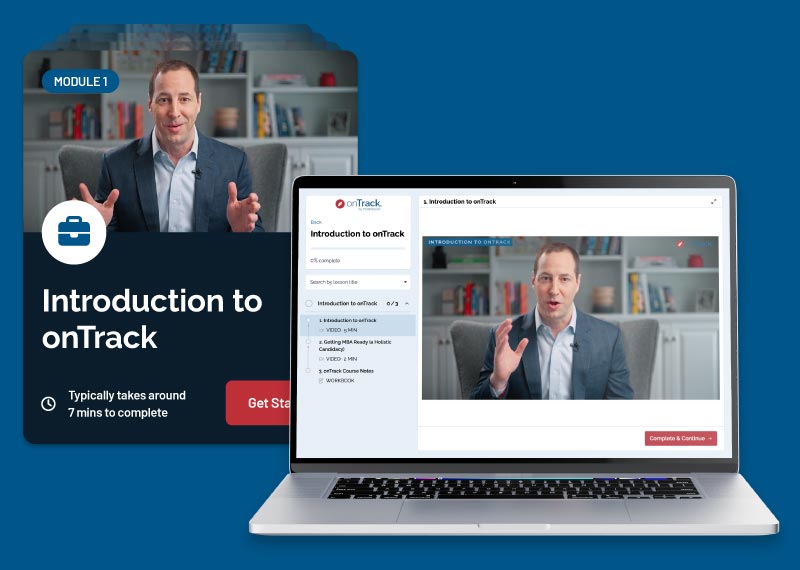
onTrack by mbaMission

A first-of-its-kind, on-demand MBA application experience that delivers a personalized curriculum for you and leverages interactive tools to guide you through the entire MBA application process.

Get Started!

2026–2027 MBA Essay Tips

Click here for the 2025–2026 MBA Essay Tips


MBA Program Updates

Explore onTrack — mbaMission’s newest offering allowing you to learn at your own pace through video. Learn more