

Blog

Managing the MBA Interview: What If I Am Stumped?

With the release of first-round interview invitations and the subsequent increase in pressure on MBA candidates, we present a five-part series with our friends at Vault to help applicants decompress and thoughtfully manage the MBA interview process. In this third entry in the series, mbaMission founder Jeremy Shinewald explains what you should do if you find yourself “stumped” by a question your interviewer asks.

In our first entry in this series, we were very clear that admissions interviewers are not seeking to stump you.  Still, regardless of the interviewer’s approach, many business school applicants still worry that, during their interview, they may be asked a single challenging question which leaves them awkwardly silent and that such a moment will be the symbolic end to their candidacy at the target school.

Although such an experience would certainly be uncomfortable—and we suggest, of course, that you definitely do your best to prepare for your interview so as to avoid this kind of predicament—sometimes even well-prepared candidates can be “stumped,” and we can assure you that an awkward pause in an interview will not cancel out all the positive elements of your application. Still, being ready for such a situation, should one occur, is important, so we offer the following tips on how to mitigate an awkward moment:

  • Resist the urge to launch into a story. Your instinct may be to just start speaking, hoping that you will find the right story as you progress. This is a high-risk strategy because, if it goes wrong, it can compound the problem. Instead, you might consider a pensive pause and take a moment to search for the story internally. You might even say, “That is a good question. I am going to have to think about it for a moment,” before answering.
  • Take a sip of water. Many interviewers will offer you a glass of water at the beginning. Take the water and use it throughout the interview as a buffer to buy time or allow yourself to slow down. If you get stumped, the water can offer a brief opportunity to pause naturally, alleviating any awkwardness before you begin.
  • Maintain your poise. If you absolutely cannot answer a question, you should not get overly apologetic or grovel. Simply acknowledge that you are having trouble with the question and politely ask if you might come back to it at the end. This is not a best-case scenario, but it is certainly far better than rambling and apologizing. A confident approach during a tricky moment may even impress!
  • Forget about it. If you cannot answer a question, accept it and move on. If you spend the rest of the interview thinking about that moment, you will be distracted and struggle with any subsequent questions.

MBA Admissions Myths Destroyed: The Admissions Committee’s Glass Is 99% Empty!

“I was the first in my class to be promoted at McKinsey. I have a 710 GMAT score and completed Level 1 of the CFA exam, but I had a B- in calculus during my freshman year. Will that grade ruin my chances for admission?”

“My company has been under a hiring and promotion freeze for the past three years, but during that time, I have earned pay increases and survived successive rounds of layoffs. Will the admissions committee accept someone who has not been promoted?”

“I have been promoted, but my company changed names. Will the admissions committee think I am going somewhere at a sketchy company?”

Although these questions may seem somewhat silly—the individuals’ strengths are obvious and their “weaknesses” comparatively innocuous—we get asked about scenarios like these every day. In short, we can assure you that your candidacy, even at vaunted schools like HBS and Stanford, is not rendered tenuous by such trivial “shortcomings.” The admissions officers do not consider you guilty until proven innocent, and they are not looking for little reasons to exclude you from contention.

Many candidates have mythologized the “perfect” applicant and fear that any small area of concern means that they do not measure up to this myth—and thus that their candidacy is insufficient. Rather than fixating on small details that in truth are inconsequential, you should think about the big picture with respect to your overall competitiveness.

You can take us at our word on this. Or, if you prefer, heed the words of J.J. Cutler, deputy vice dean of MBA admissions, financial aid, and career management at the University of Pennsylvania’s Wharton School, who explained to mbaMission that “everyone has something, or more than one thing, in their application that they need to overcome,” but added, “We read with an eye toward wanting to find all the good things about an applicant. We look for their strengths. We look for things that make them stand out, that make them unique. We look for their accomplishments. We look for positive parts of the application.”

Friday Factoid: A Unique Read at MIT-Sloan

How does MIT-Sloan review applications? True to the rigorous analytic nature of its curriculum—in a rigorous analytic fashion! When the admissions office receives an application, the candidate’s information is loaded into a database and the application is printed. Rod Garcia, who has been admissions director for MIT-Sloan for the past decade, first reviews every application online, then distributes applications randomly among readers, all of whom are either internal admissions staff members or contract readers. After picking up a batch of applications, readers review, score and then return them one week later. The scores are entered into the database, where Garcia reviews them to determine which candidates will be interviewed.

After the selected candidates have been interviewed, their applications are scored again, and the committee then decides which ones to admit. Application scoring is based on nine attributes, which Sloan divides into two major groups: demonstrated success (e.g., GPA, GMAT, work accomplishments) and leadership (e.g., high competency in creativity, relationship building, goal setting, influencing). Each attribute group is scored separately, and the two scores are added together. At mbaMission, we always tell candidates that MBA admissions is not a science—yet at MIT Sloan, there is some after all…

For more information on MIT-Sloan or 13 other leading MBA programs, check out the mbaMission Insider’s Guides.

January 6: Choosing the Right B-School (Online)

Which MBA program is right for me? How can I find the best fit? Jeremy Shinewald, founder and president of mbaMission, will help prospective MBAs understand the differences between the top MBA programs. Jeremy will elaborate on areas that will profoundly affect your academic and social lives in business school, including the flexibility of a program’s curriculum, the breadth of core courses, different methods of instruction, varying sizes of the cohorts and more. Start preparing now so you can be sure to make an educated decision when you apply!

A Q&A session will follow the presentation, after which, Jeremy will remain online to respond to your additional inquiries.

Date: Thursday, January 6, 2011
Time: 8:30-10:00 p.m. EST
Location: Online
Price: Free!

To register for this event, please click here.

December 15: MBA Admissions Myths Destroyed (Online)

What have you been told about applying to business school? With the advent of chat rooms and blogs, armchair “experts” often unintentionally propagate MBA admissions myths, which can linger and end up undermining your confidence as an applicant. For example, some MBA candidates are led to believe that schools want a specific “type” of applicant and expect certain minimum GMAT scores and GPAs. Others are led to believe that they need to know alumni from their target schools and/or get a letter of reference from the CEO of their firm to be successful in gaining admission.

Join Jeremy Shinewald, president and founder of mbaMission, as he debunks these and other myths, strives to take the anxiety out of the admissions process and helps you refocus on your applications.

A Q&A session with Jeremy will follow the presentation. Join us for this valuable event that will be essential to your business school planning!

Date: Wednesday, December 15, 2010
Time: 8:30-10:00 p.m. EST
Location: Online
Price: Free!

To register for this event, please click here.


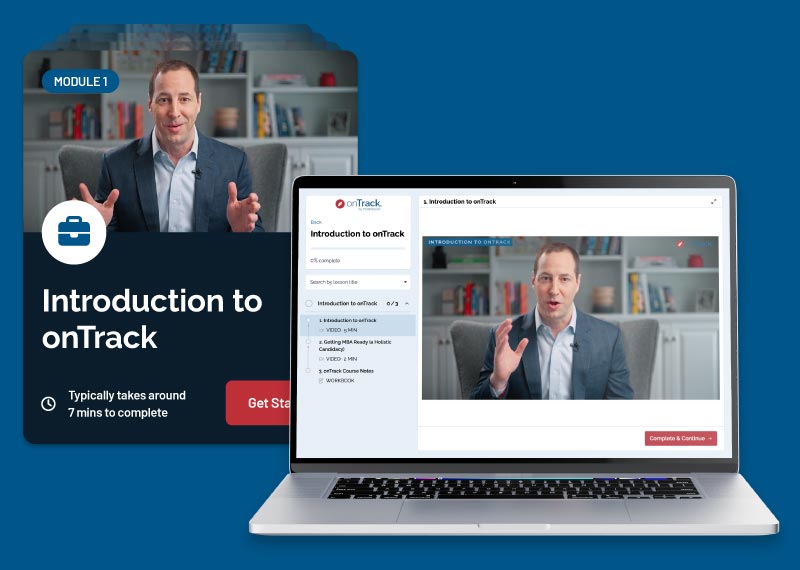
onTrack by mbaMission

A first-of-its-kind, on-demand MBA application experience that delivers a personalized curriculum for you and leverages interactive tools to guide you through the entire MBA application process.

Get Started!

2026–2027 MBA Essay Tips

Click here for the 2025–2026 MBA Essay Tips


MBA Program Updates

Explore onTrack — mbaMission’s newest offering allowing you to learn at your own pace through video. Learn more