Many writers choose to use the passive voice in their essays, yet the best writers rarely, if ever, use this technique.
The passive voice puts the verb in the wrong place in the sentence, thereby removing the “action.” Subjects become acted upon rather than performing actions. Sentences with the passive voice typically include verb phrases like “was” or “has been” (e.g.: “it was determined,” “there has been”).
Consider this example of the passive voice:
“The marathon was run despite my injury.”
In this sentence, the verb (or action) is diminished because the writer says the marathon “was run.” A better way of describing the same activity is to use the active voice, as illustrated in this example:
“I ran the marathon despite my injury.”
Below are two more examples:
Passive:“The contract was awarded to us.”
Active:“We won the contract.”
Passive:“It was decided that I would be in charge of the project.”
Active:“My boss selected me to be in charge of the project.”
Remember—you are at the center of your essays! The best way to tell your stories and explain your accomplishments is by making sure that you are the catalyst of the stories you tell. Using the active voice ensures that the admissions committees see you as an active person who makes things happen.
Harvard Business School (HBS) is well known for using the case method, through which virtually all of the school’s classes are taught. Rather than rest on its laurels with regard to teaching the case method, HBS faculty members work hard to stay at the top of their respective games. In addition to the school’s tradition of faculty-to-faculty mentoring, in 2004, HBS established the C. Roland Christensen Center for Teaching and Learning (named for the late HBS professor) to promote and support teaching excellence and innovation. The center conducts research on pedagogical innovation and teaching effectiveness related to gender and diversity issues, and helps faculty members refine their teaching styles and techniques. The center also offers professors classroom observations and the opportunity to do pre-class planning, receive within-term troubleshooting/post-term reflection and conduct case and course development.
For more information on Harvard Business School or 13 other leading MBA programs, check out the mbaMission Insider’s Guides.
Applying to business school in 2011? 2012? By taking action now, you can dramatically improve your chances of gaining admission to a top MBA program in the coming years. Indeed, it is never too soon (and certainly not too late) to take several crucial steps to shape your candidacy. Join mbaMission senior consultant Angela Guido she leads prospective applicants through a Long-Term Planning Seminar.
Topics of discussion include the following:
* Creating Your Ten-Month (and Beyond) Timeline
* Maximizing the Impact of Community Activities
* Accelerating Personal Goals
* Building an Alternative Transcript
* Taking and Retaking the GMAT
* Making the Most of Campus Visits
* Understanding the Differences Between MBA Programs
* More…
Date: Thursday, January 13, 2011
Time: 6:30-8:00 p.m. EST
Location: 222 West Ontario St, Suite 400 River North Chicago, IL 60610
Price: Free!
Applying to business school in 2011? Perhaps in 2012? By taking action now, you can dramatically improve your chances of gaining admission to a top MBA program in the coming years. Indeed, it is never too soon (and certainly not too late) to take several crucial steps to shape your candidacy. Join mbaMission founder Jeremy Shinewald as he leads prospective applicants through a Long-Term Planning Seminar.
Topics of discussion include the following:
* Creating Your 10-month (and Beyond) Timeline
* Maximizing the Impact of Community Activities
* Accelerating Personal Goals
* Building an Alternative Transcript
* Taking and Retaking the GMAT
* Making the Most of Campus Visits
* Understanding the Differences Between MBA Programs
* More…
Date: Tuesday, January 11, 2011 Time: 8:30-10:00 p.m. EST Location: Online Price: Free!
Mission Admission is a series of MBA admission tips; a new one is posted each Tuesday.
With interview decisions continuing to arrive, we thought now would be a good time to discuss challenging interview situations. Most interviews are straightforward opportunities for an interviewer to learn more about a candidate’s personal/professional background, goals, reasons for selecting a specific school and leadership/team experiences, yet interviews can vary dramatically and sometimes include some peculiarities. So, what constitutes a “tough” interview?
Stoic interviewer: Some interviewers can be unemotional, refusing to give the candidate any indication as to whether he or she is making a positive impression or not. Of course, when a candidate is under intense pressure, this perceived lack of approval can be misunderstood as a sign of disapproval. The key in managing such an interview is to tune out the interviewer’s lack of emotion; focus on thinking of answers and do your best to not be distracted by anything about the interviewer besides the questions he/she is posing. “Reading” the interviewer in real time can be challenging, and candidates should instead concentrate on showcasing their strengths.
Philosophical questions: Most candidates are ready to discuss their experiences and accomplishments, but many are not prepared to discuss their values and philosophy on life. HBS in particular likes to understand candidates’ motivations and will ask questions like “What is your motivation to succeed?” “What drives you?” and “What gives you purpose in life?” The key to answering these sorts of questions is pretty simple: expect and prepare for them in advance (after all, you are being warned right now). You can’t assume that all questions will be experiential.
Persistent questioning: Sometimes a tough interviewer will continuously delve deeper into a subject, such as by repeatedly asking, “Can you be more specific about [the topic under discussion]?” after posing an initial question. These kinds of unusual pressure tactics can be disconcerting, but the key is to simply stay on topic. No matter how persistant, the interviewer is always essentially asking you about a subject that you know quite well—you! So, again, by avoiding the distraction of the tactic and sticking to your agenda, you should be fine.
At mbaMission, we offer more interview advice in our Interview Guide, available in our online store, and through targeted mock interview sessions.
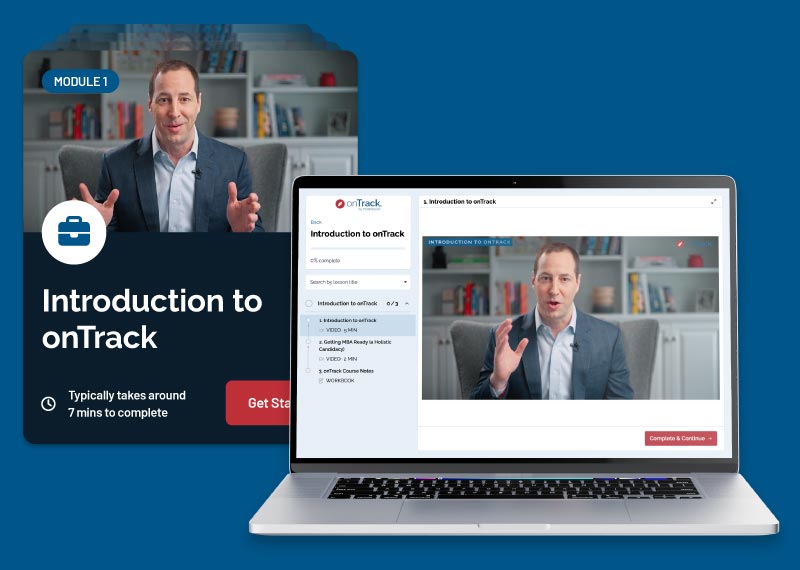
A first-of-its-kind, on-demand MBA application experience that delivers a personalized curriculum for you and leverages interactive tools to guide you through the entire MBA application process.