You look around your office and think to yourself: “I wish my coworker were not applying to the same school as I am. They can’t take two people who sit at the same desk. Also, their GPA is 0.15 higher!” On the surface, this reasoning may seem logical, and it can thus cause anxiety for some candidates—especially for those who are in positions for which an MBA is virtually a “must have” to move forward, such as in consulting and banking.
However—not to worry—this thinking has two significant flaws:
When preparing personal statements that require significant information about career progress, many MBA applicants choose to discuss their accomplishments in chronological order. Although the simplicity of this approach makes it appealing, we encourage you to consider another way of showcasing your more recent and therefore potentially stronger accomplishments first. By taking this approach instead, you may capture your reader’s imagination more quickly and reduce the risk of being lost amid similar candidates.
When admissions officers read your MBA application, they want to feel inspired by your personal statement; they want to know that you have a strong sense of purpose and will work energetically to attain your objectives. Thus, you must ensure that you are not presenting generic or shallow post-MBA goals. Although this problem is not industry specific, it occurs most often with candidates who propose careers in investment banking or consulting but do not have a true understanding of what these positions entail.
Many candidates who approach us are concerned that they cannot get their stories out in one sentence or worried that their personal branding is too muddled. Some candidates feel that they must have a single narrative and continuously speak to it to make an impression on the admissions committees. But, of course, you are not a simple product with just one or two attributes—a Budweiser beer, for example, which can be represented with a straightforward slogan, “The Great American Lager.” MBA candidates are far more complex than consumer products. So, presenting yourself as one-dimensional (“I am an entrepreneur in everything I do,” “I am a finance guy”) is definitely a mistake that prevents you from revealing your depth of character and experience.
We at mbaMission often receive questions about part-time MBA programs, so we thought we should offer a look at some of the pros and cons of this option.
As for the pros, the one that business school candidates cite most frequently is that the part-time MBA involves a limited opportunity cost. Unlike full-time MBA students, part-time ones do not miss out on two years of salary (and, in some cases, retirement savings) and can still earn raises and promotions while completing their studies. Furthermore, firm sponsorship seems to be more prevalent for part-time MBAs, so candidates who have this option can truly come out ahead, with a free education and continued earning throughout. Beyond the financial rationale, many part-time MBA students see an academic advantage; they can learn both in the classroom and at work and can then turn theory into practice (and vice versa) in real time, on an ongoing basis. Of course, a cynic might add that another pro is that part-time MBA programs are generally less selective. So, a candidate who may have had difficulty getting accepted to a traditional two-year program may have a better chance of gaining admission to a well-regarded school in its part-time program instead.
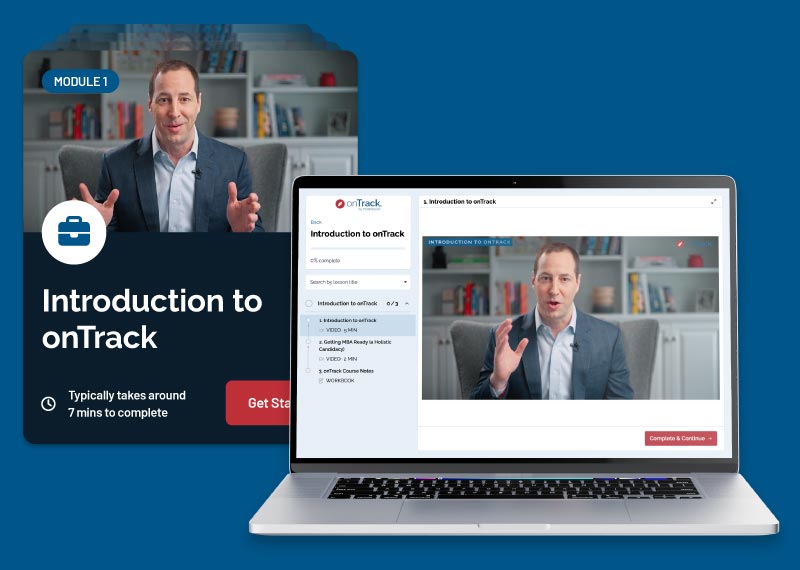
A first-of-its-kind, on-demand MBA application experience that delivers a personalized curriculum for you and leverages interactive tools to guide you through the entire MBA application process.