Harvard Business School’s (HBS’s) 2+2 essay questions are not all that different from HBS’s full-time MBA essay questions, the main difference being a mandatory question about the candidate’s undergraduate academic experience, rather than an opportunity to pose a question of your own. Still, the 2+2 questions have changed significantly from past years, most notably with the addition of a question on setbacks. 2+2ers have gained a reputation on campus—justified or not—for being comparatively immature. So, the admissions committee may just be testing 2+2ers’ resolve by adding this question, ensuring that they have a class of students who are not entitled, but determined.
Many writers tend to confuse adjectives and adverbs (“describing” words) with details. When adjectives and adverbs are used to emphasize an emotion or emotional state, they can add very little to the description of an experience and can even undermine it. However, when that emotion or emotional state is described properly, it can bring a story to life.
Example 1: “With the award in hand, I felt extremely proud of my accomplishment.”
In the case above, the word “extremely” does not help create or enhance the reader’s mental picture, but merely states the obvious. After all, the difference between being “extremely proud” and “proud” is very little, considering that pride is naturally an “extreme” emotion. This just doesn’t effectively convey how the writer actually felt.
Example 2: “Approaching the podium to receive the award, I admittedly felt faint. Even though my hands were shaking, I managed to give our company president a firm handshake when she passed me the award. As I began speaking to a crowd of my colleagues, I finally understood what it meant to be proud of myself.”
In this second example, the details of the story (“felt faint,” “my hands were shaking”) create an image in the reader’s mind. The reader is not relating to the simple adjectives that reinforce existing impressions, but experiencing details that bring color to the story. In the first example, the story does not change if the word “extremely” is removed, but in the second, real emotion is conveyed.
We encourage our candidates to avoid adjectives that reinforce an existing emotion and to write descriptively to capture a spirit.
Which MBA program is right for you? How can you find the best fit? Jeremy Shinewald, founder and president of mbaMission, will help prospective MBAs understand the differences between the top business school programs. Jeremy will elaborate on areas that will profoundly affect your academic and social lives in business school, including the flexibility of a program’s curriculum, the breadth of core courses, different methods of instruction, varying sizes of the cohorts and more. Start preparing now so you can be sure to make an educated decision when you apply!
A Q&A session will follow the presentation, after which Jeremy will remain on-site to respond to any additional inquiries.
Date: Thursday, June 16, 2011 Time: 9:30-11:00 p.m. EST Location: Online Price: Free!
We love the praise of our former clients, but nothing compares to earning the respect of the preeminent name in test prep globally. Kaplan GMAT recently determined that it would refer its GMAT students exclusively to mbaMission for MBA admissions consulting services. In turn, we at mbaMission will share our many in-person seminars and webinars with Kaplan students, provide our Complete Start-to-Finish MBA Admissions Guide to Kaplan GMAT students for free, supply Kaplan GMAT with admissions strategies and tips to use on its Web site and much, much more.
We are proud to partner with Kaplan and will continue to provide its students (our students!) with the excellent services for which we are known.
As part of our quest to gain 1,000 Twitter followers, we are starting a brand new contest, in which you have the chance to win our Complete Start-to-Finish MBA Admissions Guide plus all 14 of our Insider’s Guides, which are in-depth profiles of top U.S. business schools! Here is what you have to do to be entered to win:
Tweet the message “RT @mbaMission: We’re almost at 1,000 followers! RT & you could win our entire library of #MBA admissions guides! http://bit.ly/mKUEFO”
Once we reach 1,000 Twitter followers, we will choose one grand-prize winner at random to receive mbaMission’s entire library of publications. Good luck!
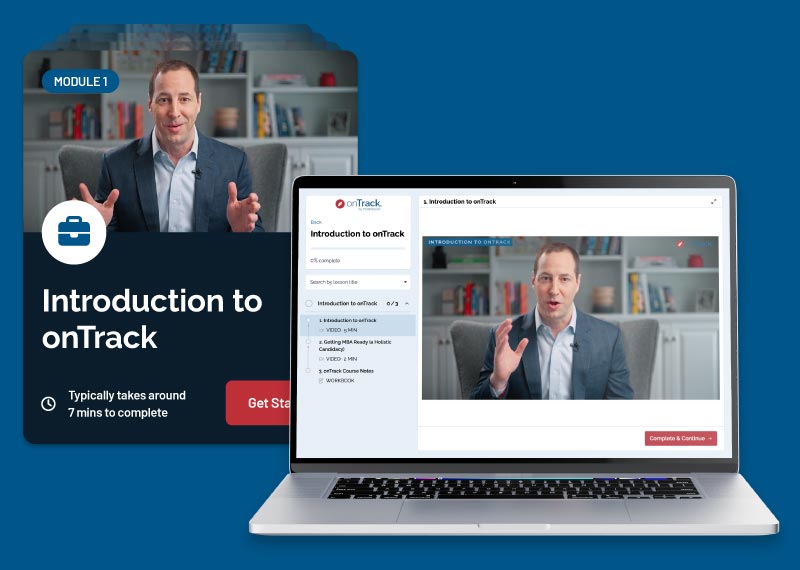
A first-of-its-kind, on-demand MBA application experience that delivers a personalized curriculum for you and leverages interactive tools to guide you through the entire MBA application process.