Blog

Mission Admission: Taking the GMAT Multiple Times

Mission Admission is a series of MBA admission tips; a new one is posted each Tuesday.

When candidates ask us whether they should take the GMAT again, our instinct is always to reply with an important question: “Do you think you can do better?” And if the candidate does indeed believe that he/she can improve, the individual’s next question is inevitably “What do the business schools think of multiple scores?”

Fortunately, MBA programs do not frown on candidates taking the test more than once. Many candidates feel that they have to be “perfect” the first time and that any subsequent test they take—particularly if they receive a lower score—might be damaging. This is not the case. In fact, Dartmouth Tuck anticipates that applicants will take the test more than once, and openly states its willingness to accept and then “fuse” candidates’ highest verbal and quantitative scores, if they occur on separate tests. Meanwhile, other programs have been known to call students and tell them that if they can increase their GMAT scores, they will be offered admission.

From an admissions perspective, accepting a candidate’s highest GMAT scores is in an MBA program’s best interest, because doing so will in turn raise the school’s GMAT average, which is then reported to rankings bodies (Bloomberg BusinessweekU.S. News & World Report, etc.) and could positively influence the school’s position in the rankings. So, do not be afraid to take the test two or even three times. It cannot really hurt you. It can only help you.

GMAT Impact: What To Do—and What Not To Do—on Test Day (Part 2)

When it comes to the GMAT, raw intellectual horsepower helps, but it is not everything. In this weekly blog series, Manhattan GMAT’s Stacey Koprince teaches you how to perform at your best on test day by using some common sense.

Last week, we discussed what to do on test day for the GMAT. As promised, this week we’re going to talk about what not to do.

Don’t:

Burn yourself out.

Don’t overtrain in the few days before the exam. This can include taking a practice test within three days of the real exam, reviewing for more than 30 minutes on the day of the exam and studying for more than two hours on the day before the exam.

Change your routine.

Keep to the same sleep schedule. Don’t take a sleeping pill for the first time the night before. Don’t have three cups of coffee—or zero cups—when you’d normally have one.

Bring GMAT notes into the test center; use electronic devices while on a break.

You’re not allowed to look at notes or practice problems even while on a break; the proctors can cancel your exam if they see you doing this (or even just suspect that you’re doing this). So don’t bring any notes into the test center in the first place! Make sure you don’t touch your cell phone or anything else electronic during the breaks. You may just be checking the score of the game, but the proctors may cancel your exam on the spot.

Dwell on past problems.

Focus on the problem on the screen in front of you; don’t think about problems that have already come and gone. If you find yourself obsessing about a past problem (or anything), tell yourself: “I can think about that all I want, but first I have to finish the problem I’m on right now.” If you’re still thinking about the past problem when you finish the current one, tell yourself the same thing for the new problem on the screen.

Try to figure out your score.

Don’t even think about it! Even the question writers have to test each question on a couple thousand students to figure out how difficult it is—and they wrote the questions in the first place! Also, when was the last time you were stuck in traffic and thought, “Oh, wow, I’m in the fastest moving lane! Yay!”

It doesn’t work that way. You only notice when you’re in the slow lane. The same thing will be true during the test—you’ll only remember the tough stuff, and you’ll think you’re doing poorly. That will hurt your confidence, and then you might actually start doing poorly. Don’t go there.

There you have it: the short list of what to do—and what not to do—on test day. Let us know how it goes!

What I Learned at…Oxford University’s Said Business School, Part 3

In our “What I Learned at…” series, MBAs discuss the tools and skills their business schools provided as they launched their careers.

Paul Watson is the co-founder and COO of Ledbury, a producer of high-quality menswear created in response to a simple problem: the difficulty of finding a great-fitting shirt. In Part 3 of this four-part series, Paul discusses the variety of electives offered at Said, which helped introduce him to areas of business with which he was previously unfamiliar.

The Said Business School at Oxford made available a wide range of elective courses that allowed me to explore a number of different industries and specialties that I found interesting. While at the time I had no idea that I would be starting an apparel company, I wanted to explore some of the more entrepreneurial courses, with an eye toward doing something start-up related later in life.

The offerings for electives were broad and varied, everything from “Advanced Finance” to “Political Risk.” It was a great way to get an introduction to unfamiliar areas of business. In the end, the class I attended on retailing became the genesis of Ledbury. This class was a great introduction to the industry of retailing and set the scene for the current structure of the market. Understanding the market structure was key in the founding of Ledbury and in determining the exact methods we used to create our particular business model.  Because of this, we decided to focus on a direct-to-consumer model, which was made all the more possible by the growing importance of e-commerce in the retailing industry.

A second very valuable elective course during my studies was the “Entrepreneurial Finance” course, which was an opportunity to learn the basics of start-up financing and the different options available for such endeavors. While much of finance and accounting education is devoted to public markets and large corporate projects (e.g., mergers and acquisitions), this “Entrepreneurial Finance” class was key to early-stage financing decisions, such as equity pools for employees, warrants for investors, preferential shares, etc.

These electives and others provided me with valuable exposure to new industries, ideas and methods that have been helpful during the growth of Ledbury. In addition, the breadth of options in the curriculum was augmented by the diverse class that I was part of during my time at Oxford.

University of Michigan (Ross) Essay Analysis, 2012–2013

The Ross School of Business at the University of Michigan has released its essay questions for 2012–2013 and made small but important changes from last year’s application. Our analysis of the school’s essay topics for this application season follows…

 width=1. Introduce yourself to your future Ross classmates in 100 words or less.

How many words is 100? This sentence alone accounts for ten percent of that allowance. Because this essay’s word count is so tight, many candidates will struggle with it. Still, in 100 words, you can write a brief vignette/story that broadly represents you—that stands for who you are. Or, you could offer several short/clever sentences that capture your personality. You might even present a theme or two with supporting anecdotes. In short, you have plenty of room to be creative and to reveal what makes you interesting. (We strongly recommend not offering a historical statement that summarizes your biography/resume.)

By the way, the paragraph above is exactly 100 words.

2. Describe your career goals. How will an MBA from Ross help you to achieve those goals? (300 word maximum)

Because Personal Statements are similar from one application to the next, we have produced the mbaMission Personal Statement Guide, which helps applicants write this style of essay for any school. We offer this guide to candidates free of charge. Please feel free to download your copy today.

For a thorough exploration of Ross’s academic program/merits, defining characteristics, crucial statistics, social life, academic environment and more, please check out the mbaMission Insider’s Guide to the Stephen M. Ross School of Business at the University of Michigan.

3. Describe a time in your career when you were frustrated or disappointed. What advice would you give to a colleague who was dealing with a similar situation?  (500 word maximum)

By specifying “in your career” here, the admissions committee is asking you to share an instance of professional disappointment/frustration. However, that moment need not be the disastrous collapse of a project you were working on (though that could definitely work); you could instead consider discussing a personal disappointment related to your work, such as your inability to foster a collegial community around you. For this essay, you do not need to have been culpable for the frustration or disappointment—note that the school is not asking you to admit to or explain a mistake—but you nevertheless need to be honest, which may require that you explain your responsibility for a frustrating situation.

Regardless of the challenge that you choose to discuss in your essay, showing how you navigated the personalities and circumstances involved is important in optimizing your results. Even if you did not “turn lemons into lemonade,” as the saying goes, your story can still present you in a positive light, revealing your strengths in the areas of diplomacy, persuasion, maturity, ethics, creativity and more. As we have noted in discussing other, similar questions pertaining to frustrations/disappointments, the key to writing an effective essay is revealing a certain thoughtfulness and problem-solving ability as you overcame and did your best to advance. In the last part of the question regarding advice you would give a colleague, be sure to reflect in a sincere manner on how this experience changed your perspective on your own strengths, weaknesses or abilities, and how someone else might benefit from your perspective.

4. What are you most passionate about and why?  How will this passion positively impact Ross? (300 word maximum)

This question is the only major change from last year’s application, with it being a required question instead of one candidates can select as an option.  Further, Ross has added the second question of how this passion will impact Ross. We are guessing that this essay may prove a bit frustrating for some MBA aspirants, because they will have already revealed some passion when they introduced themselves in Essay 1. Still, these two essay questions together offer candidates an open-ended opportunity to differentiate themselves from the rest of the Ross candidate pool. Think carefully about what the admissions committee already knows about you from the other portions of your application package, as well as what unique interest you may have revealed in Essay 1, and be sure to consider a different theme, skill or experience to highlight here.

Once you have determined what it is that you are indeed most passionate about, take some time to reflect on the way in which you manifest that passion. Simply stating that you are enthusiastic about or devoted to something is not sufficient; you must demonstrate evidence of this passion and truly illustrate how it plays a role in your life. Consider the following examples:

Example 1 (Bad): I love cooking and cook frequently for friends and family, often experimenting with new ingredients.

Example 2 (Good): After intensely searching throughout Chinatown for three hours, I finally found fresh Daikon and could not wait to get home to add it to my soup and be able to taste my newest recipe for the first time.

Although cooking may not be the most ideal/serious passion (unless it becomes a metaphor for a broader theme of spontaneity, creativity, etc., or, perhaps, your post-MBA goals involve starting or running a restaurant or other food-related business), our point is that the description of your actions with respect to your passion needs to truly convey and reveal your high level of dedication and interest. The reader cannot finish this essay and simply conclude, “nice hobby,” but must get a sense that you are in a comparatively inordinate pursuit and are thus quite purposeful.

Finally, you should relate this passion to the Ross community.  You can consider how it will enhance students’ classroom experiences, or how it will contribute to the broader campus life.  What is important is that you reveal a detailed understanding of what makes the Ross community unique and how you will play a vital role.

5. Optional question: Is there anything else you think the Admissions Committee should know about you to evaluate your candidacy? (500 word maximum)

However tempted you might be, this is not the place to paste in a strong essay from another school or to offer a few anecdotes that you were unable to use in any of your other essays. Instead, this is your opportunity, if needed, to address any lingering questions that an admissions officer may have about your candidacy, such as a poor grade or overall GPA, a low GMAT score, a gap in your work experience, etc. In our mbaMission Optional Statement Guide (available through our online store), we offer detailed advice on when and how to take advantage of the optional essay to help you mitigate any problem areas in your profile, and include multiple examples of effective optional essays.

Yale School of Management Essay Analysis, 2012–2013

The Yale School of Management (SOM) joins the brigade of MBA programs that are reducing the word count for their application essays this year— likely making things more difficult for candidates who strive to differentiate themselves. Last year, Yale gave candidates 1,600 words with which to impart qualitative information—that number is now just 1,350. This is not a huge difference, but every word counts. To ensure that you make the most of the school’s essay prompts, our analysis follows…

Yale School of ManagementThis year’s application contains four essay questions. The first question has a maximum response length of 150 words; the other three have maximum response lengths of 300 words. Applicants must respond to all four questions. The questions are:

1. What prompted your decision to get an MBA? When did you realize that this was a step you wanted – or needed – to take? (150 words maximum)

Yale makes a fair request here: explain why you want/need this degree. Do not let the 150-word limit intimidate you, though—you can successfully describe the development of that need in a brief essay. But take care not to write something like “I have reached a ceiling, and an MBA is the next step. I need more training in marketing/finance/etc.” This kind of answer is too generic. To be effective, you will need to own your response. Consider launching into a narrative instead—make your essay personal. The school needs to “see” you in action to fully understand you as an individual and for you to stand out.

Although you might want to connect some of Yale’s resources to specific elements of your need for an MBA, this is not mandatory—otherwise, the school would have asked, “Why Yale?” Still, you can tactfully identify some relevant offerings in your response.

(By the way, note that our write-up for Essay 1 is exactly 150 words.)

 2. Describe a difficult professional decision you had to make. What were the consequences, and what, if anything, did you learn? Would you make the same decision again? (300 words maximum)

We usually tell candidates not to second-guess the admissions committee, but you can definitely disregard the “if anything” portion of this essay question, because you must show that you did indeed learn something from this difficult decision. In only 300 words, you will need to establish a very clear narrative that leads up to that tough decision—and make sure that the decision you describe was in fact a tough one to make. The reader must understand that you had an indisputable problem on your hands and had to weigh your options carefully. In your essay, take the reader through the decision-making process, discuss the possible outcomes and explicitly analyze the decision you ultimately made. Do not omit your analysis of the results and make sure to address whether you would choose today to pursue a different path. The admissions committee makes a point of asking this question specifically, so be sure to take it on and answer it directly.

3. The Yale School of Management provides a leadership education characterized by broad-minded and intellectually curious students with diverse backgrounds, a distinctive integrated curriculum, connections to one of the great research universities in the world, and the broad reach of an innovative and expanding global network of top business schools. What will you contribute to the Yale SOM community, and how will being part of it help you extend your professional vision? (300 words maximum)

The extended lead-up to this question is mostly irrelevant. You do not need to connect your intended contribution to the Yale community to intellectual curiosity, diversity, the integrated curriculum or any other facet of the MBA program mentioned in the question. Think of the first sentence here as a kind of mini commercial for the school and focus your energy instead on identifying what you have to offer in return—though, if you can make it work, you can certainly connect your contribution to any or all of these aspects.

The core question here is “What will you contribute?” The school is not expecting anything specific from you, so do not try to figure out what it “wants” to hear. There is no “right” answer to this question. Think carefully about your distinctiveness, and keep in mind that what makes you distinct does not need to be personified by a singular standout achievement. In other words, do not worry that what you have to offer will not be “good enough” if you have not founded Facebook or won an Olympic medal.

Ask yourself, “In what instances and in what ways have I contributed in the past?” This surprisingly simple question should unlock a few possible answers. Also, think about how you contribute through specific character traits, such as your sense of humor, your honesty, your dependability and so on. The key is showing not only that you understand your own abilities and strengths, but also that you know how you would apply them in the Yale SOM environment. You therefore need to be very clear and reveal knowledge of the Yale experience. Writing that you will apply your skills in the classroom or socially is not enough. You must explain that you can make unique contributions in specific classes, clubs, etc. Avoid just listing the names of several classes (or clubs, etc.) and instead demonstrate that you truly understand what each one offers and what you could bring to it to make it better. Doing so successfully requires research of—and hopefully some a priori experience with—the school and its students, so this will be an important first step in writing this essay.

4. What do you consider to be your most significant accomplishment? Why? (300 words maximum)

In addition to creating a compelling narrative for this essay, you will need to choose the central story very carefully. Start by asking yourself what exactly you have already shared with the admissions committee through your other essays and the rest of your application materials. Make sure that you are offering the school something new about yourself in each essay—not a new physical location or event, but a new skill, talent, personality trait, etc. A well-diversified package of essays will keep your admissions reader engaged by keeping him/her learning about you throughout your application.

As you start writing this essay in particular, be careful not to brag. The school is less interested in the accomplishment itself and more interested in how you accomplished it and why you consider it your most significant one. Successfully conveying this information requires that you write a narrative about your experience, revealing any and all bumps and bruises you sustained along the way—after all, no great accomplishment is truly easy to reach. As you tell your story, emphasize your actions and let the story do the work for you. Finally, make sure to reflect on the experience. Yale asks you specifically “why” this accomplishment is so important to you, so dedicate a portion of your essay to the reasons behind your choice.

If you are a reapplicant, you must answer three essay questions: Question 1., Question 4., and then a response to the question “What steps have you taken to improve your candidacy since your last application? (300 words maximum).”

Whether you have improved your academic record, received a promotion, begun a new and exciting project, increased your community involvement or taken on a personal challenge of sorts, the key to success with this additional essay is conveying a very deliberate path of achievement. Yale wants to know that you have been actively striving to improve and that you have seized opportunities during the previous year to do so, because a Yale MBA is vital to you. The responses to this essay question will vary greatly from one candidate to the next, because each person’s needs and experiences differ. We are more than happy to provide one-on-one assistance with this highly personal essay to ensure that your efforts over the past year are presented in the best light possible.


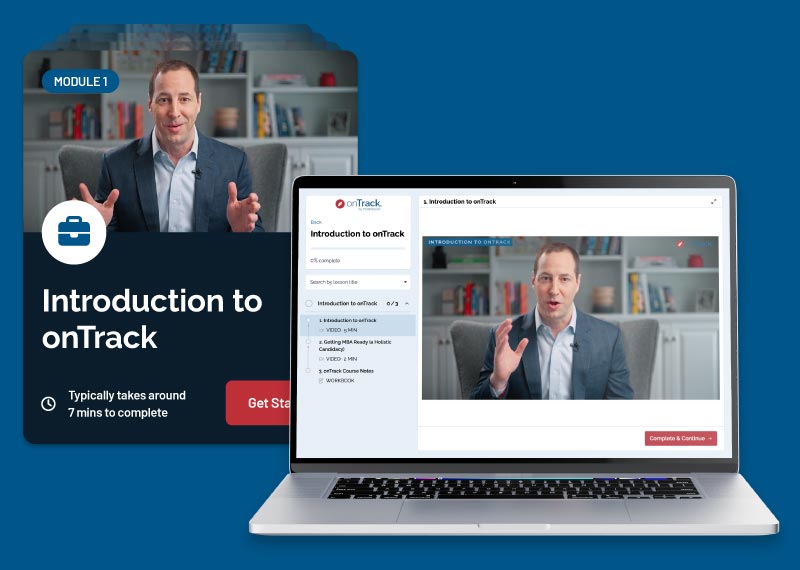
onTrack by mbaMission

A first-of-its-kind, on-demand MBA application experience that delivers a personalized curriculum for you and leverages interactive tools to guide you through the entire MBA application process.

Get Started!

2026–2027 MBA Essay Tips

Click here for the 2025–2026 MBA Essay Tips


MBA Program Updates

Explore onTrack — mbaMission’s newest offering allowing you to learn at your own pace through video. Learn more