Blog

What I Learned at…Kellogg, Part 4

In our “What I Learned at…” series, MBAs discuss the tools and skills their business schools provided as they launched their careers.

mbaMission connected with Chris Brusznicki, founder of Gameday Housing, the leader in the sports vacation rental market. In the final part of this four-part series, Chris acknowledges how important the Kellogg community was, and still is, in shaping his business.

When people think Kellogg, they think “marketing,” and while the marketing program is great, people miss the importance of the community—the social/networking aspect of the MBA was invaluable to my business, GamedayHousing.com, and its growth. At Kellogg, everyone lives a mile from school, so it is easy to be on campus all the time—I treated my MBA experience like a job. I was there 8:00 a.m. to 8:00 p.m., every day of the week. This immersion experience gave me a real comfort and made me feel at ease sharing ideas and asking questions—and asking questions to the right people.

As I built Gameday, I was constantly getting feedback from professors and my fellow students. I would show people my logo, would reach out to professors with questions constantly. I remember thinking, “If I was not a student, my professors would be charging me $500 per hour—I need to soak up as much as possible while I am not on the clock!” Even today, I have a great friend who is a JD/MBA from Northwestern, and we talk all the time. I send him screen shots of our new Web site. We go back and forth about our pricing strategy. We have not seen each other in two and a half years, but we talk all the time. This socialization with others and this shared experience still is one of the most valuable and enduring impacts of my MBA. I have a way of thinking and testing that I did not have before Kellogg.

Duke University (Fuqua) Essay Analysis, 2012–2013

Duke University’s Fuqua School of Business is changing things up this application season, most interestingly, joining the ranks of schools with creative essay questions (e.g., NYU Stern, Chicago , Cornell) with its prompt asking candidates to list “25 random things” about themselves. Maybe we have a maverick admissions committee in our midst! We will see how the school’s approach evolves, but the rest of Fuqua’s application is pretty much boilerplate, except for the admissions committee’s request for backup goals in its short-answer questions. Let us begin our full analysis…

From the admissions committee: Three short answer questions and two essays are required for all applicants. Responses should use 1.5 line spacing and a font size no smaller than 10-point. Responses must be completed before submitting your application. Prepare your responses carefully. The Admissions Committee considers your answers important in the selection process.

 width=Required Short Answer Questions: Answer all 3 questions

For each short answer question, respond in 250 characters only (the equivalent of about 50 words).

1. What are your short-term goals, post-MBA?

2. What are your long-term goals?

3. Life is full of uncertainties, and plans and circumstances can change. As a result, navigating a career requires you to be adaptable. Should the short-term goals that you provided above not materialize what alternative directions have you considered?

With this trio of questions, Fuqua is essentially asking for a standard Personal Statement, but with one nonstandard component, presented in the third query. Most candidates feel that they have to be unequivocal in their goals, but here Fuqua is asking applicants to equivocate somewhat. Fuqua’s admissions committee knows that sometimes the best-laid plans do not always play out or yield the best results, and the school wants to know that you are prepared to switch gears and recommit to a different path, if necessary, and are fully capable of doing so. The key in answering this question is showing that your alternate goal is just as connected to your skills, interests and ambitions as your original plan and does not come “out of left field,” so to speak. For example, you would probably have a difficult time convincing the admissions committee that your short-term goal is to work in technology consulting, but your alternate goal would be to work in human resources, because these industries, for the most part, require entirely different skills and personalities. Just be mindful that both of the goals you present need to be plausible and achievable.

Because Personal Statements are similar from one application to the next, we have produced the mbaMission Personal Statement Guide, which helps applicants write this style of essay for any school. We offer this guide to candidates free of charge. Please feel free to download your copy today.

For a thorough exploration of Fuqua’s academic program/merits, defining characteristics, crucial statistics, social life, academic environment and more, please check out the mbaMission Insider’s Guide to the Fuqua School of Business.

Monday Morning Essay Tip: Goals Should Be Ambitious but Realistic

When writing about your career, strive to inspire your reader by showing that your goals are ambitious, but not so ambitious that they are implausible. You should work to find a middle ground between goals that are easily achievable and those that are naïve or entirely fantastic. For example, stating that in the short term, you want to return to your existing position at your firm would be an example of an unambitious goal and thus an unwise approach; on the other hand, declaring that in the short term, you want to become CEO of the New York Yankees would be shooting unreasonably high, and the goal would therefore be viewed as unrealistic.

Generally, with respect to short-term goals, you should be able to identify a reasonably precise position that you would expect to take upon graduating from your MBA program. (If you intend to start your own firm, you should have a clear understanding of what the firm will be, the direction you will take and how you will steward the business to achieve its short-term goals.) As for the long term, we suggest that candidates pick a goal that derives from an existing career path—or could be considered a logical transition from it—and that represents an ideal of sorts. Essentially, we recommend that you consider writing about goals that would be within your grasp if everything were to go according to plan.

What I Learned at…Kellogg, Part 3

In our “What I Learned at…” series, MBAs discuss the tools and skills their business schools provided as they launched their careers.

mbaMission connected with Chris Brusznicki, founder of Gameday Housing, the leader in the sports vacation rental market. In the third part of this four-part series, Chris discusses how one class and one project at Kellogg helped him see the big picture.

One of my favorite classes at Kellogg was with Brian Uzzi: “Management & Organizations.” It was, in fact, the first class I ever took as a Kellogg student and one all Kellogg students take during orientation (CIM) week. Brian’s focus is on the power of networks and teams and how such ideas can be applied to creative businesses. In particular, Brian heralded the successes of IDEO, a design and innovation consulting firm with offices nearby in Evanston in addition to around the country and world. The IDEO case resonated with me because I have always had both a technical and creative bent. I had also learned a lot from just understanding IDEO’s approach to product development: rapid feedback and diverse teams were the keys to success. For example, in the case we studied, the team had to redesign a shopping cart, and in so doing, involved not just designers, but also customers at grocery stores, cart collectors, designers, philosophers, manufacturers and even the logistics companies that ship the carts to the stores at which they’ll be used.  This passion for thinking about the full life cycle of a product and all the stake holders who touched it really blew my mind and both humbled and empowered me as a designer.

Just one quarter later, I was ecstatic to actually meet and work with IDEO designers as part of the design curriculum of the MMM (Master in Management in Manufacturing) program—the design program was led by Don Norman, who is one of the foremost thinkers in the design world and author of the seminal design book Emotional Design: Why We Love (or Hate) Everyday Things.  We had a project for which we had to build a green prototype, and Don and IDEO were available for that rapid feedback. The project was certainly fun and educational, but for me, because Gameday Housing was already moving, I took lessons from that prototyping to our Web site: “What are our core features?” “How will a customer experience our site?” “What’s the minimum this Web site needs to do well to make money?” We were able to launch a site with the minimal functionality needed to get things going and then constantly solicited feedback from users—feedback that we were able to quickly apply to our Web site. Everyone I went through that experience with—whether they were bankers or consultants or went into industry—had a base level knowledge of what “right” looks like. For me, that was crucial.

University of California Los Angeles (Anderson) Essay Analysis, 2012–2013

UCLA Anderson keeps things short and sweet this application season, with one personal essay question and one forward-looking professional essay prompt. As always, think carefully about what you want to say before you begin writing, and be especially careful to craft a concise and eye-catching resume. We emphasize the word concise! Do not overstuff your resume with details to compensate for the lack of room UCLA has provided for you to express yourself elsewhere. If you fill every inch of your resume with text, your reader will become overwhelmed and your resume will lose its effectiveness. Strive to balance your essays and your resume so that you present a well-rounded, compelling picture of yourself without trying to include every last detail.

 width=1. What is your proudest achievement outside the workplace, and how has it impacted you? (700 words maximum)

UCLA Anderson wants to know that you are a real, live human being, not just a spreadsheet machine, so this essay question asks explicitly about your personal life. We hope we do not really need to say this, but we will anyway: do not discuss your professional life! The school is specifically asking you not to, so give the admissions committee what it wants!

As for which anecdote you should share, we have to ask, “Well, what are you most proud of?” Rest assured that this is not some kind of a game in which the admissions committee is waiting to see if you pick the “right” story. The school does not “like” certain types of achievements and dislike others. The particular achievement you choose to describe is not actually the point here. Instead, it is meant as an avenue through which you can create and convey an impression of yourself.

To ensure that you write a compelling essay response, remember to tell a story about yourself. If you write, for example, something like “My proudest achievement was completing the Kona Ironman Triathlon,” your story has both started and finished in the very first sentence (and that is not good). Where could you go from there, and how could you keep your reader’s attention? Instead, let the story develop by taking your reader step by step through the events how they happened, discuss how you were able to achieve what you did and make sure that your story involves a clear conflict or challenge, because no great achievement is truly easy—otherwise anyone could do it, and that would lessen its import.

Finally, do not neglect to discuss the impact the achievement had on you. What has changed about you since then? What have you pursued or not pursued as a result? How is your life, your personal philosophy or the way you prioritize things different from before the event? Reflect thoroughly on this aspect of the situation, and use your findings to clearly show that you have grown personally.


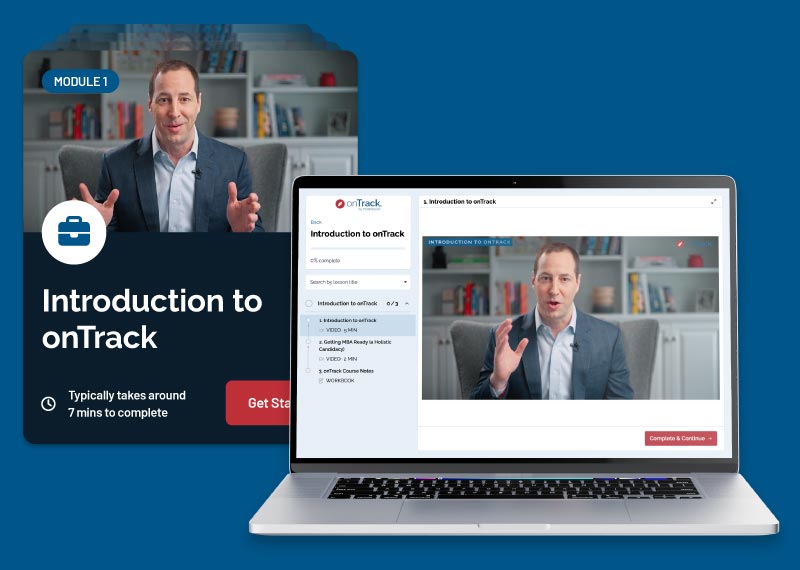
onTrack by mbaMission

A first-of-its-kind, on-demand MBA application experience that delivers a personalized curriculum for you and leverages interactive tools to guide you through the entire MBA application process.

Get Started!

2026–2027 MBA Essay Tips

Click here for the 2025–2026 MBA Essay Tips


MBA Program Updates

Explore onTrack — mbaMission’s newest offering allowing you to learn at your own pace through video. Learn more