
Blog

Professor Profiles: Campbell Harvey, Duke University’s Fuqua School of Business

Many MBA applicants feel that they are purchasing a brand when they select a program to attend, but the educational experience at business school is what is crucial to your future, and no one will affect your education more than your professors. Each Wednesday, we profile a standout professor as identified by students. Today, we focus on Campbell Harvey from Duke University’s Fuqua School of Business.

Campbell HarveyMultiple students interviewed by mbaMission described Campbell Harvey (“Global Asset Allocation” and “Emerging Markets Corporate Finance”), known as simply “Cam,” as an “amazing” professor, and one second year remarked that “he alone should give Fuqua a place in the top ten as a go-to school for finance.” Harvey has published more than 100 scholarly articles, is editor of The Journal of Finance and serves on both the board of directors and the executive committee for the American Finance Association. His hypertextual finance glossary—which includes more than 8,000 entries and 18,000 hyperlinks—has been covered, linked to and cited by the New York Times, Forbes, Bloomberg, the Washington Post, CNNMoney and Yahoo. In addition, Harvey coauthored the book version of The New York Times Dictionary of Money and Investing: The Essential A-to-Z Guide to the Language of the New Market, published in 2002 (Times Books), with Pulitzer Prize–winner Gretchen Morgenson. An alumnus mbaMission interviewed said that Harvey was “one of the best professors I had,” adding that he is “very tough, very brilliant and very good at explaining things.”

For more information about Duke Fuqua and 15 other top-ranked business schools, check out the mbaMission Insider’s Guides.

mbaMission’s Exclusive Interview with Hima Bindu, Former Associate Director of Admissions and Financial Aid at the Indian School of Business

Update: Hima Bindu is no longer the Associate Director of Admissions at the Indian School of Business (ISB). 

We were pleased to have the opportunity recently to speak with Hima Bindu, the Indian School of Business’s (ISB’s) associate director of admissions and financial aid. During our conversation, Bindu provided us with valuable insight into the following:

  • The school’s notable growth and rise in the rankings in its short history
  • The ISB’s partnerships with Wharton, Kellogg, London Business School and other international institutions and what these connections mean for its students
  • The advantages offered by the school’s one-year program (even for career changers) and the reasons the ISB chose that format
  • The wealth of resources and support offered to entrepreneurially minded students that many may not realize the school offers
  • The program’s goals and efforts related to international enrollment and recruiting
  • What gurukul means and how it is integrated into the ISB’s program and philosophy

Read on for the full transcript of the conversation.

mbaMission: Hello, Hima—thanks so much for joining me this morning, and on short notice. I appreciate your flexibility.

Hima Bindu: Not at all. I’m always happy to speak about the school for candidates.

mbaMission: The ISB was just an idea in 1995, and the doors opened in 2001. Only 11 years later, it’s a top international school ranked quite highly, particularly in the Financial Times. What has been the secret of the ISB’s success?

HB: The ISB is the youngest school to be ranked among the top 20 global by the Financial Times. We owe this achievement to the strong faith and vision of the founders of the school, whose relentless effort brought that vision to reality.

During the 1990s, when the school was just an idea, India saw a 10% growth in GDP. With a population of a billion and only a few hundred quality managers being educated in the country, the founders foresaw the need for strategic leaders and managers. ISB was established on the strength of that vision and this has been instrumental in the school’s success. Of course, our associate schools, the faculty, the board and the students have also contributed enormously to this success.

mbaMission: You mentioned partner schools. Can you tell me more about that—how those partnerships work, what you all share and how you share it?

HB: The vision of the school is to be top-ranked globally as a research-based school. So, when our founders embarked on setting up a premier business school in India, they sought to associate and partner with the best institutions in the world, such as Wharton, Kellogg and London Business School, which are known for their expertise in the areas of marketing and finance, as well as leadership and strategy. They are also our founding associate schools.

After ten years, we have tied up with other international schools offering specialized courses, such as Tufts Fletcher School and MIT Sloan for manufacturing, and infrastructure management for our Mohali campus.

The association provides for sharing research, joint research, curriculum design and even faculty, on a mutual basis. Our curriculum is largely modeled on that of these schools. Professors from these schools, who are acknowledged thought leaders in their area of expertise, not only teach at ISB but also participate in joint research activities.

Professor Profiles: “Interpersonal Dynamics,” Stanford Graduate School of Business

Many MBA applicants feel that they are purchasing a brand when they choose which business school to attend, but the educational experience you’ll have is what is really crucial to your future, and no one will affect your education more than your professors. Each Wednesday, we profile a standout professor as identified by students, but today we focus on a course instead: “Interpersonal Dynamics” at the Stanford Graduate School of Business.

Although “Interpersonal Dynamics” is a course at the Stanford Graduate School of Business (GSB) rather than an outstanding professor (as we usually profile), mbaMission feels it deserves a special mention. Also known as “Touchy Feely,” this extremely popular class is regarded as one of the quintessential Stanford GSB experiences and is all about interpersonal relationships. Some alumni have described the class to mbaMission as one that is “not to be missed.” In fact, one GSB graduate who did not take the course while in school wrote an article in Stanford Business Magazine about how grateful he was for the opportunity to take a weeklong version of the class at Stanford as an alumnus. In the article, he explained, “The approach was much more interactive and application oriented than anything I remembered from the GSB, and I pushed myself intellectually, emotionally and physically in ways I could not have anticipated before I arrived. And yes, I did cry.”

Another alumnus noted to mbaMission that “everyone ends up crying” at least once during the course of the class, quickly noting that he found the experience extremely valuable and that it had a positive impact on his relationships with his GSB classmates, friends and family. Via unstructured and structured course time, videotapes, role-plays and even a weekend retreat, students exchange feedback on how they interact with others. In addition to meeting for a regular class session two days a week, students are divided into 10–12 person T-groups (“T” is for training) to work with the aid of an outside facilitator on communication goals. The experience is often so powerful that some Touchy Feely sections even have reunions after graduation. According to an alumna, Touchy Feely section reunions are very informal and sometimes even involve annual weekend trips, such as to Las Vegas.

For more information about the Stanford GSB and 15 other top-ranked business schools, check out the mbaMission Insider’s Guides.

Mission Admission: Leveraging Scholarships

Mission Admission is a series of MBA admission tips; a new one is posted each Tuesday.

Oh the difference a day makes. One day, you are on the outside, wondering whether you will ever get into any of your target schools. Then, the next day, you get a call from the MBA admissions committee at your first-choice B-school, and your life changes forever. Suddenly, with an acceptance letter in hand, you become more self-assured and start to contemplate whether you will receive scholarships. Then, your second-choice school calls and offers you $10K. You now find yourself facing a tough choice: accepting the offer from the second-choice school that comes with a scholarship or the offer from the first-choice program, even though it does not come with any funds.

In the short term, you do not need to make this choice. With acceptance letters in hand, you can diplomatically leverage the financial aid offer you received from your second-choice school to influence the decision at your first. Once you have been accepted, your first choice just might not be prepared to let you go. Of course, diplomacy is key. If you make your request in too forceful a manner, you will only alienate the financial aid office, which may then decide to not offer additional resources to encourage you to choose the other school.

So tread carefully, but you will not lose anything by asking for more.

Professor Profiles: Raymond Fisman, Columbia Business School

Many MBA applicants feel that they are purchasing a brand when choosing a business school, but the educational experience is what is crucial to your future, and no one will affect your education more than your professors. Each Wednesday, we profile a standout professor as identified by students. Today, we focus on Raymond Fisman from Columbia Business School (CBS).

Raymond Fisman, Columbia Business SchoolRanked among “The Best 40 B-School Profs Under the Age of 40” by Poets&Quants, Raymond Fisman (“The Private Sector & International Development” and “Managerial Economics”) is best known for taking a somewhat unique behavioral angle to his research, examining what he calls “economic gangsters.” Fisman’s book Economic Gangsters: Corruption, Violence, and the Poverty of Nations (Princeton University Press, 2008) reexamines the term “gangster” alongside the opportunistic context of global economic development. In addition to contributing a monthly column to Slate magazine, Fisman has had his work featured in publications as varied as The New York Times, al Jazeera and Shanghai Daily. Poets & Quants quotes a student from the Class of 2005, who says that Fisman “shows you how economics can be used to parse a wide variety of complex business and public policy issues. He also challenges you to do the best work you have ever done.”
For more information on the defining characteristics of the MBA program at CBS or one of 15 other top business schools, please check out the mbaMission Insider’s Guides.


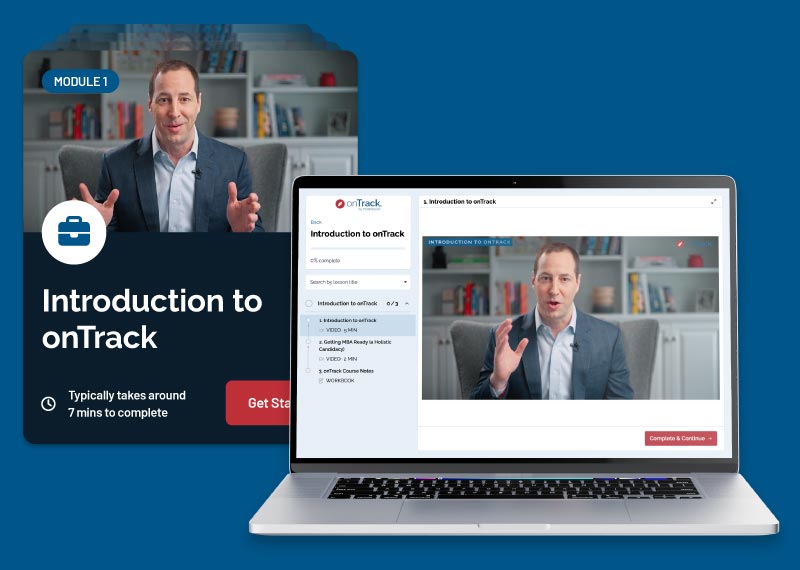
onTrack by mbaMission

A first-of-its-kind, on-demand MBA application experience that delivers a personalized curriculum for you and leverages interactive tools to guide you through the entire MBA application process.

Get Started!

2026–2027 MBA Essay Tips

Click here for the 2025–2026 MBA Essay Tips


MBA Program Updates

Explore onTrack — mbaMission’s newest offering allowing you to learn at your own pace through video. Learn more