Blog

University of Michigan (Ross) Essay Analysis, 2014–2015

*Please note: You are viewing an essay analysis from the 2014-2015 admissions cycle. Click here to view our collection of essay analyses for the current admissions season. 

The Ross School of Business at the University of Michigan has refashioned its essay questions, going “smaller” with its requirements, as have several other schools this application season. Ross’s broadly worded essay prompts give you ample breadth—if not an overabundance of words—in which to tell your story. As always, think carefully about what you want to say and the impression you want to make before you start writing, because more opportunity lurks here than you might realize at first.

Michigan RossEssay 1: What are you most proud of professionally and why? What did you learn from that experience? (400 words)

Many applicants who read this essay prompt will conclude that they have an opportunity here to share just one anecdote. However, you actually have another option. You could, of course, take a “task-oriented” approach, showing how you did one thing remarkably well, or you might consider taking a thematic approach, presenting instead a consistent record of achievement in one area. For example, you could discuss how you tamed your firm’s most feared client as a single clear accomplishment, or you could integrate this incident as one example supporting a theme of how you have developed your skills as a diplomat.

Any reader of our essay analyses or attendee of our essay writing seminars knows that we have an avowed preference for narrative-style writing. We strongly advocate getting right to the important details and describing your actions and results. Starting your essay with a bland declaration like “I am most proud of how I tamed our most difficult client and learned that I am a diplomat…” would be an essay killer!

As you are writing, be careful not to get carried away and forget to explain what you learned—the essay question very clearly asks, “What did you learn from the experience?” This information may be largely implied in your narrative, but your reflection on what you learned should not just repeat your key theme: “Clearly, I learned to be a diplomat in taming our toughest client, and I look forward to greater challenges going forward!” Just to be 100% clear, let us stress again that such a statement simply will not work. Contemplate your growth and development through the experience or series of experiences and use the theme of your essay as a starting point, but take the reflective piece further and reveal the self-awareness or skills that developed therein.

Essay 2: What are you most proud of personally and why? How does it shape who you are today?  (400 words)

Clearly, this essay is a fraternal twin of Essay 1. So again, you can focus on a single accomplishment (task) or a series of accomplishments that reveal a trait (theme). And revealing your chosen task or theme through a narrative will allow your actions and their impact to shine through.

Applicants are often flustered by the word “personal,” puzzling over why an admissions committee would want to learn anything about their personal life. Well, the reason is that the admissions committee want to get to know the entire you, and you are not just a series of professional accomplishments. We would define personal as “anything outside of work,” so your community service activities should be fair game here. But if you are so inclined, do not be afraid to discuss an aspect of your life that is truly personal, such as making a significant impact on a family member, pushing yourself to try something that is a radical personal departure, teaching yourself a new skill or committing to learning something interesting. The list of personal topics is vast, because you are living, changing and growing every day.

One thing you do not need to worry about is “scale”—no one expects you to be changing the world in your spare time. Admissions officers want to experience the intensity of your passion and commitment, but they also recognize that you are mortal, so you are not likely scaling the world’s ten highest peaks or curing a disease outside of work. You just need to show that you are doing your thing in a way that is spirited and determined.

As with Essay 1, do not neglect to reflect on the impact of your chosen task or theme: the admissions committee wants to hear how your personal accomplishment “shapes” the you you are today. The same rules apply—do not just offer a summary statement. Truly explore your development and elucidate what affects you today and how.

Essay 3: Optional question:  Is there anything not addressed elsewhere in the application that you  would like the Admissions Committee to know about you to evaluate your candidacy? (300 words)

The phrasing of this optional essay question is broader than most in that Ross does not specifically limit you to discussing problem areas in your candidacy. That said, in most cases, this is still your opportunity to address any lingering questions that an admissions officer may have about your profile—if you need to—such as a poor grade or overall GPA, a low GMAT score, a gap in your work experience, etc. In our mbaMission Optional Statement Guide, we offer detailed advice on when and how to take advantage of the optional essay, with multiple examples, to help you mitigate any problem areas in your application.

However, because the question can be interpreted rather broadly, it does open the door for you to discuss a strength or attribute that has not yet been highlighted elsewhere in your application and that you think may be pivotal or particularly compelling. We caution you about simply trying to fill this space because you fear that not doing so would somehow count against you. You must have a crucial aspect of your background/experience/profile that you would be bringing to light—remember, by submitting an additional essay, you are asking the admissions committee to do extra work on your behalf, so you need to make sure that time is warranted. If you are using the essay to emphasize something that if omitted would render your application incomplete, take this opportunity to write a very brief narrative that reveals this key new side of your profile.

University of Pennsylvania (Wharton) Essay Analysis, 2014–2015

*Please note: You are viewing an essay analysis from the 2014-2015 admissions cycle. Click here to view our collection of essay analyses for the current admissions season. 

The Wharton School of the University of Pennsylvania has decreased its number of application essays to just two this year and is giving candidates a whopping 900 words with which to distinguish themselves. We surmise that the influx of application essays can be overwhelming for the school’s overworked admissions officers, who find them somewhat deadening over time. So, by cutting back the program’s application requirements, they are able to stay sharp and still get what they need from you as an applicant. While this change may be helpful on the school’s end, the limitations make your job much harder. Wharton gives you a mostly boilerplate personal statement and a rather Harvard Business School–esque “discuss what you want” style prompt—seemingly not a lot of latitude with which to make an impression, but the key word here is “seemingly.” The smart applicant will make use of Essay 2 in particular to stand out from the pack. Our analysis follows…

WhartonThis year we require one essay, with a second being optional.  For the second optional essay, we recommend that you use your best judgment and focus your energy on highlighting new information that we are unable to ascertain from other sections of the application.

Essay 1: Required: What do you hope to gain both personally and professionally from the Wharton MBA? (500 words)

In many ways, this prompt is asking for a typical MBA personal statement. In a mere 500 words, you must discuss your goals, giving very brief context for why they are realistic for you. You will then need to reveal how you will engage with Wharton’s resources in pursuit of these goals, by showing that you truly understand what the school offers and that you have a thoughtful game plan for immersing yourself in the Wharton experience. You will need to familiarize yourself with the school’s various resources and pinpoint those that truly pertain to you and the direction in which you hope to go—definitely do not just present a list of classes you think might be interesting.

Wharton adds a slight twist to this essay by asking you to discuss personal growth as well. This request might perplex you, but before you get too bewildered, take a step back and ask yourself what personal areas you genuinely need to develop. Maybe you need to challenge yourself to become a better public speaker, so you look forward to debating ideas in the classroom and on your learning team—not to mention pushing yourself out of your comfort zone by taking a role in the Wharton Follies. Do not worry about finding the “right” answer for what or how you want to develop personally—no such answer exists!—but focus instead on demonstrating self-awareness and showing that you truly grasp how Wharton in particular will best serve your personal needs.

Because personal statements are generally similar from one application to the next, we have produced the mbaMission Personal Statement Guide, which helps applicants write this style of essay for any school. We offer this guide to candidates free of charge. Please feel free to download your copy today.

For a thorough exploration of Wharton’s academic program/merits, defining characteristics, crucial statistics, social life, academic environment and more, please check out the mbaMission Insider’s Guide to the Wharton School of the University of Pennsylvania.

Essay 2: Optional: Please use the space below to highlight any additional information that you would like the Admissions Committee to know about your candidacy. (400 words)

We were surprised to see Wharton’s admissions committee asking for new information it would be unable to ascertain from other sections of the application, because this appears to be unashamedly parroting Harvard Business School’s (HBS’s) essay question that says the admissions committee “can see your resume, school transcripts, extracurricular activities, awards” etc. and then asks, “What else would you like us to know?” Typically, each of the top schools has strived to maintain its own distinct essay questions to deter applicants from simply copying and pasting the same essay into multiple applications. By creating unique essay questions, the schools obligate you to do original work exclusively for their application, ensuring that you are genuinely interested in their specific program. Wharton’s imposition of a 400-word limit may be a tactic meant to force applicants to create something distinct; very few candidates will limit their open-ended HBS essay to just 400 words, so a copy and paste from HBS to Wharton (or vice versa) should make an applicant’s lack of effort fairly obvious. Note: we have to assume that HBS will be highly suspicious of 400-word essays!

As for what to write… even with only 400 words, you can still effectively grab the admissions committee’s attention. Indeed, as the committee itself suggests, think carefully about providing new information, but remember that you do not need to exclude anything and everything that has been included in minute detail in your application. Hypothetically, if a bullet on your resume describes your role on your firm’s charitable board, but it does not do justice to the incredible work you have accomplished in this capacity, you can use this essay to further explore and expound on this activity. Your task with this essay is to ensure that your reader is receiving new information about you—and additional information counts as new!

You can use this opportunity to reveal a single accomplishment, highlight a theme (thereby unifying several accomplishments), discuss a formative moment in your life, identify a time when your personal philosophy was challenged and changed—and probably countless other options. Just remember, you are trying to distinguish yourself from thousands of others. To do this, you need to own your story, and the best way to ensure that the story is fully yours is to tell it, as it happened, in your voice. Returning to the hypothetical example of your position on your firm’s charitable board, you should not start an essay with the following:

“I consider it a great honor to have been asked to join my firm’s charitable board. My work with the board is something that I will always be proud of, particularly because I was the youngest member of the team.”

This opening is not only banal and self-evident, it is also the type of information you could convey just as effectively in a single bullet on your resume. Instead, strive to put your reader in the middle of the action, and allow him/her to share your experience:

“As I advocated to the board to donate $11,500 to a literacy program for Caribbean immigrants, I reminded myself that I was taking on our firm’s CFO.”

In this second example, we are engaged in the details of a story—a story that this individual clearly owns. The applicant can continue with the narrative until he has created a representative example of himself (or possibly representative examples) and through his achievement has made a profound and memorable impression on the admissions committee.

New York University (Stern) Essay Analysis, 2014–2015

*Please note: You are viewing an essay analysis from the 2014-2015 admissions cycle. Click here to view our collection of essay analyses for the current admissions season. 

The admissions committee at New York University’s (NYU’s) Stern School of Business must be happy with the essay responses it received from applicants last admissions season, because the school has made no changes to its essay questions for this year. Stern maintains its standard career essay prompt and again gives candidates two completely different options for the second essay, one that is professional in nature and another that is personal. Many applicants will likely be daunted by the “personal expression” option, because the significant latitude it offers can lead to uncertainty—as in, “Am I doing this right?” We suggest that rather than worrying about which format to choose, you first consider what you want to say as an applicant. Who are you? What do you want the Stern admissions committee to know about you? Once you can answer those questions, determine which option better allows you to showcase your message and your strengths.

NYU SternEssay 1:  Professional Aspirations (750 word maximum, double-spaced, 12-point font)

  • Why pursue an MBA (or dual degree) at this point in your life?
  • What actions have you taken to determine that Stern is the best fit for your MBA experience?
  • What do you see yourself doing professionally upon graduation?

The three points that make up Stern’s Essay 1 question basically constitute a Personal Statement, and because Personal Statements are similar from one application to the next, we have produced the mbaMission Personal Statement Guide, which helps applicants write this style of essay for any school. We offer this guide to candidates free of charge. Please feel free to download your copy today.

And for a thorough exploration of NYU Stern’s academic program/merits, defining characteristics, important statistics, social life, academic environment and more, please check out the mbaMission Insider’s Guide to New York University’s Leonard N. Stern School of Business.

Essay 2: Choose Option A or Option B

Option A: Your Two Paths (500 word maximum, double-spaced, 12-point font)

The mission of the Stern School of Business is to develop people and ideas that transform the challenges of the 21st century into opportunities to create value for business and society. Given today’s ever-changing global landscape, Stern seeks and develops leaders who thrive in ambiguity, embrace a broad perspective and think creatively about the range of ways they can have impact.

  • Describe two different and distinct paths you could see your career taking long term. How do you see your two paths unfolding?
  • What factors will most determine which path you will take?
  • How do your paths tie to the mission of NYU Stern?

Given that the school is asking about two possible paths for your long-term career, you may be wondering whether you have room to be vague or uncertain about your goals in this essay. Quite simply, “No.” In fact, you will instead need to present two feasible career options and relate your skills and experiences to both of them very clearly to create an effective, coherent statement and to show not only that you are versatile but also that you know yourself well.

The key here is demonstrating that you have a full understanding of the career paths you propose for yourself and truly grasp how and why each one would be a good fit for you. If you write that you could see yourself as either a marketing manager or a hedge fund manager, for example, you will reveal that you actually do not know much about these positions, because the personalities and skills necessary to succeed in the roles are quite different. Although identifying and showing a connection between these options is not impossible (both can require a very intense focus on data mining, for example), your essay will really only be successful if you can effectively show that you know yourself and the two diverse paths well. A more plausible—and likely convincing—option is to choose two positions that are more relatable to each other, such as entrepreneur and politician. There is no “right” combination for this essay, but whatever you propose has to be credible. Basically, Stern is saying that it wants to know that you are able to make the most of opportunities, even if life (or the economy!) throws you a curveball. By thoughtfully discussing two feasible alternatives, you will prove that you are multitalented and prepared to knock any curveball out of the park.

To best answer the question that relates to Stern’s mission, you must first understand—you guessed it!—the school’s mission, which Stern conveniently provides as the intro to its Option A questions. The school’s mission is clearly quite broad. You need not address every aspect of it in your essay, but make sure that you connect your proposed paths to at least one element of Stern’s statement. Further, you should definitely not trot out clichés about “doing good,” just because Stern has the word “society” in its mission. In short, avoid approaching this part of the essay with a “What do they want to hear?” perspective and truly consider how your stated career trajectories relate to the school’s objectives—think deeply about who you are, where you want to be and how your ambitions and values connect with Stern’s own mission.

mbaMission’s MBA Application Writing Boot Camp Is Back!

We are pleased to announce our MBA Application Writing Boot Camp dates for the 2014–2015 business school application season!

Through seven hours of live instruction, two hours of recorded materialsdirect review of your work and 30 minutes of one-on-one feedback from your expert instructor, we will guide you step-by-step through the process of creating a compelling MBA application that will reveal your unique character and catch the attention of the MBA admissions committee. In a classroom workshop environment over the course of one weekend day, you will brainstorm for creative ideas, practice the techniques of effective storytelling and resume construction and learn how to structure and draft your essays for your target school. You will also get a head start on your recommendations and interviews in the two additional hours of recorded content and develop a process for completing the rest of your applications. This class is designed to jump-start your application process and get you headed in the right direction. Throughout the course, you will benefit from direct feedback from both the instructor, an mbaMission Senior Consultant, and your classmates. And after the formal instruction is complete, you will have one half hour of one-on-one coaching from your instructor on some of the specific work you developed during class.

Class Dates:

  • Online A: Sunday, July 27
  • Online B: Saturday, August 9
  • Online C: Sunday, August 24
  • Online D: Saturday, September 6
  • Online E: Saturday, September 13
  • Online F: Sunday, November 16
  • Online G: Saturday, November 22
  • Online H: Saturday, December 6
  • Online I: Saturday, December 13

All boot camps are held in our online workshop environment from 10:00 a.m. until 6:30 p.m. Eastern Time, with ample breaks. The cost of each boot camp is $799.

For more information or to register for one of our MBA Application Writing Boot Camps, click here.

Dartmouth College (Tuck) Essay Analysis, 2014–2015

*Please note: You are viewing an essay analysis from the 2014-2015 admissions cycle. Click here to view our collection of essay analyses for the current admissions season. 

Following what seems to be an emerging trend this season, the Tuck School of Business at Dartmouth College has decreased the number of required applications essays this year from (an already fairly minimal) three to just two 500-word submissions, one of which is a classic career statement, while the other asks candidates to share and reflect on a significant leadership experience. Having just 1,000 words with which to convey meaningful elements of their profile means that applicants will need to be especially judicious in choosing their messages and particularly efficient in their writing to get the most impact from these two rather circumscribed essays. As always, we recommend a thorough brainstorming session before you put pen to paper (or fingers to keyboard) so that your messages are clear, complete and fully on topic.

Please respond fully but concisely to the following essay questions. There are no right or wrong answers. We encourage applicants to limit the length of their responses to 500 words for each essay. Please double-space your responses.

Dartmouth Tuck School of Business1. Why is an MBA a critical next step toward your short- and long-term career goals? Why is Tuck the best MBA fit for you and your goals and why are you the best fit for Tuck?

Because personal statements are similar from one application to the next, we have produced the mbaMission Personal Statement Guide, which helps applicants write this style of essay for any school. We offer this guide to candidates free of charge. Please feel free to download your copy today.

For a thorough exploration of Dartmouth Tuck’s academic program, merits, defining characteristics, crucial statistics, social life, academic environment and more, please check out the mbaMission Insider’s Guide to the Tuck School of Business.

2. Tell us about your most meaningful leadership experience and what role you played. What did you learn about your own individual strengths and weaknesses through this experience?

In an interesting divergence from last year’s version of this essay prompt, Tuck has removed the adjective “collaborative” from where it appeared just before “leadership,” thereby allowing this season’s candidates to select from a broader range of experiences to find the best one for this essay. For you, your most “meaningful leadership experience” may be one in which you shared power with someone else (or various people) and achieved an objective, in which case you should feel free to discuss that situation. On the other hand, your standout leadership experience may have been a more conventional one, in which you stood alone at the head of a group or team and achieved something of note—that would also be a fitting story for this prompt. What is key is choosing the experience that was the most significant for you and has had the longest-lasting impact. Also, keep in mind that leadership is not a matter of title—you can be the associate to someone else’s vice president or vice versa and still be a leader if you are helping to drive something forward. In other words, think about your actions, not about the org chart.

To effectively reveal your “strengths and weaknesses,” you will need to demonstrate that you encountered challenges along the way and show how you overcame them. You cannot tell the story of your experience and then just tack on a mention of some unrelated—and thus “unproven”—lesson at the end. This is a common mistake, so be extra careful to avoid it. You must also reflect on the experience, because the question asks you to, but make sure the reflection you share is derived directly from the experience you describe in your essay. If you write 350–400 words of narrative and 100–150 words of related reflection, you should be on the right track.


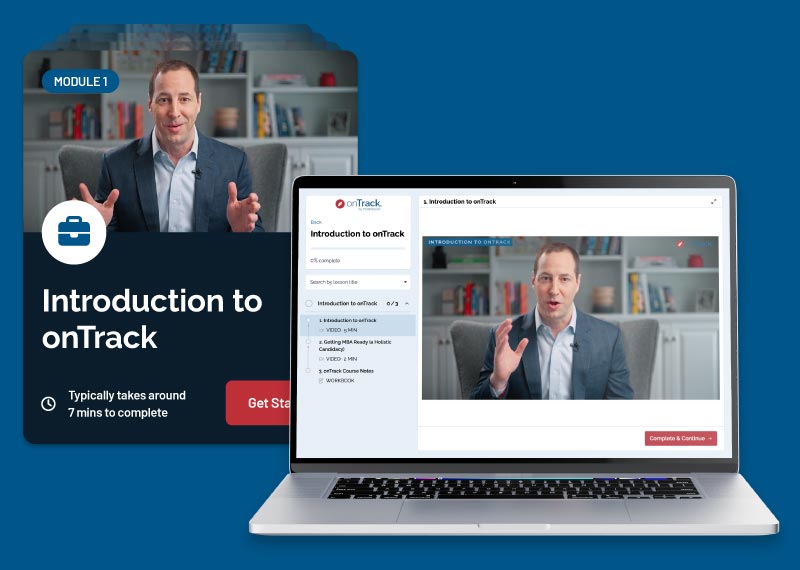
onTrack by mbaMission

A first-of-its-kind, on-demand MBA application experience that delivers a personalized curriculum for you and leverages interactive tools to guide you through the entire MBA application process.

Get Started!

2026–2027 MBA Essay Tips

Click here for the 2025–2026 MBA Essay Tips


MBA Program Updates

Explore onTrack — mbaMission’s newest offering allowing you to learn at your own pace through video. Learn more