In this weekly series, our friends at MBA Career Coaches will be dispensing invaluable advice to help you actively manage your career. Topics include building your network, learning from mistakes and setbacks, perfecting your written communication, and mastering even the toughest interviews.
Your resume is most likely the first and, in many cases, the only document recruiters will screen when they are evaluating your candidacy to determine if they want to continue the hiring process with you. For some firms, on the basis of your resume alone, you will be offered a phone screen, networking dinner invitation, follow up coffee chat, or even an interview. Recruiters can learn a lot about you by looking at your resume, but it is your communications skills – your ability to communicate through that resume – that will get you in the door.
Think about who will likely be doing that first resume screen — most likely a member of the human resource team who has never done the actual work in your target position and may have no experience outside of the HR department in your industry. And, remember, these are very, very busy people who will likely be screening hundreds of resumes in a single sitting. It’s easy to understand how someone like that would be put off by a lot of technical jargon and firm-specific terminology. Rather than taking the time to read your bullets three or four times to figure out what you intend to convey, a busy HR professional just might put your resume in the “no thanks” pile. Honestly, with a mountain of resumes to sort through, isn’t that what you would do?
With regard to the GMAT, raw intellectual horsepower helps, but it is not everything. In this blog series, Manhattan Prep’s Stacey Koprince teaches you how to perform at your best on test day by using some common sense.
Is the GMAT topic of number properties driving you crazy? This concept covers things that we often call “basic”—topics that we learned in middle school (or earlier), such as divisibility, factors and multiples, odds and evens, positives and negatives, and so on. I assure you, though, that number properties questions on the GMAT are anything but basic.
I strongly urge you to develop a solid grounding in this topic, particularly because the test writers are so good at disguising what these problems are really testing.
You will need some kind of book or e-book that covers this topic thoroughly, but I have some resources to help you get started.
Start with this article, “Disguising—and Decoding—Quant Problems.” We talk about how the test writers disguise material that you probably do already know, and how we can learn to “decode” the problem or strip away the camouflage.
If you feel good about the concepts discussed in that article, and you are at a higher math level, try out this challenging problem next.
With regard to the GMAT, raw intellectual horsepower helps, but it is not everything. In this blog series Manhattan Prep’s Stacey Koprince teaches you how to perform at your best on test day by using some common sense.
How do you maximize your score on the GMAT? Sure, you have to learn to answer harder questions correctly—but that is not actually enough.
Let us stipulate a couple of things. First, whenever I say “easier” or “harder” in this post, I am referring to easier or harder for you, the reader; everything here is relative to your current scoring level and your desire to lift that level to whatever your goal score is. In other words, this works at every level and for every goal.
Second, as a general rule, you take (on average) more time to answer harder questions than you take to answer easier ones.
Okay, so what does that mean? Most people do not spend much time studying the things that they generally already know how to do; they do not analyze questions that they answered correctly unless there was some other issue (such as spending too much time).
That is a mistake—and not just because we can still learn things from questions that we answer correctly. More importantly, if you want to lift your score, then the questions that you find of medium difficulty today need to turn into questions that you find easier in the future.
Perennially ranked among the top business schools in the world, the Wharton School of the University of Pennsylvania—as its original name, the Wharton School of Finance and Commerce, indicates—is best known for its reputation in finance, which is still the school’s largest department. However, if you are interested in a career in consulting but believe that Wharton is the program of choice for future investment bankers only… well, think again!
Check out these five facts about consulting at Wharton:
Every year since 2005, more Wharton graduates have accepted positions in consulting than in investment banking.
Wharton’s Consulting Club is one of its largest student organizations.
One of Wharton’s most popular electives is “Strategy and Competitive Advantage.” Professor Nicolaj Siggelkow, a protégé of strategy guru Michael Porter, is notorious for pushing his students to clarify their answers. But if they use trite buzzwords such as “adding value” and “frameworks,” they may find themselves in the hot seat for 30 minutes of additional questioning!
In recent years, Wharton’s Consulting Club has hosted an annual case competition for first-year students; winners have been offered summer internships with Boston Consulting Group.
For more information on UPenn Wharton or 15 other leading MBA programs, check out the mbaMission Insider’s Guides.
Mission Admission is a series of MBA admission tips; a new one is posted each Tuesday.
These days, as social media pervades most of our lives, we need to take special care to keep our private lives just that—private! Our partners at Kaplan Test Prep found that 26% of college admissions officers check applicants’ Facebook profiles or other social networking pages to learn more about them—both the good and the bad. And although MBA admissions committees probably have better things to do than troll the Internet for your private information, you can never truly know whether an alumnus/alumna or a student interviewer will take a few minutes to find out a little more about you online.
Although your pages on these sites are likely innocuous, you must still ensure that access to those pages is limited so that you can control who sees them—and can thereby have more control over your interviewer’s perception of you. You do not want your interviewer’s first impression to be drawn from your vacation photos but rather from your confident demeanor as you walk in the door and shake his/her hand. So take a moment and make sure that only those you invite to your pages can use them to learn about you and your life.
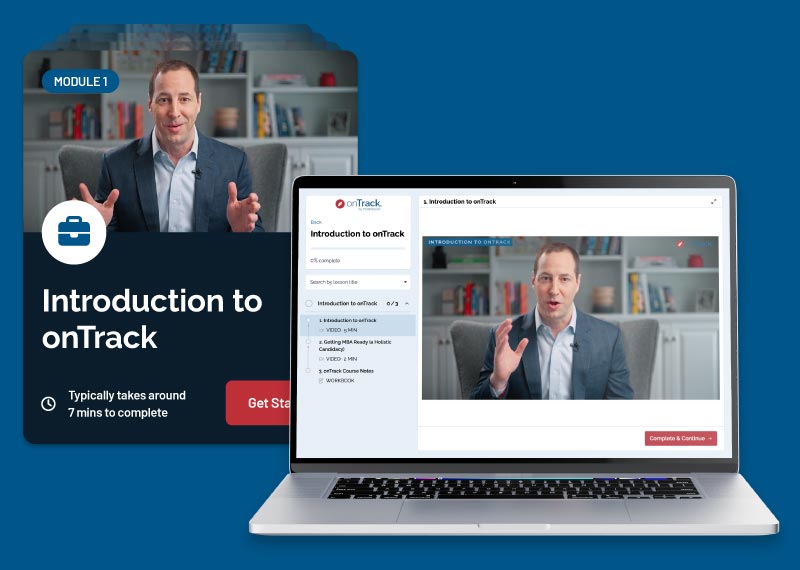
A first-of-its-kind, on-demand MBA application experience that delivers a personalized curriculum for you and leverages interactive tools to guide you through the entire MBA application process.