In our “What I Learned at…” series, MBAs discuss the tools and skills their business school provided as they launched their career.
Sarah Rumbaugh is the CEO and founder of RelishMBA, the marketplace for MBA hiring, which connects MBA candidates and the companies that hire them through the recruiting process. Sarah founded RelishMBA while completing her MBA at the Darden School of Business and continued to work full-time on the venture after graduation. In Part 3 of this three-part series, Sarah discusses how Darden helped her grow her venture to a point where she could pursue it full-time after graduation.
I wouldn’t say we (my cofounder Zach and I) set the best metrics to evaluate whether we were “successful” at the end of the ten-week accelerator in the i.Lab at UVA Incubator, but we definitely gathered the data that we felt indicated we should keep pursing the business. The idea of setting key metrics, milestones, and/or key performance indicators is another thing I learned the importance of at Darden. How else can you measure your venture’s success? The problem is that it’s really hard to determine what the best metrics are and to determine a benchmark for “success”—especially if you’re setting these standards when you’re at zero and you may still not know what the best solution is for the problem you’re trying to solve. The i.Lab helped us work through all this. Among the other valuable resources that helped us get from point A to point B were the mentors, workshops, other start-ups, and the entire UVA-Darden ecosystem (not to mention the free food).
Going into Darden my second year, I had a cofounder, a tested MVP [minimum viable product], our first revenue, a significant number of users on our software platform (we defined this as the majority of Darden students), and a decision—a decision to continue pursuing the business. I loaded up my academic schedule with entrepreneurial classes and divided my time 50-50: 50% in the i.Lab, working on the business, and 50% on academics. However, as many entrepreneurs will tell you, the business quickly took over my life, and you could really call it 100% focus on the business.
In our “What I Learned at…” series, MBAs discuss the tools and skills their business school provided as they launched their career.
Sarah Rumbaugh, CEO and founder of RelishMBA.
Sarah Rumbaugh is the CEO and founder of RelishMBA, the marketplace for MBA hiring, which connects MBA candidates and the companies that hire them through the recruiting process. Sarah founded RelishMBA while completing her MBA at the Darden School of Business and continued to work full-time on the venture after graduation. In Part 2 of this three-part series, Sarah discusses how Darden helped her prepare to launch her venture while in school.
Once I had identified the problem I wanted my venture to solve, the next step was figuring out how to use this information to help me get into the i.Lab at UVA Incubator. I had about two months in which to figure this out. Continuing to seek guidance from Darden’s entrepreneurship faculty and staff, I decided the answer was to gather data to support my claim that this problem existed for MBA students and recruiters and to talk to people who had started businesses in similar areas. For the first part, I conducted a few focus groups and surveys with MBA students and recruiters (both of which were easily accessible; I just had to get them to say yes). I later learned in a marketing course that focus groups and surveys can be pretty difficult to do and could result in unreliable data if not done correctly. In any case, I collected the data that I believed supported the notion that the problem I had identified was worth solving.
For the second task, I took a look at the Entrepreneurs-in-Residence at the i.Lab (experienced entrepreneurs volunteering to mentor i.Lab members pursuing start-ups). [Editor’s note: These individuals are now known simply as Mentors.] I found a few who had experience with B2B [business-to-business] software or marketplace businesses and met with them to learn what obstacles I may face in solving the problem I had set out to fix. These mentors have continued to be instrumental to my venture’s success; they truly provide invaluable insight on the day-to-day operations of start-up life.
In our “What I Learned at…” series, MBAs discuss the tools and skills their business school provided as they launched their career.
Sarah Rumbaugh, CEO and founder of RelishMBA.
Sarah Rumbaugh is the CEO and founder of RelishCareers.com, the marketplace for MBA hiring, which connects MBA candidates and the companies that hire them through the recruiting process. Sarah founded RelishCareers.com while completing her MBA at the University of Virginia’s (UVA) Darden School of Business and continued to work full-time on the venture after graduation. In Part 1 of this three-part series, Sarah discusses how Darden helped her identify a workable start-up idea while in school.
Throughout the grueling MBA application process and coming into Darden, I knew I wanted to be an entrepreneur. For this reason, Darden was my top choice, my dream business school. I grew up in the Washington, DC, area and lived in Virginia before business school, and I wanted to be semi-close to home, which was another reason Darden was number one for me. Still, it was blatantly clear to me that Darden’s entrepreneurial resources were superior to those of many of its peer schools.
Before I go into why this is, I’ll explain why I wanted to go to B-school in the first place. Yes, I wanted to be an entrepreneur, but my interest in business school went beyond my entrepreneurial ambitions. I was going to try my hand at entrepreneurship one way or another, regardless of business school. Rather, I wanted to go to B-school because I felt it was the next step in my career. I had reached a point with my work experiences where I felt that to continue to grow, I needed an advanced degree. Business school over other graduate options was an easy choice. I like the generality of “business.” You can do so many things with an expertise in “business.” It’s one of the few master’s degrees that actually expand one’s career options rather than narrowing them. And I chose a school that I felt would enable me to pursue my entrepreneurial aspirations. I recognized that Darden would offer me the resources, connections, and time that would make the probability of my entrepreneurial success higher.
With regard to the GMAT, raw intellectual horsepower helps, but it is not everything. In this blog series, Manhattan Prep’s Stacey Koprince teaches you how to perform at your best on test day by using some common sense.
This week, I have got a short and sweet post for you.
Take a look at your calendar and find a weekend to take off from your studies (or even an entire week). Yes, I am serious! People tend to get really burned out studying for the GMAT; you will be doing your brain a favor if you give it a bit of a break. (Note in general: when your brain is fatigued, it cannot make solid new memories. Do not keep pushing yourself to study under those circumstances!)
Second, I have a few resources for you. I put together a couple of posts that highlight what I think are the most useful articles from recent years. Take a look at What Would Stacey Do? for resources and advice on areas with which you may be struggling.
I do want to take time to mention explicitly the one post that I think is the most important and the first thing that every GMAT student should read: What the GMAT Really Tests.
Third, recently we discussed how to study for Critical Reasoning (CR). Here are two available resources:
Finally, go take a break! Take a look at your calendar and find a good time to rest your brain. I have never met anyone who can study effectively for months straight without at least one solid weekend break (and an entire week is often better!).
In this weekly series, our friends at MBA Career Coaches will be dispensing invaluable advice to help you actively manage your career. Topics include building your network, learning from mistakes and setbacks, perfecting your written communication, and mastering even the toughest interviews.
We have been talking about three tests to apply to your resume to ensure that each bullet showcases your accomplishments and how you excelled. The Cause and Effect Test requires you to show not just the results you produced, but also the actions you took that led to those results. Let’s explore some of the reasons bullets fail the Cause and Effect Test.
Cause and Effect Test Fail:
Implemented cost optimization program for a major CPG company, successfully reducing costs by $8M in their raw material sourcing
If your bullet is not focused on your individual contributions, it will fail the Cause and Effect Test. This candidate has highlighted the result of the project in this bullet – the outcome of the entire team’s efforts– not the result of her individual work. This makes it impossible for the reader to understand what she did and how it translated into impact. So even when the overall result was a team effort, you need to highlight your specific contribution and how it helped lead to the outcome.
Here is another phrasing of this bullet that would fail the Cause and Effect Test.
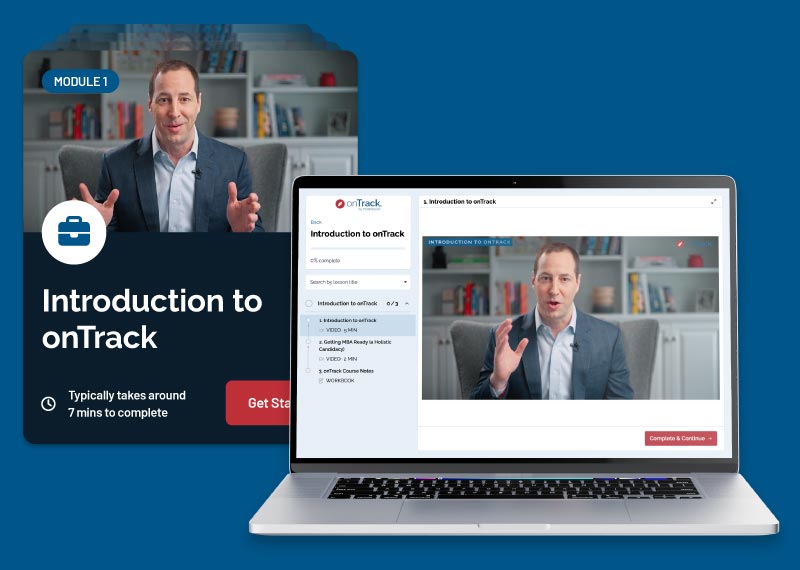
A first-of-its-kind, on-demand MBA application experience that delivers a personalized curriculum for you and leverages interactive tools to guide you through the entire MBA application process.