Many business school candidates unwittingly start their essays with platitudes—obvious or trite remarks written as though they were original. For example, when responding to the essay question, “Tell us about a time when you made a difficult decision,” an applicant might mistakenly write the following:
“Managers constantly face difficult decisions. Still, everyone hates indecision.”
The applicant does not “own” this idea and cannot lay claim to this statement. A simple alternative would be to insert his/her personal experience and viewpoint into the sentence:
“I found myself back in the boardroom with Steve, anticipating that yet again, he would change his mind on the mbaMission file.”
By discussing your personal and unique experiences, you demonstrate ownership of your story while engaging your reader. Avoiding platitudes and generalities—and ensuring that you are sharing your experience, rather than one that could belong to anyone else—is a simple but often overlooked step in creating a compelling message.
In this new blog series, our mbaMission Career Coaches offer invaluable advice and industry-related news to help you actively manage your career. Topics include building your network, learning from mistakes and setbacks, perfecting your written communication, and mastering even the toughest interviews. To schedule a free half-hour consultation with one of our mbaMission Career Coaches, click here.
Once you have secured a networking meeting, prepare to make the most of the opportunity. Ready yourself for the meeting with the same level of seriousness and dedication as you would for a formal interview.
Conduct industry, company, and contact research so you can generate ideas for potential questions and can customize how you talk about yourself.
Adapt and practice your pitch (your story/what you want to be remembered for).
Prepare at least five or six tailored questions to ask during the meeting.
During the conversation, focus on your goals. We suggest a three-part agenda:
Opening – Establish a common bond, explain the purpose of your meeting, and deliver your pitch.
Discussion – Ask your prepared questions, and gather advice/insights. Do not ask for a job; communicate your knowledge of/passion for the industry and the company.
Closing – Adhere to time limits. Be appreciative and offer to help them with their career in the future. Ask for referrals/recommendations based on what you have heard.
Because business school candidates must share examples of a variety of experiences with admissions committees, we encourage applicants to truly reflect on their lives and consider all potential stories, including academic, professional, community, extracurricular, athletic, international, and personal. However, candidates inevitably have questions about which anecdotes are truly appropriate and effective. “Can I use stories from high school and college?” “Can I use a story from four years ago?” “How far in the past is too far in the past?” Although no definitive rule exists, with the exception of questions that specifically ask about personal history or family background, schools generally want to learn about the mature you—the individual you are today. So we ask you, “How long have you been the you that you are today?”
When considering experiences that occurred long ago, ask yourself, “Would this impress an MBA admissions committee today?” If you ran a few successful bake sales six years ago when you were in college, this clearly would not stand the test of time and impress a stranger today. However, if, while you were still a student, you started a small business that grew and was ultimately sold to a local firm when you graduated, you would have a story to tell that would likely impress an admissions reader.
Inevitably, judgment is always involved in these decisions. Nonetheless, we offer this simple example as a starting point to help you decide which stories to share.
Mission Admission is a series of MBA admission tips; a new one is posted each Tuesday.
After visiting campus or interviewing, many business school candidates choose to write thank you letters to their respective hosts. But what makes a good thank you note?
Personalization: When writing to your host/interviewer, show sincerity by personalizing your letter. By handwriting your letter and mentioning specifics about your conversation and experiences, you will continue to foster your connection with your interviewer and show that your interaction truly made an impression.
Brevity: Your letter should be no more than a few sentences long. If you write several paragraphs, you run the risk of creating the negative impression that you are trying too hard or do not respect limits (possibly even suggesting that you might carry on too long in class). By being brief and sincere, you will instead make a powerful impression that will yield results.
Speed: Ideally, send your letter within 24 hours of your visit and within 48 hours at the most. Most interviewers must submit their reports very soon after the interview, and your thank you note will have a better chance of positively influencing this report if it is received before the report is submitted. Also, after too long, your interest may logically fall into question, or your host may simply forget some of the details of your conversation that you are trying to reinforce. By writing your letter immediately, you will give the impression that you have been energized by the experience and are eager to maintain your connection.
Many MBA candidates struggle to define their long-term goals. Although short-term goals should be relatively specific, long-term goals can be broad and ambitious. Regardless of what your short- and long-term aspirations actually are, what is most important is presenting a clear “cause and effect” relationship between them. The admissions committee will have difficulty buying into a long-term goal that lacks grounding. However, do not interpret this to mean that you must declare your interest in an industry and then assert that you will stay in it for your entire career. You can present any career path that excites you—again, as long as you also demonstrate a logical path to achieving your goals.
For example, many candidates discuss having ambitions in the field of management consulting. Could an individual with such aspirations justify any of the following long-term goals?
A) Climbing the ladder and becoming a partner in a consulting firm
B) Launching a boutique consulting firm
C) Leaving consulting to manage a nonprofit
D) Leaving consulting to buy a failing manufacturing firm and forge a “turnaround”
E) Entering the management ranks of a major corporation
The answer is yes! This candidate could justify any of these long-term goals (along with many others), as long as he/she connects them to experiences gained via his/her career as a consultant. With regard to your goals, do not feel constrained—just be sure to emphasize and illustrate that your career objectives are logical, achievable, and ambitious.
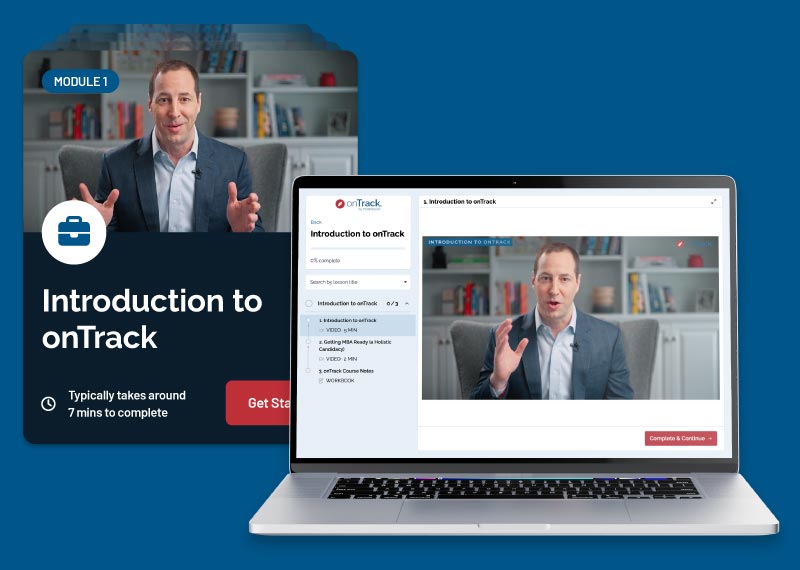
A first-of-its-kind, on-demand MBA application experience that delivers a personalized curriculum for you and leverages interactive tools to guide you through the entire MBA application process.