Blog

London Business School and INSEAD: Which Program Is Right for You?

If you are interested in attending a top MBA program in Europe, you have likely identified the top two programs that are consistently considered the region’s most prestigious—and most selective: London Business School (LBS) and INSEAD.

So how do these programs compare to one another? And what factors should you consider if you are researching these two schools?

In this post, we will take a deep dive into the similarities and differences between LBS and INSEAD.

MBA Admissions Myths Destroyed: Do Alumni Connections Help Get You Admitted?

From time to time, we at mbaMission visit admissions officers at the top-ranked business schools, which gives us the opportunity to ask rather frank questions. On one such visit, we urged an admissions officer to give us the truth about the extent of alumni influence in the admissions process, and the response we got was rather surprising: “We get ten letters each year from [a globally famous alumnus], telling us that this or that MBA candidate is the greatest thing since sliced bread. He gets upset when we don’t admit ‘his’ applicants, but what makes him think that he deserves to decide ten spots in our class?”

Many applicants fret about their lack of personal alumni connection with their target schools, and the myth persists that admission to business school is about who you know rather than who you are or what you can offer. Of course, these latter qualities are much more important, and a standout applicant who knows no graduates at all from the MBA program they are targeting is still a standout applicant and should get in—just as a weak applicant who knows a large number of alumni or a particularly well-known graduate is still a weak applicant and should not get in. Clearly, some extreme exceptions exist where influence can be exerted, but “standard” applicants do not need to worry that every seat at the top programs has already been claimed by someone with good connections.

Keep in mind that the admissions committees want to ensure that a diversity of ideas and experiences is represented in the classroom. Every top MBA class includes people from various socioeconomic backgrounds, nationalities, religions, professional backgrounds, ages, and so on. Harvard Business School, for example, has more than 900 students in each incoming class, and the vast majority of these students do not personally know a CEO or the president of a country. And who knows—these days, such connections could even be a liability.

Chicago Booth School of Business Essay Tips 

The two required application essays for the University of Chicago Booth School of Business complement each other well, allowing candidates to offer insight into both their professional goals and their personal values. Booth also offers applicants significant leeway in how thoroughly they want (or feel they need) to respond to the questions by stipulating a minimum word count of 250 but no maximum. That said, the admissions committee does offer “response guidelines,” encouraging applicants to “think strategically” about how long their essays ultimately are. No doubt Chicago Booth is interested in learning more about you and your story (as fits the given question, of course) but is simultaneously not interested in learning absolutely everything you can think of to share. Our full essay analysis follows.

All About MBA Application Recommendations

Yin and yang, two halves of a whole, a bagel and cream cheese—no, these are not philosophical concepts (or breakfast options); they are ways of thinking about how to choose your MBA application recommenders. Nearly all business schools require two recommendations, and rather than viewing the people who will write them as two discrete individuals, each making a separate point about you, you should think of them as two knowledgeable sources whose letters will complement—and not repeat—each other. If you choose two recommenders who both highlight the same strengths they see in you, you will miss a valuable opportunity to make an impression on the admissions committee.

What Aspiring MBAs Should Know About Pursuing Product Management

Product management is the general business practice within a company that supports and directs all the activities related to planning, developing, marketing, and launching a product. Product managers (PMs) own the product road map, working alongside stakeholders across an organization. 

 class=

Which Industries Use PMs

Tech companies are best known for using PMs for launching new products, but service firms also call on PMs in the process of innovating:

  • Consulting
  • Banking
  • Insurance
  • Analytics
  • Law

For example, Deloitte has begun using AI in its tax and audit work. A product management team builds that kind of automation. And Vanguard has a team of more than a thousand people building out its website and app with digital tools, with PMs leading cross-functional efforts to enhance user experience, drive innovation, and deliver customer-centric solutions.


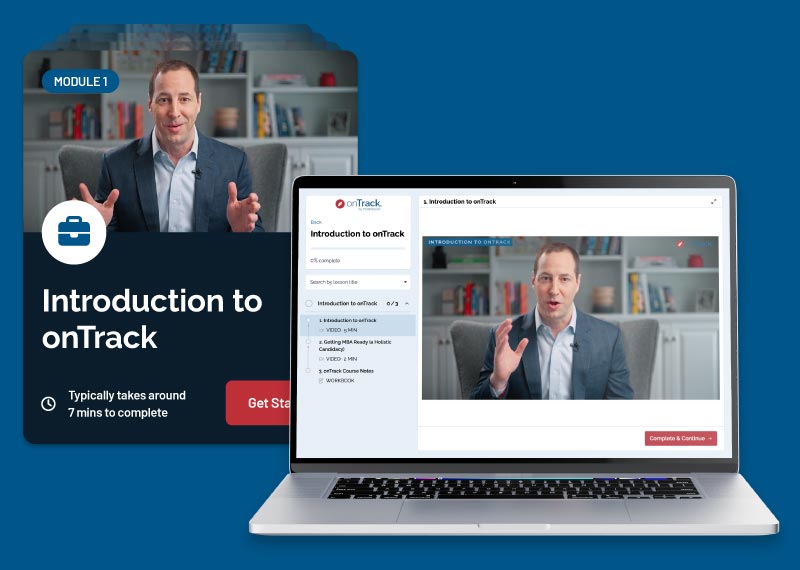
onTrack by mbaMission

A first-of-its-kind, on-demand MBA application experience that delivers a personalized curriculum for you and leverages interactive tools to guide you through the entire MBA application process.


Get Started!

2026–2027 MBA Essay Tips

Click here for the 2025–2026 MBA Essay Tips


MBA Program Updates

Explore onTrack — mbaMission’s newest offering allowing you to learn at your own pace through video. Learn more