Blog

Finanical Times Releases EMBA Rankings

The Financial Times has released its 2006 EMBA Rankings and what is most notable about this year’s list is that in its top-5, six countries are represented (due to joint programs). Wharton remains atop the list, with previously unranked Columbia/LBS coming in second and Kellogg/Hong Kong UST, placing third. See the link above for a complete table, listing the top-85 programs.

NYU Stern Essay Analysis

Essay 1: Professional Aspirations

Think about the decisions you have made in your life. Describe the following: (500 word maximum, double-spaced, 12-point font)

(a) What choices have you made that led you to your current position?

(b) Why pursue an MBA at this point in your life?

(c) What is your career goal upon graduation from NYU Stern? What is your long-term career goal?

Essay 2: Fit with Stern

The NYU Stern community is one of our strongest assets. Please answer the following questions about community:(500 word maximum, double-spaced, 12-point font)

(a) What is your personal experience with the Stern community? What actions have you taken to learn more about us?

(b) How would you contribute to our community as a student?

(c) How will you benefit personally and professionally from the Stern community?

Yet again, because of significant overlap from school to school, we offer our document on personal statements. Please email [email protected] for an electronic copy which will help you approach this essay.

NYU’s only minor deviation is its question “What is your personal experience with the Stern Community…” Stern wants to ensure that you have done your homework and truly understand why it is the right school for you. In order to impress the committee, you will need to discuss a priori experience with the school via alumni, students and/or admissions officers and especially via campus visits. For those who are abroad, it is still possible to learn a great deal by reaching out to the school in order to arrange to speak with current students, for example, by phone. Discussing repeated visits to the schools websites will only mean that you have achieved a minimum; it is vital that you show specific effort in your research and thus purpose in your application.

Essay 3: Personal Expression

Please describe yourself to your MBA classmates. You may use any method to convey your message (e.g. words, illustrations). Feel free to be creative.

All submissions become part of NYU Stern’s permanent records and cannot be returned for any reason. Do not submit anything that must be played or viewed electronically, that is perishable (e.g. food) or that has been worn (e.g. used clothing). If you submit a written essay, it should be 500 words maximum, double-spaced, 12-point font.

In NYU’s famed essay three, you are offered a phenomenal opportunity to differentiate yourself in two distinct ways. First, you can differentiate yourself via the vehicle that you choose to develop your persona. By choosing a creative and captivating avenue, you can grab the attention of the Admissions Committee and compel them to read your content closely. While a baseball card may be captivating, it may not be a good choice because it limits you to a picture, your height, weight, birth-date and a very brief bio; meanwhile, a eulogy theoretically written by your best friend (don’t use this idea, it is now public) is sufficiently broad that it allows you to probe all that is unique about you. Indeed, once you have set yourself apart via your “vehicle” you can continue to differentiate via your content. Ideally, you will exploit the opportunity to showcase a diversity of professional, personal, academic and community accomplishments, few of which will be advertised in essays one or two.

INSEAD Essay Analysis

Note: The following essay questions pertain to the previous academic year. This section will be updated when the new question are released in early to mid-July of 2008. 

1. Give a candid description of yourself, stressing the personal characteristics you feel to be your strengths and weaknesses and the main factors, which have influenced your personal development, giving examples when necessary. (400 words approx.)

While “main factors which have influenced your development” comes later in the question, it seems clear to us that you would be best off providing this context for your experiences before discussing the strengths and weaknesses derived from them, as it is important that you show a cause and effect relationship between your formative experiences and personal characteristics. Although the question advises you to “use examples when necessary,” your story will be strongest if you offer anecdotes consistently; the details of your story will reveal each of your attributes. Still, this should not be a hodgepodge of strengths/anecdotes. You might focus on two/three strengths and one weakness in a mere 400 words.

An important note: it is vital that you be honest about your strengths (don’t tell the committee what you think they want to hear; tell them who you are) and especially about your weaknesses; transparent or disingenuous statements about your weaknesses will not fool anyone and will only reveal you to be a person who cannot critically evaluate him/herself.

2. Describe what you believe to be your two most substantial accomplishments to date, explaining why you view them as such. (400 words approx.)

It is important to offer two anecdotes that reveal different sides of you as an applicant. While one professional accomplishment is “mandatory” for almost all candidates, the other accomplishment can come from your community, personal and possibly from your academic life. It is important that you not forget that there are two elements that need to be tackled, the story of your accomplishment itself and then a reflective element (“why do you view them as such?”). The second half of this question should not be ignored; your personal thoughts are no one else’s and can differentiate you from the pack.

3. Describe a situation taken from school, business, civil or military life, where you did not meet your personal objectives, and discuss briefly the effect. (250 words approx.)

The best failure essays are often those that show reasoned optimism and tremendous momentum toward a goal – a goal that is ultimately derailed. In most cases, you will need to show that you were emotionally invested in your project/experience, which will enable the reader to connect with your story and vicariously experience your disappointment. If you were not invested at all, it is hardly credible to discuss the experience as a failure or learning experience.

It is important to note that INSEAD is not only focused on failures; “not meet(ing) personal objectives” could include setbacks, which allows the door to swing open to include a range of personal experience. For example, you could not discuss an injury that prevented you from competing for an elite college athletic competition as a failure, but it would certainly qualify as “not meet(ing) personal objectives.” You can carefully consider setbacks in which you bear no responsibility for creating the situation; in such a case, again, it is crucial that you show that you were emotionally invested, that events were going in a certain direction and that the situation quickly turned in an unfavorable direction.

Even though INSEAD does not ask for reflection, you should still consider explaining what you learned. It is very easy to offer trite and clichéd statements about your response and what you learned about yourself (Note: everyone learns resiliency – consider another key learning). It will take time to truly create a unique statement about your road forward and lessons learned, but the payoff will come in an essay that is much more personal and self-aware than thousands of others.

4. Discuss your career goals. What skills do you expect to gain from studying at INSEAD and how will they contribute to your professional career? (500 words approx.)

Because of significant overlap from one MBA application to the next, we have produced the “MBA Mission Personal Statement Guide.” We offer our guide to candidates free of charge, via our online store.  Please feel free to download your copy today.

5. Please choose one of the following two essay topics:

a) Have you ever experienced culture shock? What did it mean to you? (250 words approx.), or

b) What would you say to a foreigner moving to your home country? (250 words approx.)

Clearly, with INSEAD priding itself on its international focus, the Admission Committee is trying to get a sense of your cultural sensitivity and international awareness. If you have traveled at all — on business or pleasure — we recommend answering Essay A, as it approaches you in the international sphere. In contrast, Essay B presents you with a stronger domestic knowledge, which is generally less desirable in the classroom. In either instance, it is essential that you offer anecdotes and try to capture the spirit of human interaction; simple country facts will bore, whereas placing the reader in the middle of your experience will be quite compelling.

6. Is there anything that you have not mentioned in the above essays that you would like the Admissions Committee to know? (200 words approx.) This essay is optional.

This essay should only be used if there is something quite compelling that you have not had the opportunity to discuss, or if there is a problem with your application (grades, GMAT, recommender, etc.). This is not an “all purpose” essay or a place to paste an essay from another application.

Yale Essay Analysis

1. Why an MBA?

Please describe your short- and long-term goals and how your previous experience and an MBA will help you to achieve these goals. 500 words maximum Because of significant overlap from school to school, we offer our document on personal statements. Please email [email protected] for an electronic copy which will help you approach this essay.

2. Personal statementPlease develop a question/topic of your choice and answer it in essay form. Please state the question/topic at the beginning of your essay. 500 words maximum

Some example questions/topics include: • Describe a situation in which your leadership and/or teamwork had a significant impact. • What personal achievement are you most proud of and why? • What activities/interests do you enjoy outside the office and/or classroom and how would you integrate these activities/ interests into the Yale SOM community? • What is the most difficult feedback that you have received and how did you address it? • Where is the most exciting place you have ever been and what did you learn from being there? • Describe a situation where you questioned your values and/or beliefs. • What does accountability mean to you? • If you are reapplying: How has your candidacy changed since your last application?

This question is wide open and candidates can be overwhelmed by the possibilities. Generally, we favor essays which are broad and thus give the candidate an opportunity to reveal a few different dimensions his/her profile. Still, it is possible to say a great deal in a single event as well, as long as the event is representative of a diversity of talents/strengths. It is important not to just use your favorite 500 word essay from another school’s application, but to consider if you are maximizing the impact of your candidacy via your choice.

UCLA Essay Analysis

1. Please provide us with a summary of your personal and family background. Include information about your parents and siblings, where you grew up, and perhaps a highlight or special memory of your youth. (Limit to 2 pages.)

The power in this essay comes not from stating facts, but from being reflective and thinking about the events, experiences and people that have shaped your life. While this can be a brief whimsical memoir, it is important that you identify the factors that have made you who you are today. This does not need to be a chronological story, but the reader needs to gain an understanding of a set of values that are imbued in you – whether overtly or implicitly — via your experiences. Not all of this essay needs to be “sunshine”, but if you are going to approach difficult topics it is essential that you do so without bitterness or resentment. This is the committees first and only truly personal introduction to you and you want to implicitly give them a sense of the type of personality and contributor you will be on campus.

2. Discuss a situation, preferably work related, where you have taken a significant leadership role. How does this event demonstrate your managerial potential? (Limit to 1 page.)

With one page, it can certainly be a challenge to keep this essay within its limits. If you are like most candidates, you probably have one obvious choice from your work experience; still, if there is something absolutely remarkable that you achieved elsewhere, via your community experience for example, then it could be worth discussing. As you write your leadership essay, consider whether there is direct cause and effect between your intentions and actions. The reader needs to understand that you were decisive and led with a clear sense of purpose. After you have established how you led effectively, it is important to remember that there is a reflective piece; you need to analyze your skills and offer insight into how you will rely on them again going forward. Note: Many people attempt to write about how the experience gave them more confidence as a leader and that they will be more inclined to seek leadership in the future; this is the most obvious conclusion and thus is terribly clichéd; it does not even directly address your managerial potential.

3. Discuss your career goals. Why are you seeking an MBA degree at this particular point in your career? Specifically, why are you applying to UCLA Anderson? (Limit to 2 pages.)

Again, because of significant overlap from school to school, we have produced a document on personal statements and are more than happy to offer it to anyone interested. Please email [email protected] for an electronic copy which will help you approach this essay.


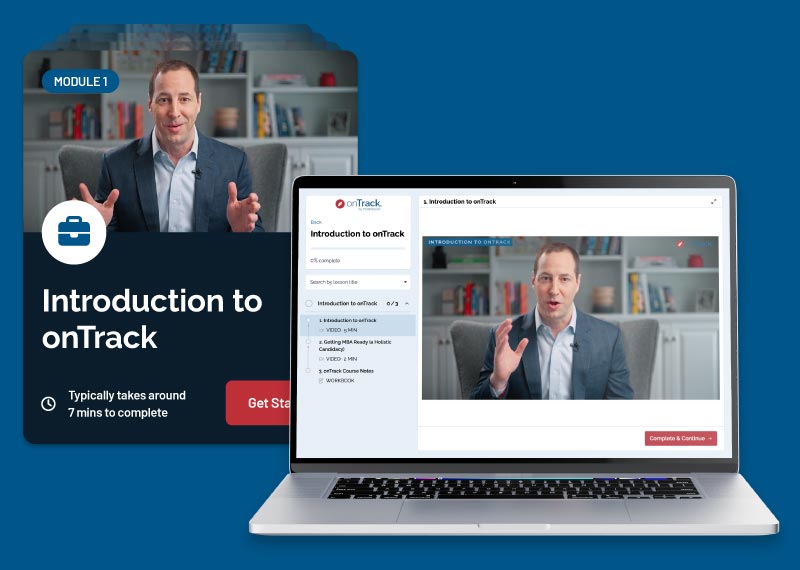
onTrack by mbaMission

A first-of-its-kind, on-demand MBA application experience that delivers a personalized curriculum for you and leverages interactive tools to guide you through the entire MBA application process.

Get Started!

2026–2027 MBA Essay Tips

Click here for the 2025–2026 MBA Essay Tips


MBA Program Updates

Explore onTrack — mbaMission’s newest offering allowing you to learn at your own pace through video. Learn more