Blog

Wall Street Journal: The Admission Police

In today’s Wall Street Journal, Jon Weinbach writes about the growth in the background check industry, specifically pertaining to undergrads and MBAs (”The Admissions Police”).

While this article may strike fear into your heart, the bottom line is that it is only a threat to the guilty. Schools are not seeking to interrogate the innocent, but to find the obvious fabrications, lies and mistruths. If you have been honest – as you should have been – then rest easy….

Ross: Class of 2009 Stats

Earlier this week, the Munroe Street Journal, the student newspaper at the University of Michigan’s Ross School of Business, published an article from Soojin Kwon Koh, Director of Admissions, on this year’s admission cycle to date (Admissions breaks down the incoming Class of 2009).

Some highlights:

  • 31% increase in applications
  • Four point rise in GMAT scores
  • Eight more countries represented (from 31 to 39)

What was most interesting about this article is that Soojin Kwon Koh states that the rise in applications is coming from individual candidates applying to more schools and that, because of this trend, Ross will have to fight for each candidate. She offers a clear call to action from the community to help keep the yield high by enaggeing candidates.

Wharton Keeps Banks at Bay, Invites UBS into the Admissions Suite

In our previous Blog entry, we offered a link to a Bloomberg article on increased salaries for MBAs and heightened competition for MBA talent amid top-banks and consulting firms. In the article, career services offices were shown to be protecting students from over-zealous recruiters. In particular, Bloomberg cited Wharton:

“The Philadelphia business school…limited the number of events this academic year to three per company. Wharton also delayed the start of on-campus recruiting until late October to give students time to settle in. ‘We wanted to reduce the frenzied perceptions by some students that they had to attend all 15 events to show they were really interested in a particular company’”

Two days later, Wharton announced a $1.25 Million Gift from UBS for its MBA Admissions Suite. While it is certainly well within Wharton’s rights to accept this donation, can an objective reader assume that UBS gave $1.5 with no expectation of increased influence?

Cambridge University (Judge) Essay Analysis

Immediately after the rush of January deadlines, we asked candidates a simple question: What Next? We offered a variety of options: relax, look east (apply to European MBA programs), look North (apply to Canadian MBA programs) and consider the third round or safety schools.

Today, we continue our MBA Essay Analysis series, with another “Look East,” exploring the University of Cambridge’s Judge Business School. Our series will continue with additional analysis of Canadian and European MBA programs in the coming weeks.

Essay 1: What are your short-term and long-term career objectives? What skills / characteristics do you already have that will help achieve them? How will the Cambridge MBA help you? (Please do not exceed 400 words in total.)

Once again, because of significant overlap from school to school, we offer a document that we have produced on personal statements. Please email [email protected] for an electronic copy which will help you approach this essay.

Describe a work project or task that you found difficult or which did not go well. What would you have done differently in retrospect?

While this essay can be interpreted as a classic failure essay, it is also open to experiences that were not complete debacles, but were merely disappointing. Nonetheless, even with this broad interpretation, the key elements of the story remain the same. The best failure/disappointment essays show reasoned optimism and tremendous momentum toward a goal – a goal that is ultimately derailed. The writer will need to show an emotional investment in his/her project/experience, which will enable the reader to connect with the story and vicariously experience the disappointment. If the writer were not invested at all, it is hardly credible to discuss the experience as a failure or learning experience.

Of course, the reflective element is vitally important. It is very easy to offer trite and clichéd statements about “what you would have done differently.” (Note: everyone learns resiliency – consider another key learning) It will take time to truly create a unique statement about the road forward and lessons learned, but the payoff will come in an essay that is much more personal and self-aware than thousands of others.

How would you like to be remembered?

This is quite possibly the most unusual question of all, among the domestically and internationally recognized MBA programs. While many approaches could work as the candidate tries to answer this question creatively, the key will be to imagine a life unfolding and then further ponder ultimate dreams achieved. We would advise candidates to show some altruism and consider their impact on others in various spheres (the magnanimous boss and charitable community member come to mind) as the root of an interesting essay.

Oxford University (SAID) Essay Analysis

Immediately after the rush of January deadlines, we asked candidates a simple question: What Next? We offered a variety of options: relax, look east (apply to European MBA programs), look North (apply to Canadian MBA programs) and consider the third round or safety schools.

Today, we continue our MBA Essay Analysis series, with a “Look East,” exploring the Oxford University’s Said Business School. Our series will continue with additional analysis of Canadian and European MBA programs in the coming weeks.

Essay 1: Explain why you chose your current job. How do you hope to see your career developing over the next five years? How will an MBA assist you in the development of these ambitions? (1000 word maximum)

Once again, because of significant overlap from school to school, we offer a document that we have produced on personal statements. Please email [email protected] for an electronic copy which will help you approach this essay.

Still, we would like to make readers aware of a “twist” in this essay is: “How do you see your career developing over the next five years?” While HBS is shifting to a broad career vision in its goal essay, Oxford is taking an entirely different path, asking for a detailed plan of action. Thus, it is important that candidates be quite specific about their future positions, ambitions and possible progressions, as Oxford wants to be sure that you will execute.

Essay 2: Which recent development, world event or book has most influenced your thinking and why? (2000 word maximum)

With this essay, Oxford is clearly signaling its desire to attract intellectuals – those who are open to ideas, engaged in contemporary issues and willing to flexibly consider their own opinions and viewpoints. Thus, regardless of whether you choose a recent development, world event or book, you will need to offer a thorough and educated discussion of the issue and then relate it directly to your thoughts. A simple discussion of the war on terror, for example, will not do – the reader wants to know not just about the event, but also about how and why you have changed because of it. We offer two cautionary notes:

1) Be careful to avoid the most publicized of global events or the most popular of contemporary books, unless you can break new ground and offer unique analysis or relate it to yourself in an unusually compelling way

2) Be very careful when expressing personal political opinions; this is not the place for a polemic.


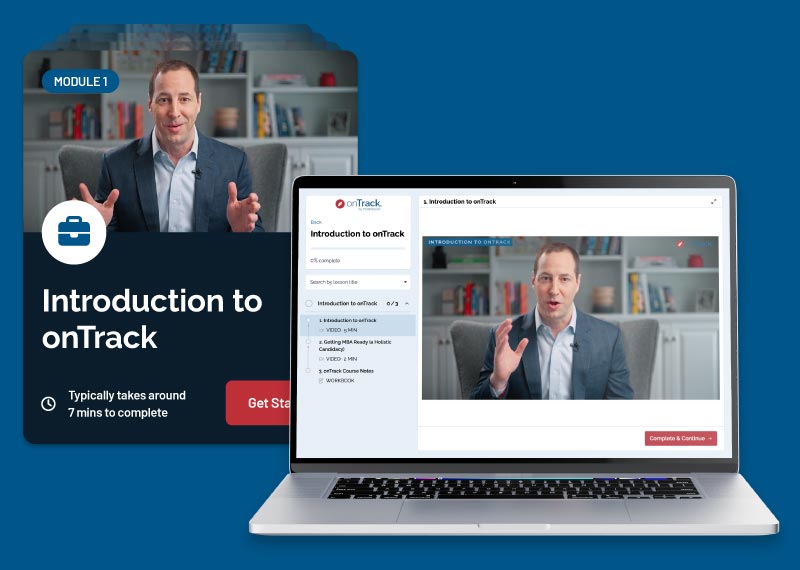
onTrack by mbaMission

A first-of-its-kind, on-demand MBA application experience that delivers a personalized curriculum for you and leverages interactive tools to guide you through the entire MBA application process.

Get Started!

2026–2027 MBA Essay Tips

Click here for the 2025–2026 MBA Essay Tips


MBA Program Updates

Explore onTrack — mbaMission’s newest offering allowing you to learn at your own pace through video. Learn more