Blog

Part II of MBA Mission’s Interview with the Author of “Ahead of the Curve: Two Years at Harvard Business School”

Yesterday, we posted the first part of a two part interview with Philip Delves Broughton, an HBS graduate (’06) who wrote the controversial book, “Ahead of the Curve.”  We interviewed Delves Broughton to better understand his intentions and motivations as well as others’ reactions to his book and are publishing the second part of the interview below:

PART II

MBA Mission: You poke fun at a few characters who take the HBS experience quite seriously.  Is there room at HBS for such people?

Delves Broughton: Yes, of course. Business needs people who make things go. It can’t be run by a lot of cynical, artsy types. Business is serious and needs hard-driving, committed types. But I also think it needs people with perspective, who perceive the true nature of what it is they are doing, people who are capable of taking the right things seriously and possessing a complete sense of their responsibilities. When this is lacking, businesses can become alienating places both for employees and for the rest of society who must suffer the consequences of business’ excessively blinkered behavior.
 
MBA Mission: Should HBS have more Arthur Harveys (Note: Harvey is put forth as an incorruptible, anti-capitalist foil)?

Delves Broughton: I doubt Arthur would ever have cared to go to HBS. But yes, HBS could certainly use more people who see the way business operates from multiple perspectives, not just that of senior management. What does it mean when big food companies lobby government to loosen organic food regulations? It may be good news for food companies trying to exploit consumer interest in organic. But is it honest? Is it helpful to society? Is this even a decent long term business strategy? Or is it self-defeating? Businesses these days like to talk about listening to multiple stakeholders, but you wonder, do they really give a damn? Men like Harvey bring these issues into their proper perspective.

MBA Mission: What more would you like to have gotten out of Harvard Business School?

Well, the problem is that business people think that their way of doing things is best way. This message is a pretty strong one at Harvard Business School. When I went to business school, I went to learn about business. I didn’t want to be taught that it is my duty to go out and run the world. I wanted to be taught to run a business, which I think is perfectly worthwhile to do, and I wish they would have just stuck to that.

MBA Mission:  When Harbus critiqued your book, the BMW line and the booze luge seemed to really draw their ire. (Note: Delves Broughton tells the story of a student who suggests that many students manipulate financial aid to buy luxury cars and also reveals a hard partying lifestyle via a “booze luge” at a party).

Delves Broughton: Well, it’s two pages of a 300 page book… I feel they’re being slightly Orwellian about this and it’s almost like a political campaign where you focus on minutiae to avoid discussing big issues. If you want to make a fuss about the BWW and the booze luge, which they’ve chosen to do, I include those things as part of the experience, which they were.

But you know no one wants to talk to me about Arthur, you’re the first person who’s asked me about Arthur Harvey. Or, you know, my discussion of Michal Porter’s 5 horses, [or] how business can be used in government and all these things, which the book is full of. Half of them never bothered to. . .they’ve never been in touch with me. Which, I don’t mind, but they’ve never bothered to engage on these things.

They never want to talk about work-life balance, they put out this message that I’m a sort of bitter grad of the school, you know, that I’m full of sour grapes. I’m absolutely not. I very much enjoyed, I’ve given money to the school in the past since graduating. I’m merely trying to do my own thing. I think it’s something they feel very uncomfortable with…. I think that an institution of that power and influence merits discussion and criticism and praise and all these things…

MBA Mission: So, HBS focuses too closely on these two sections and possibly shoots the messenger?

Delves Broughton: I’ve been a journalist, I know the way these things work… This is the truth: that they like to think it is a book about Harvard Business School, it has Harvard Business School on the cover, you can’t get away from that. But, you know what’s really interesting is when I’m talking to people for whom it’s just a name, they just couldn’t care less about the booze luge and the BMW. What they want to talk about is work-life balance, entrepreneurial living….They want to talk about the big things which really keep you going. How can I make buck and still see the people I love? How can I do something interesting in my life and not drop dead having bored myself to tears so I can pay the rent. There are the big things, and that’s what the book is really about…

MBA Mission Interviews Author of “Ahead of the Curve: Two Years at Harvard Business School”

Earlier this year, Philip Delves Broughton, an HBS graduate (’06) and former New York and Paris Bureau Chief for the Daily Telegraph (London), caused a stir when he released a book detailing his experiences at HBS. In “Ahead of the Curve” Delves Broughton revealed both positive and negative sides of his experience at HBS, but drew attention because so many considered this to be a broad representative experience. Recently, we interviewed Delves Broughton to better understand his intentions and motivations as well as others’ reactions to his book.

The first part of our two part series follows below. We will publish the second part tomorrow:

PART I

MBA Mission: You wrote a great deal at the beginning of your book about how powerful the Harvard Business School (HBS) network is, and now you’ve written a book that has clearly drawn the ire of many an HBS grad. Have you noticed a decrease in invitations to cocktail parties?

Delves Broughton: No, no, I’ve never worried about that. I’ve just got my fundraising letter, as usual, so that hasn’t stopped. No, I haven’t heard from anyone who is hostile- but I’ve had a lot of positive reaction, because this is the truth of it…There’s often this gap between what the institution says about itself and what it does and the way it behaves, along with the kind of attention and some of the ambitions of some of the human beings inside them…

My book isn’t an anti-business book, it’s [about] how do we make this work for us as people? How do we get away from the kind of rah-rah chest bumping/chest-beating kind of act we’re seeing so much in business? I think it’s alienating for a lot of people, even people who do well…

MBA Mission: Did you feel like your experience was shared by many or by few in your class?

Delves Broughton: You know it’s my experience, it isn’t anyone else’s, but I think a lot of people see pieces of themselves in it. Not everyone is me — that’s fairly obvious. But I think a lot of people see that pressure to conform, it can be oppressive. A lot of people refer to the notion of I’m very lucky, I know this is a great thing to be doing, but yet there’s something that makes me uneasy about all this.

I’ve been really surprised at who gets back to me, and it’s not just all the liberal arts majors who like this book. I’ve had emails from Asian women immigrants who end up in business school, who in many ways are classic success stories. They read it and they say, You know what this is resonating with me because parts of pursuing success as defined by Harvard Business School make me feel very uncomfortable…You’ve got to have a sympathy or empathy towards it.

MBA Mission: Have you had any positive reaction from within HBS?

Delves Broughton: I’ve had emails from a lot of people in my classes. I’ve had email from people at the school, and you know people say the same things. They use the term “brutally honest.” I’m not brutally honest, I just try to be honest, but I think it seems brutal because a lot of people aren’t very honest about this whole business school, the institution. People are kind of afraid to say, “I’m not going to tell the truth or talk about an experience like it isn’t 100% positive.” Of course, the truth is very few experiences are, so why should all business school be 100% positive? My books accentuates that it’s about 75-80% positive and about 5% not so positive…

I think that an institution like Harvard Business School. . .essentiality the problem is that people either expect you to be 100% cheerleading for it, saying this place walks on water, or you have to be one of these people who likes kicking it. It’s very hard for people to see you as neither, and that’s what I am..

MBA Mission: Is HBS secure as an institution?

Delves Broughton: I think all business schools are insecure about one key question: can business actually be taught? It’s not like law or medicine where you need to go to school to succeed. So what is it they’re teaching? Do they have a place on a university campus? The other strange thing about HBS is that it often acts more like a corporation, fiercely protective of its image as if guarding a stock price, and less like an educational establishment, open to criticism and inquiry. Which is probably a sign of some kind of insecurity.

MBA Mission: You spend a lot of time discussing work life balance versus the intense demands of corporate America. Is balance an HBS problem or is this a problem of the world as it is today? Would balance issues not occur in any business school?

Delves Broughton: To an extent, yeah, and I hope that my book has kind of a broader resonance. I’m trying to describe through my experience. I know these problems exist for a lot of people, you’re right. Here’s the thing. It’s that I think writing about Harvard Business School is so interesting because here you have 900 people who essentially have all the choices in the world….These people in theory could pick and chose the life they want. In many ways they accept the fact that their personal lives are kind of going to have to go to hell… Why do they feel like that? I think that more people should stand up and say that they demand more out of their professional and personal lives. I sort of wish institutions like HBS were more aggressive about this.

MBA Mission in Crain’s Business New York… Again.

Jeremy Shinewald was recently quoted in Crain’s Business New York in an article entitled, “As economy sputters, grad schools overflow.” Discussing how the global financial meltdown would impact students’ abilities to finance their own educations, Shinewald stated, “(Some) graduate students finance education via the sale of a house or liquidation of investments…Many people will be reluctant to do so if they are under water. This is going to mean more students will look for loans.” Fortunately, it was also noted in the article that domestic students will not need to worry about securing these loans, as the Stafford Federal Loan Program and the Federal Graduate PLUS Program enable students to borrow up their full tuition. However, international students are facing an uncertain future as Citigroup has cancelled the CitiAssist program, which allowed international students to borrow funds without a domestically based co-signer.  We are expecting announcements from schools in the coming weeks to discuss how they will facilitate lending for international students going forward.

Leading Admissions Officers to MBA Mission: Rounds One and Two are Virtually Equal in Terms of Selectivity

MBA Mission Exclusive 

The main admissions story thus far this year has clearly been the expected surge in applications due to the faltering economy. However, because much of the recent Wall Street carnage occurred so close to many schools’ first-round deadlines, those caught by surprise had little time to take the GMAT and submit first-round applications. As a result, numerous candidates are now concerned that they will be applying too late this year because they perceive that many places will already be given away in the first round —anxieties previously reserved not for second-round, but for third-round applicants. Well, mbaMission connected with Admissions Officers at several leading business schools and can confirm for our clients that there is plenty of scope left for submitting winning MBA applications.

For instance, we connected with Rose Martinelli, Associate Dean, Student Recruitment & Admissions, at the Chicago Graduate School of Business, who stated, “I would like to temper all this incredible pressure on applicants. What is most important is to apply well.” She then added, “Between Rounds 1 and 2 there is very little difference (in terms of selectivity)…  I can assure you that schools will not take 100% of their class from the first round. We look for the best applicants throughout the entire year, even in Round 3.”

This sentiment was echoed by Peter Johnson, Director of Admissions at UC-Berkeley’s Haas School of Business, who told mbaMission, “I think candidate anxiety may be out of proportion with the actual situation…. In the past, chances of admission to the Berkeley MBA Program in Round 2 have been almost identical to those in Round 1.” Johnson noted that in Haas’s final round, its fourth, chances will be “slight” and encouraged candidates to submit applications by the third round.

Similarly, Beth Flye, Director of Admissions and Financial Aid at Kellogg, urged calm and patience: “First, it is most important that candidates apply when they are ready to submit their applications, as the overall process involves a lot of time, including much thought and reflection… Candidates interested in Kellogg should not operate on the assumption that they have missed the boat if they do not apply for the first application round.” Ms. Flye added, “Selectivity tends to be about the same for both the first and second rounds.”

Meanwhile, Yale’s Director of Admissions, Bruce DelMonico, regards the first two application rounds as “functionally equivalent in terms of both selectivity and scholarship availability.” He too emphasized that the final round can be more challenging, but urged candidates to be thoughtful and “submit their strongest application.” He added, “They shouldn’t rush to apply (with weaker applications) sooner.”

Clearly, there are no “new rules” for MBA applicants this year. While it can be nerve-wracking to apply in a competitive year, if you want to pursue an MBA next year, you should rest assured that you can still submit a competitive application this year. Resist the temptation to focus on the competition and instead focus on creating the most impressive and interesting application you can in order to standout from the crowd, capture the imaginations of admissions committees and take that next, exciting step in advancing your career.

IMD Essay Analysis, 2007-2008

1. Please describe the situation you will be seeking after graduation (please specify position, responsibilities, industry, location, etc.). Very briefly give us your short-term, mid-term, and long-term goals and objectives. (1,230 character limit)

Amid very tight word constraints, you will need to offer very precise details of your short-term position, but thereafter can broaden your scope significantly with your mid-term objectives and especially with your “ultimate” objective. The key to this bullet of an essay is to show continuity in your objectives, from the present throughout your career and also to show distinct ambition – certainly a tall task in approximately 200 words.

2. What do you consider your single most important achievement and why? (1,230 character limit)

3. Please describe two situations, business or otherwise, in which you were involved and which were of importance to you. Explain why you view them as such. (1,230 character limit each)

Essays two and three are very similar; the key is to choose a diversity of accomplishments within these three opportunities. (Clearly, candidates’ answers will vary significantly, based on different professional, personal, community or academic accomplishments.) It is important that you not forget that there are two elements that need to be tackled, the story of your accomplishment itself and then a reflective element (“why you view them as such”). The second half of this question should not be ignored; your personal thoughts are no one else’s and can differentiate you from the pack.

4. Please comment on a situation where you failed to reach an objective and what you learned from it. (1,230 character limit)

The best failure essays show reasoned optimism and tremendous momentum toward a goal – a goal that is ultimately derailed. You will need to quickly show that you were emotionally invested in your project/experience, which will enable the reader to connect with your story and vicariously experience your disappointment. If you were not invested at all, it is hardly credible to discuss the experience as a failure or learning experience.

Of course, the reflective element is vitally important. It is very easy to offer trite and clichéd statements about your response and what you learned about yourself (Note: everyone learns resiliency – consider another key learning). It will take time to truly create a unique statement about your road forward and lessons learned, but the payoff will come in an essay that is much more personal and self-aware than thousands of others.

5. Describe a situation where you had to demonstrate strong leadership skills. Explain how effective you were and what you learned. (1,230 character limit)

In this essay, you will need to show a clear cause and effect relationship between your actions and the resulting implication for others. A successful essay will show how you took specific steps to produce the desired results, focus on the results themselves and then, most importantly, add a reflective element, explaining the personal significance or learning, via the experience. This essay does not demand that you exemplify rousing leadership — the goal is to show how you exercise your influence and bring about a new and better reality. 

6. How do you imagine your superior would describe your strengths and weaknesses to someone who does not know you? (1,230 character limit)

With respect to your strengths, even in such a short space, it is vital that you offer evidence of them by way of examples. Being insincere with your weaknesses and offering disguised strengths will only show that you do not have the capacity for self-reflection or the ability to manage criticism. You might find it difficult to be forthright, but by identifying those that are not damning (meaning those that are not critical to your success at IMD), you will gain the credit that disingenuous statements (i.e., “My weakness is that I am too passionate about my work…”) will only undermine. 

7. What is motivating you to seek an MBA education at IMD? (1,230 character limit)

Because of significant overlap from one MBA application to the next, we have produced the “MBA Mission Personal Statement Guide.” We offer our guide to candidates free of charge, via our online store.  Please feel free to download your copy today.

8. What will you be able to contribute that will make you a valuable addition to the IMD MBA class? (1,230 character limit)

In such a short space, candidates should consider limiting their contributions to one or two themes, possibly one professional (subject relevant expertise) and one interpersonal element (facilitator, diplomat). Again, in such a short space, it may seem difficult to offer examples, but they are the evidence that the committee needs to truly understand your assertions. Further, it is not enough to just state your contribution; you should take the additional step of showing your contribution in action.

9. If you are not admitted, what alternatives will you consider? (1,230 character limit)

This essay can be a conundrum for some; the key to a successful essay is to show that you will still progress, but that you will nonetheless have an identifiable need for your MBA as well. Essentially, you want to show that your career will not grind to a halt, but that you could better approach your tasks and reach your ambitions with an MBA and will either reapply or simply attempt to acquire your MBA via de facto experience.


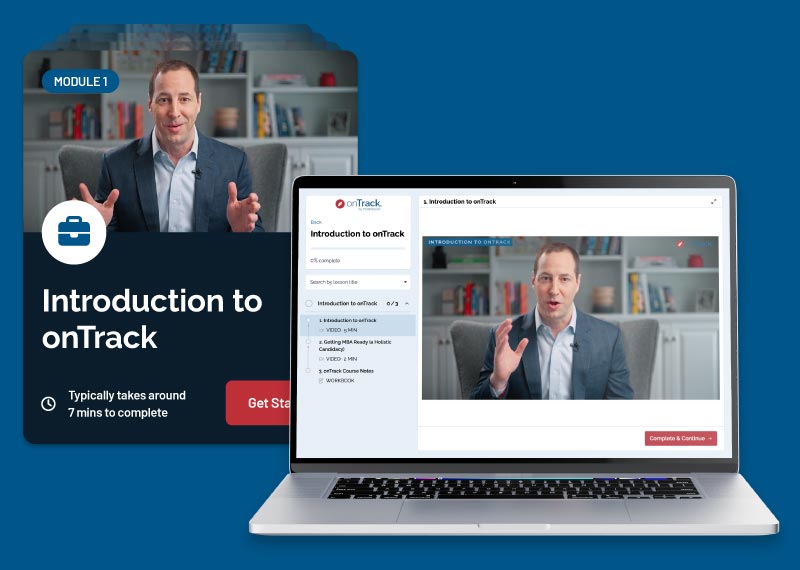
onTrack by mbaMission

A first-of-its-kind, on-demand MBA application experience that delivers a personalized curriculum for you and leverages interactive tools to guide you through the entire MBA application process.

Get Started!

2026–2027 MBA Essay Tips

Click here for the 2025–2026 MBA Essay Tips


MBA Program Updates

Explore onTrack — mbaMission’s newest offering allowing you to learn at your own pace through video. Learn more