Blog

Free Complete Start to Finish Guide!

mbaMission is growing its presence on Twitter. Until July 15th, anyone who either already follows mbaMission  or starts to follow us on Twitter (@mbamission) and re-tweets our offer for a free Complete Start to Finish Guide — an offer made on our own Twitter feed — will receive a guide. All you have to do is retweet, sit back and wait for us to reach out to you with our guide!

Mission Admission: Clearly, You Are Not Anonymous

Mission Admission is a series of MBA admission tips; a new one is posted each Tuesday.

Last year at this time, many MBA applicants were fretting about their futures, because of an investigation into users of the Scoretop.com website, a site which was designed to provide those studying for the GMAT with actual questions from the test. In 2005, one-hundred and nineteen applicants were rejected by HBS for trying to access their admissions decisions online prior to the release date.  In 2003, Darden rejected an applicant for making statements on the BusinessWeek message boards which were not consistent with the school’s Honor Code. In short, people have a tendency to think that the web is an anonymous place, where their actions won’t follow them. Of course, as the scandals above show, they are wrong. Whether you are publicly displaying your private life on your Facebook or MySpace page or you are surfing the web without identifying yourself, you should certainly be careful not to violate any principles of good practice. Such violations can follow you and adversely affect your fate.

New York University (Stern) Essay Analysis, 2009-2010

As promised, our NYU Stern essay analysis follows….

Essay 1. Professional Aspirations
(750-word maximum, double-spaced, 12-point font)
Think about the decisions you have made in your life. Answer the following:
(a) What choices have you made that led you to your current position?
(b) Why pursue an MBA at this point in your life?
(c) What is your career goal upon graduation from NYU Stern? What is your long-term career goal?

Because Personal Statements are similar from one application to the next, we have produced the “MBA Mission Personal Statement Guide.” We offer this guide to candidates free of charge, via our online store.  Please feel free to download your copy today.

For additional information on the NYU-Stern experience, please consult the MBA Mission Insider’s Guide series.

Essay 2. Your Stern Experience
(500-word maximum, double-spaced, 12-point font)
We take great care to shape the Stern community with individuals who possess both intellectual and interpersonal strengths. We seek individuals who are highly intelligent, collaborative, and committed to flourishing as Stern leaders. Please answer the following questions:
(a) What is your personal experience with the Stern community? Tell us what actions you have taken to learn about us.
(b) Describe what most excites you about Stern from both an academic and extracurricular perspective.
(c) How do you anticipate making your mark on the Stern community? Be specific about the roles you will take on and the impact you hope to achieve.

New York is an incredible asset for an MBA program, as it keeps students close to professional opportunities and attracts many great MBA candidates who simply love the city. However, from NYU’s perspective, New York can also be a liability, as many students who have worked in New York may be more focused on the lives that they have thus far been living, instead of immersing themselves in the Stern community. Stern is determined to select candidates who will truly buy-in to the community and this essay is a first step in weeding out those who have not done their homework or simply do not understand the nature of the experience.

To make your impression on the MBA Admissions Committee, you will need to discuss a priori experience with the school, via your personal interactions with alumni, students and/or admissions officers, and especially via a campus visit. For those who are abroad, it is still possible to learn a great deal by reaching out to the school to arrange to speak with current students or alumni by phone or to attend Stern outreach events abroad. Discussing repeated visits to the school’s Web sites will show only that you have achieved a minimum; it is vital that you show specific effort in your research and thus purpose in your application. Additionally, as you explore “what most excites you about Stern from an academic and extracurricular perspective” it is important that you not just create a long list of classes and professors, but that you connect and apply these experiences to your goals and interests. (Again, please consult the MBA Mission Personal Statement Guide, for examples.) Similarly, as you discuss your “mark on the community,” it is not sufficient to list the clubs you will join. It is important that you show how you will immerse yourself in the Stern community — remember, the school wants to see “impact.”

Essay 3. Personal Expression
Please describe yourself to your MBA classmates. You may use almost any method to convey your message (e.g., words, illustrations). Feel free to be creative.
All submissions become part of NYU Stern’s permanent records and cannot be returned for any reason. Please do not submit anything that must be viewed or played electronically (e.g., CDs, DVDs, MP3s, online links), that is perishable (e.g., food) or that has been worn (e.g., used clothing). If you submit a written essay, it should be 500 words maximum, double-spaced, 12-point font. If you are not submitting Essay 3 online, you are required to upload a brief description of your submission in your online application. Please note that on the online application checklist, you must select “Submitted Online” for Essay 3 even if you are mailing it.

In NYU’s famed essay three, you are offered a phenomenal opportunity to differentiate yourself in two distinct ways. First, you can differentiate yourself via the vehicle that you choose to reveal your persona. By choosing a creative and captivating format, you can grab the Admissions Committee’s attention and compel them to read your content more closely. Remember though, while a baseball card may be aesthetically pleasing, it may not be a good format because it limits the information that you can convey (a picture, your height, weight, birth date and a very brief bio). Instead, if you were to write a eulogy theoretically written by your best friend (don’t use this idea; it is now public) it would be sufficiently broad to allow you to probe all that is unique about your profile. Indeed, once you have set yourself apart via your “vehicle,” you advance the second mode of differentiation – your content. Ideally, you will exploit the opportunity to showcase a diversity of professional, personal, academic and community accomplishments, few of which will be advertised in essays 1 or 2. Essay three is the ideal opportunity to reveal your true personality and “likeability” beyond your professional/academic competencies.

Northwestern University (Kellogg) Essay Analysis, 2009-2010

Essay 1
a) MBA Program applicants – Briefly assess your career progress to date. Elaborate on your future career plans and your motivation for pursuing a graduate degree at Kellogg. (600-word limit)

Because Personal Statements are similar from one application to the next, we have produced the “mbaMission Personal Statement Guide.” We offer this guide to candidates free of charge, via our online store. Please feel free to download your copy today.

For a thorough exploration of Kellogg’s academic program/merits, defining characteristics, crucial statistics, social life, academic environment and more, please check out the mbaMission Insider’s Guide to Kellogg.

Essay 2 – Describe your key leadership experiences and evaluate what leadership areas you hope to develop through your MBA experiences (600-word limit)

In this essay, you might offer two simple vignettes that showcase your leadership via a narrative, then evaluate yourself and illustrate certain areas for development. Although you are expected to be critical in discussing these areas for development, you should not deride your existing skills. Rather than thinking about ways in which you are lacking as a leader, you should focus on true opportunities to become a more complete and capable one. In this essay, (much as in Essays 1 and 3), specific reference is made to your future MBA experience. So, in answering this question, you should seize the opportunity to create a connection between yourself and Kellogg by showing that you understand how the school’s resources will facilitate your development as a leader.

Essay 3 – Assume you are evaluating your application from the perspective of a student member of the Kellogg Admissions Committee. Why would your peers select you to become a member of the Kellogg community? (600-word limit)

No doubt, many candidates will wonder whether they should respond to this question in first person or third person. We would guess that most applicants will choose to respond in third person, but there really is no right answer. What is important is that your content is compelling.

Because this essay is so open-ended, we strongly recommend that you outline your thoughts and try to avoid reviewing every single element of your profile. Many candidates will fail to write a compelling essay and will instead give brief attention to their transcript, GMAT score(s), professional history, community activities, personal life, etc. You only have six 600 words, so give careful thought to what a dispassionate outsider might think about you, and play to your strengths rather than surveying everything. In short, we encourage candidates to think in terms of anecdotes for this essay and not default to simply “listing” qualities and accomplishments.

A strong self-assessment will prepare you to not merely reiterate experiences but to instead effectively bring color to certain experiences and attributes and then apply them to the Kellogg community. By doing so, you will not only reveal your strengths and place them in a unique light, but you will also show your fit with Kellogg and prove to the Admissions Committee that you profoundly understand how you will contribute.

(Note: We strongly advise that you not get bogged down in discussing your GMAT score and/or GPA.)

Essay 4 – Complete one of the following three questions or statements. (400-word limit)
Reapplicants have the option to answer a question from this grouping, but this is not required.

a) Describe a time when you had to make an unpopular decision.

It is oh-so-difficult to be unpopular, and writing about being unpopular is even more difficult. Candidates should not make the mistake of simply writing about a challenging decision, but should make sure to write about a decision that was met with significant opposition. Of course, the reader will be interested in how you made your decision, how it was received and how you resolved the issue of its unpopularity (or did not resolve it). It is important that the reader not learn only that you made a tough call, but also that you followed through or reconsidered your decision and what you learned as a result of doing so.

b) People may be surprised to learn that I….

We suggest that candidates give profound thought to the image that they have presented thus far in their application and other essays before writing this essay. Many applicants believe that they are offering a unique window into their experiences and personality when they are really only offering a different side of the same coin: “You know that I am an engineer, but did you know that I also do training?” (This just won’t work.)

The reader needs to be truly surprised by what he/she learns about you and should be pleasantly shocked—the former college shot putter now performs in an ethnic dance troupe, for example. Of course, your story need not be as over the top as this, but the reader should certainly have the opportunity to get to know a new and ideally courageous side of you that he/she may not have otherwise expected or seen.

c) I wish the Admissions Committee had asked me……

This essay is essentially an open invitation to present anything vital about yourself—compelling stories or differentiators—that you have not otherwise been able to showcase. Basically, you could not ask for a better opportunity to explain to the Admissions Committee how you are unique. Many candidates use this essay to discuss a particular hobby or interest. If this is your choice, your inordinate passion for the activity in question must be fully and clearly expressed—otherwise, this window into your life will be boring and unconvincing. Ask yourself, “How can I show that I take this passion further than others?” This essay should not be a fallback option you choose because you have run out of creative ideas. Rather, it should allow you to offer your reader something exceptional about yourself and add depth of character to your application.

Required essay for reapplicants only – Since your previous application, what steps have you taken to strengthen your candidacy? (400-word limit)

Whether you have improved your academic record, received a promotion, begun a new and exciting project, increased your community involvement or taken on a personal challenge of sorts, the key to this essay is conveying a very deliberate path of achievement. Kellogg wants to know that you have been actively striving to improve, and that you have seized opportunities during the previous year to do so, because a Kellogg MBA is vital to you. This essay question will vary greatly from one candidate to the next, as each person’s needs and experiences will differ. We are more than happy to provide one-on-one assistance with this highly personal essay to ensure that the above requirements are met.

Massachusetts Institute of Technology (Sloan) Essay Analysis, 2009-2010

MIT-Sloan takes a slightly different approach with its essays compared to most top schools.  The admissions committee has stated explicitly in various admissions chats that Sloan’s application is unique in that it focuses exclusively on examples of candidates’ past behaviors. The committee is more interested in the details of an applicant’s story and his/her actions and decision-making than in the results/conclusion or in fact the candidate’s ultimate success.

The committee also requests that applicants use fairly current examples, ideally from the past three years. A successful accomplishment that occurred more than five years ago is less appealing to the committee than one that may not have turned out the way the applicant had intended, but still took place more recently.

In writing your essays, you would be well served to keep in mind the phrase “past behavior is a predictor of future success.” 

Cover Letter:Prepare a cover letter (up to 500 words) seeking a place in the MIT Sloan MBA Program. Describe your accomplishments and include an example of how you had an impact on a group or organization. Your letter should conform to standard business correspondence and be addressed to Mr. Rod Garcia, Director of MBA Admissions.

You will note that unlike most schools, Sloan does not ask for MBA candidates to discuss either future goals or “why Sloan.”  This is not an oversight!  In keeping with its conviction that past behavior is the best predictor of future success, Sloan wants applicants to emphasize past actions and thought processes rather than long-term aspirations.  Rather than paraphrasing what the admissions committee wants, we will let Admissions Director Rod Garcia (from an interview with the MIT-Sloan newspaper) tell you: “the admissions committee does not explicitly ask applicants for their future goals to prevent candidates from telling stories that they think the AdCom wants to hear.” According to Mr. Garcia, “That’s why we don’t ask the ‘Why Now?,’ ‘Why MBA,’ and ‘Why Sloan’ type of questions that every other business school asks because these questions are leading questions, i.e. they lead the interviewees to tell the interviewer what the interviewer wants to hear. So, to go around this trickery, we ask candidates to talk to us about past examples instead.”

Our advice?  If you believe it necessary to include your goals in order to provide context, do so, but limit them to the extent possible.  Similarly, mentioning Why Sloan is not expected nor encouraged, but if you feel a need to do so anyway, again, keep it brief, relevant and specific.

While the MIT cover letter differs from the typical personal statement, some “global” fundamentals still apply. Thus, we offer our “mbaMission Personal Statement Guide” to you, free of charge, via our online store. Please feel free to download your copy today.

Essays

We are interested in learning more about you and how you work, think, and act. For each essay, please provide a brief overview of the situation followed by a detailed description of your response. Please limit the experiences you discuss to those which have occurred in the past three years.

In each of the essays please describe in detail what you thought, felt, said, and did.

Essay 1: Please describe a time when you went beyond what was defined, expected, established, or popular. (500 words or less, limited to one page)

Typically, candidates consider times in which they possessed a bold vision and achieved ambitious goals, despite being discouraged by others, or times when no one had even realized an opportunity existed. While either circumstance is reasonable as a starting point, we suggest that candidates also consider instances when they revealed themselves to be independent thinkers, capable of finding their own path and/or adhering to morals and principles they hold dear. Regardless of which path you choose, by creating a clear picture of what was expected of you and then contrasting your choice—by describing your actions and outlining your reasoning and thoughts—you can present a compelling picture of yourself as a strong-minded and adventurous “hero.”

Essay 2: Please describe a time when you coached, trained, or mentored a person or group. (500 words or less, limited to one page)

Coaching, training and mentoring need not be considered exclusively in a formal context: “I was part of my company’s mentorship program and….” You can contemplate times when you were successful in an informal way, when you simply took the new hire under your wing or started and ran a few unsanctioned pre-work training sessions. The key to writing a strong essay is showing how you connected with your audience and, again, revealing your impact. Ideally, you would prove that there was a “before and after” and that your efforts led to a significant improvement in others’ abilities to contribute and in their confidence levels as well.

Essay 3: Please describe a time when you took responsibility for achieving an objective. (500 words or less, limited to one page)

This essay question is pretty open ended and will likely be a relief for those who felt constrained by the other two far more narrow questions above. Still, you should not simply paste in your favorite leadership story. You will need to be very clear about how you “took responsibility”—that you did not just lead but that you stated your intention to lead and thus created expectations for yourself. You can then explore how you achieved your goals and delivered on the expectations you created. (Note: You do not need to exclude instances in which you only partially achieved, or did not achieve, your goals, as long as you reveal the positive attributes of the experience.) At mbaMission, we recommend that candidates present their stories via a narrative structure. Do not just tell the reader what you accomplished, truly show the reader how you did it.


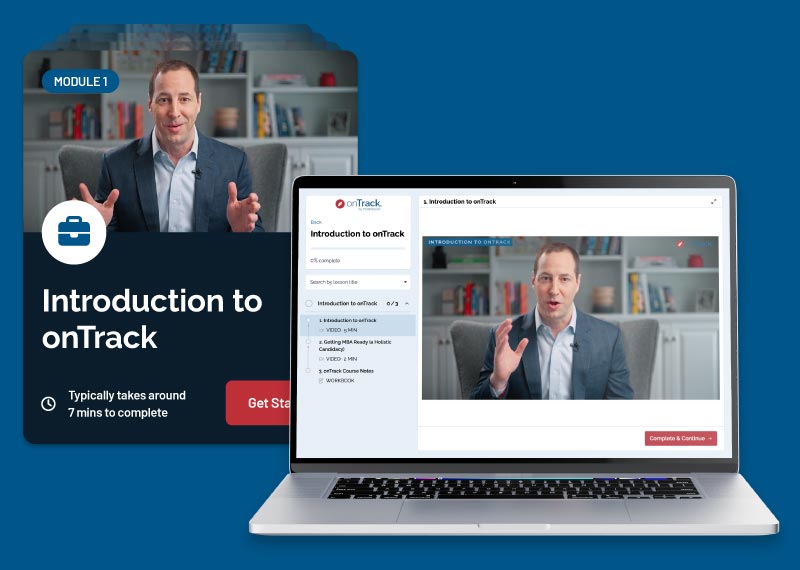
onTrack by mbaMission

A first-of-its-kind, on-demand MBA application experience that delivers a personalized curriculum for you and leverages interactive tools to guide you through the entire MBA application process.

Get Started!

2026–2027 MBA Essay Tips

Click here for the 2025–2026 MBA Essay Tips


MBA Program Updates

Explore onTrack — mbaMission’s newest offering allowing you to learn at your own pace through video. Learn more