Perhaps because of UCLA Anderson’s close ties to Hollywood and to the media and entertainment industries, the school has taken the lead in offering alternative essay questions to applicants—alternative in the sense of involving a nonwritten response. Anderson began by offering applicants the option to submit a short audio recording of their answer to one essay question, and in the 2009–2010 application season, began soliciting short video clips that answer one of two questions. In the 2010–2011 application season, applicants could answer the question “What is something people will find surprising about you?” via audio response (up to 2 minutes in length), video response (up to 1 minute in length) or essay (250-word maximum). If you’re considering applying to Anderson and have no idea how you might begin answering an essay question via audio or video clip, visit the Anderson Web site to see and hear original video and audio essay submissions from members of the Class of 2012, including “Mechanical Flower,” “Word Nut” and “My Dark Secret.”
For more information on UCLA Anderson or 13 other leading MBA programs, check out the mbaMission Insider’s Guides.
Many MBA applicants feel that they are purchasing a brand when they choose an MBA program, but the educational experience at business school is crucial to your future, and no one will affect your education more than your professors. Each Wednesday, we profile a standout professor as identified by students. Today, we focus on Art Middlebrooks from the University of Chicago Booth School of Business.
A 1988 Chicago Booth alumnus, Professor Art Middlebrooks (“Marketing of Services” “Developing New Products and Services”) is also a management consultant who helps service companies—including the Bank of America, IBM Consulting and BP/Amoco—develop new products and services. With these experiences in hand, Middlebrooks is prepared to take students in his “Developing New Products and Services” class through the product development process, starting from scratch. In his class, rather than being instructed to dream up a product, students are given raw data and hold focus groups as they strive to identify a consumer need. Recently, students in this course conceptualized new bag products for Ziploc and presented their findings to a panel of entrepreneurs. Students with whom mbaMission spoke described Middlebrooks as innovative and gushed about his passion and energy. Plus, several were impressed that he knew each student’s name on day one of class.
Applying to business school in 2011? 2012? By taking action now, you can dramatically improve your chances of gaining admission to a top MBA program in the coming years. Indeed, it is never too soon (and certainly not too late) to take several crucial steps to shape your MBA candidacy. Join mbaMission Founder Jeremy Shinewald as he leads prospective applicants through a Long-Term Planning Seminar. Topics of discussion will include the following:
* Creating Your Ten-Month (and Beyond) Timeline
* Maximizing the Impact of Community Activities
* Accelerating Personal Goals
* Building an Alternative Transcript
* Taking and Retaking the GMAT
* Making the Most of Campus Visits
* Understanding the Differences Between MBA Programs
* More…
Date: Tuesday, March 22, 2011 Time: 1:00-2:30 p.m. EST Location: Online at Beat the GMAT Price: Free!
Mission Admission is a series of MBA admission tips; a new one is posted each Tuesday.
This week, we consider another option for those looking to broaden their possibilities for next year: European MBA programs.
Although many candidates who are competing for places at the top U.S. business schools are well aware of the strengths of the MBA programs at INSEAD and the London Business School, even more options are certainly available beyond these two, including IESE, ESADE, Oxford (Said) and Cambridge (Judge). These four schools in particular have been aggressively playing “catch up” with their better-known brethren by raising funds and dedicating them to scholarships and to enhancing their global brands. Those who know their business schools also know that IMD offers a boutique MBA program with remarkable international diversity, very highly regarded academics and a stellar reputation with international employers.
So, numerous options are available, and each can be explored on its own academic merit, but is earning your MBA in Europe, in itself, a good choice for you? For many, the key issue in determining this centers on where they would like to be after completing their education. If you are seeking to work in Europe, then clearly, these schools offer an advantage over all but the top five or six schools in the United States. (HBS, for example, can probably open as many doors in Europe as INSEAD can.) However, if you are seeking to work in the States, then the European schools will not provide the pipeline of opportunities that a top-15 American school will provide, particularly for those who hope to work in niche industries or with companies that are not well-known international brands.
Still, beyond the employment picture, studying abroad offers intrinsic value. Two years in London, Fountainbleu or Lausanne can certainly be its own reward…
Which MBA program is right for me? How can I find the best fit? Jeremy Shinewald, founder and president of mbaMission, will help prospective MBAs understand the differences between the top business schools. Jeremy will elaborate on areas that will profoundly affect your academic and social lives in business school, including the flexibility of a program’s curriculum, the breadth of core courses, different methods of instruction, varying sizes of the cohorts and more. Start preparing now so you can be sure to make an educated decision when you apply!
A Q&A session will follow the presentation, after which Jeremy will remain online to respond to your additional inquiries.
Date: Monday, March 21, 2011 Time: 8:30-10:00 p.m. EST Location: Online Price: Free!
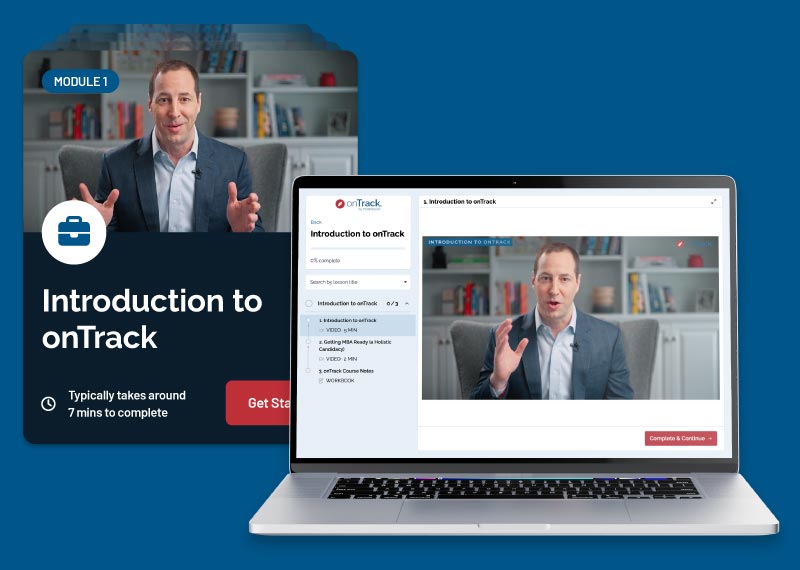
A first-of-its-kind, on-demand MBA application experience that delivers a personalized curriculum for you and leverages interactive tools to guide you through the entire MBA application process.