An often unsung program at Kellogg is the school’s Health Enterprise Management (HEMA) program, and a “star” within HEMA is the Global Health Initiative (GHI)—co-founded by Kellogg professor Daniel Diermeier, with several students in leadership and advisory roles—in which academics, students, corporations and nonprofits create products that solve medical problems around the world. As evidence of the program’s profile, in 2006, the GHI received a $4.9M grant from the Bill and Melinda Gates Foundation to develop diagnostic devices capable of identifying the HIV virus. Another impressive experiential offering is the multidisciplinary “Medical Innovation” class, which brings together industry leaders, top faculty members and students from several of Northwestern’s graduate schools (Law, Engineering, Medicine and Business). During this two-term course, students experience the “entire innovation life cycle” from a variety of perspectives: scientific, legal and entrepreneurial/managerial. Students even shadow surgeons and observe clinicians to facilitate their own brainstorming sessions for an innovative product—an actual product is created and presented to potential investors. Clearly, Kellogg provides students interested in health care with an opportunity to roll up their sleeves and get their hands dirty (and sanitize them as well.)
Which business school is right for me? How can I find the best fit? Jeremy Shinewald, founder and president of mbaMission, will help prospective MBAs understand the differences between the top MBA programs. Jeremy will elaborate on areas that will profoundly affect your academic and social lives in business school, including the flexibility of a program’s curriculum, the breadth of core courses, different methods of instruction, varying sizes of the cohorts and more. Start preparing now so you can be sure to make an educated decision when you apply! A Q&A session will follow the presentation, after which Jeremy will remain online to respond to additional inquiries.
Date: Monday, May 9, 2011 Time: 9:30-11:00 p.m. EST Location: Online Price: Free!
Mission Admission is a series of MBA admission tips; a new one is posted each Tuesday.
MBA admissions committees try to identify applicants who are constantly active, challenging themselves in all spheres of their lives. So, not only are extracurricular and community activities powerful in showing an MBA candidate’s benevolence, but they also help create the impression that the candidate is always pursuing goals and is therefore predisposed to success.
Each week, we meet at least one candidate who says, “I have been so busy professionally that I haven’t had time to volunteer. However, I was really active during college.” In almost all cases, however, as candidates get further from their college years, their college experience becomes less and less relevant. Although having a record of consistent achievement throughout college and into a candidate’s professional life is best, MBA applicants are often evaluated on a “What have you done for me lately?” basis, meaning that contemporary community service is generally more important.
Although MBA admissions officers know how finding the time to commit to external activities can be challenging for some professionals to do, they will still encounter many applicants from the most competitive fields who indeed find time to offer to others. So, if you had a rich and fulfilling college experience filled with leadership, in short, keep that trend going. You have a powerful complement to your contemporary involvements, but not a substitute.
“I had an internship from June to August of 2007. Will the admissions committee count it as work experience?”
“I was running a lab during my Master’s program—is that part of my total number of months of work experience?”
“I ran a small business that ultimately failed—will I get credit for my time as an entrepreneur?”
Business schools have not seriously considered a candidate’s number of months of work experience as a factor in admissions decisions for a long time. In fact, with Harvard Business School and the Stanford GSB increasingly open to younger candidates, work experience on a strictly quantitative level is actually being devalued at some schools. A candidate’s quantity of work experience is just not relevant—quality is, of course, what is important. An “average” employee who has merely fulfilled expectations during a five-year stint at a Fortune 500 company could certainly be said to be at a disadvantage compared with an individual who has made the most of a three-year stint elsewhere and has been promoted ahead of schedule. Think about it—which of the two would you hire? Which of the two would you admit?
So, if you are asked on an application how many months of work experience you will have prior to matriculating, you should simply answer honestly. If you have any gray areas or are unsure about any aspect of your professional experience as it pertains to your application, you can always call the admissions office for guidance. (Far from being punitive, most admissions offices are actually surprisingly helpful with this kind of simple technical question.) Thereafter, stop worrying about the number of months you do or do not have and instead focus on revealing that—and how—you have had an impact in your professional life. Your essays, recommendations, interviews, resume and other application elements will ultimately make a qualitative impact that will outweigh any quantitative data.
Which MBA program is right for me? How can I find the best fit? Jeremy Shinewald, founder and president of mbaMission, will help prospective MBAs understand the differences between the top MBA programs. Jeremy will elaborate on areas that will profoundly affect your academic and social lives in business school, including the flexibility of a program’s curriculum, the breadth of core courses, different methods of instruction, varying sizes of the cohorts and more. Start preparing now so you can be sure to make an educated decision when you apply! A Q&A session will follow the presentation, after which Jeremy will remain to respond to any additional inquiries.
Date: Wednesday, April 27, 2011 Time: 7:00-8:30 p.m. EST Location: Midtown Kaplan Center, 131 W. 56th Street (between 6th and 7th Ave) Price: Free!
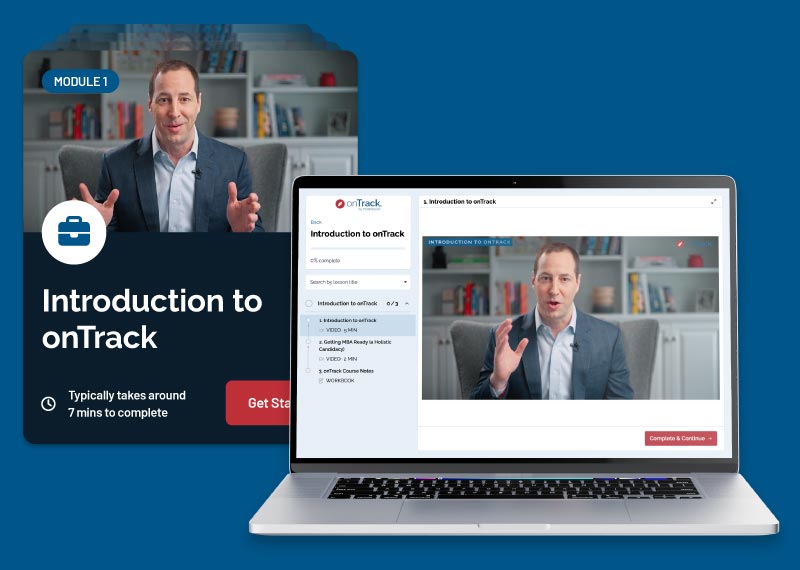
A first-of-its-kind, on-demand MBA application experience that delivers a personalized curriculum for you and leverages interactive tools to guide you through the entire MBA application process.