Mission Admission is a series of MBA admission tips; a new one is posted each Tuesday.
“I am self-employed.”
“I am a vice-president in a family business.”
“I am a freelancer.”
“I am a contract consultant.”
If you can describe your professional situation using any of these statements—or something very similar—you may very well be thinking (and worrying), “I have no supervisor! Who is going to write my recommendations?!”
Before we address this problem, let us first remind you that MBA admissions committees have indeed seen it all. Your situation is most likely not unique, so you do not need to fret. Let’s consider the example of the family-business vice-president and add a detail—that the family business is in manufacturing. This hypothetical MBA candidate could contact one of the company’s long-standing clients or suppliers, who may be able to write about the applicant’s integrity, growth, sense of humor, determination and more, all in relation to other comparable individuals.
If these constituents were not able to offer adequate feedback, however, the MBA candidate might instead ask the head of a trade association or possibly even a respected competitor to write on his/her behalf. If the applicant really needed to get creative, he/she might even consider asking a service provider; for example, getting a letter of reference from an architectural firm that collaborated with the candidate to build a new manufacturing facility could be an interesting solution.
In short, most MBA candidates have more potential recommenders to choose among than they realize. Keep looking and try not to get discouraged—someone out there knows you well and can write objectively on your behalf.
mbaMission is proud to introduce a first-of-its-kind MBA application writing class led by a veteran mbaMission admissions consultant. Throughout this four-session, 12-hour course, we will guide you step-by-step through the process of creating a compelling MBA application that reveals your unique character and will inspire the admissions committee to grant you that coveted letter of acceptance. This class is designed to jump-start your application process—you will brainstorm for unique ideas, practice the techniques of effective storytelling and resume construction and learn how to structure and draft essays for your target school—so that you are headed in the right direction with all your applications.
Expected Outcomes
In this class you will accomplish the following:
Understand how to view essays through the lens of the admissions committee
Learn to identify the characteristics of a great essay and avoid common pitfalls
Dig deep into your past experiences to reveal your most compelling stories
Start constructing your essays with feedback and direction from your peers and the instructor
Benefit from the workshop leader’s deep expertise on the admissions process and top programs
Workshop your essays in an online session after the formal instruction sessions to enhance your drafts and move your work toward the final draft stage
Get a head start on your recommendations and interviews in an extra hour of recorded content and develop a process for completing the rest of your applications
Class Dates:
Online A –
Thurs., Sept. 8 (8-11 p.m.)
Sat., Sept. 10 (11 a.m.-2 p.m.)
Sat., Sept. 10 (3-6 p.m.)
Mon., Sept. 12 (8-11 p.m.)
Online B–
Tues., Oct 11 (8-11 p.m.)
Wed., Oct. 12 (8-11 p.m.)
Thurs., Oct. 13 (8-11 p.m.)
Wed., Oct. 19 (8-11 p.m.)
New York A–
Fri., Sept. 23 (6-9 p.m.)
Sat., Sept. 24 (10 a.m.-1 p.m.)
Sat., Sept. 24 (2-5 p.m.)
Tues., Sept. 27 (6-9 p.m.)
New York B–
Fri., Oct. 28 (6-9 p.m.)
Sat., Oct. 29 (10 a.m.-1 p.m.)
Sat., Oct. 29 (2-5 p.m.)
Wed. Nov. 2 (6-9 p.m.)
Chicago A*–
Sun., Sept. 25 (10 a.m.-1 p.m.)
Sun., Sept. 25 (2-5 p.m.)
Mon., Sept. 26 (6-9 p.m.)
Wed., Oct. 5 (6-9 p.m.)
*Chicago times are listed in Central Time Zone. All other times listed in Eastern Time Zone.
Fees: Online A & B – $525, New York A & B – $650, Chicago A – $650
In the past, we have advised MBA candidates to exercise caution in choosing to write the optional essay. (See our Monday Morning Essay Tip: The Optional Mistake.) Our philosophy has not changed on this point, but we do want to make MBA candidates aware of certain circumstances, other than discussing a problem area, that may necessitate writing an optional essay.
For example, if you have achieved something absolutely extraordinary that is relevant to your candidacy—something that truly strikes at the essence of who you are—but that will simply not fit as an answer to any of the school’s essay questions, then you should consider writing the optional essay to illuminate the experience and its importance to you. We would advise a candidate to make this exception only in the most unique of circumstances and remind applicants that they should still be quite conservative in their use of this space. Again, this is not the place for a 500-word “extra” essay, but a few sentences illustrating the extraordinary experience and its significance would be appropriate. Such an experience should be able to stand on its own, so you do not need to belabor the point and agitate the admissions committee with a long essay detailing a variety of themes and accomplishments.
Let’s play a quick game of word association. We’ll start… “Kellogg.” Ok, go ahead… “Entrepreneurship.” Right? No? Aspiring MBAs may be surprised to learn that Kellogg offers approximately 29 courses in this discipline and that roughly 16% of each student class typically completes an Entrepreneurship and Innovation major—defying the stereotype that Kellogg produces only marketing MBAs. But Kellogg’s Entrepreneurship and Innovation Program offers more than classes; it provides a variety of hands-on opportunities, including the Entrepreneurial Internship Program, in which rising second-year students intern with small businesses to help facilitate career transitions (while earning a $1,000 weekly stipend).
Kellogg also has an Entrepreneur in Residence program, wherein an experienced entrepreneur hosts half-hour sessions with students who aspire to careers in this field or are seeking advice on their already active projects. MBA student entrepreneurs coming from or planning to enter a family business will likely be interested to learn that Kellogg’s Center for Family Businesses not only publishes research and cases on family business, but also confidentially consults to family-run companies. Indeed, this is all just the tip of the iceberg…
Go beyond the stereotypes. For in-depth information on Kellogg and 14 other leading business school programs, check out the mbaMission Insider’s Guides.
Many MBA applicants feel that they are purchasing a brand when they choose a business school to attend, but the educational experience is what is crucial to your future, and no one will affect your education more than your professors. Each Wednesday, we profile a standout professor as identified by students. Today, we focus on Harry Kraemer from the Kellogg School of Management at Northwestern University.
A winner of the Lavengood Award for Outstanding Professor of the Year (2008), Harry Kraemer (“Management and Strategy”) is a Kellogg alumnus (MBA ’79) and was CEO and president of Baxter International (a $9B health care firm) before becoming an adjunct professor at Kellogg. Kraemer remains active in the business community as an executive partner at Madison Dearborn, a Chicago-based private equity firm. Students we interviewed described how Kraemer fuses theory and practice, bringing CEOs from some of the biggest companies in the United States to his class, but outsiders need not worry that such a successful individual would be out of touch with the common student—Kraemer is known for offering students one-on-one career guidance, even if they are not enrolled in his class.
For more information about Kellogg and 14 other top-ranked business schools, check out the mbaMission Insider’s Guides.
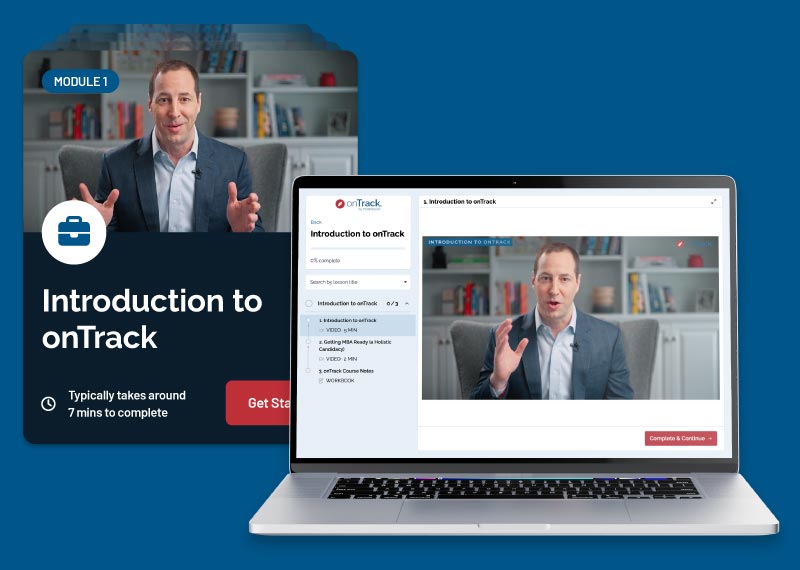
A first-of-its-kind, on-demand MBA application experience that delivers a personalized curriculum for you and leverages interactive tools to guide you through the entire MBA application process.