In your first required essay for the University of Michigan’s Ross School of Business, you need to discuss your immediate post-MBA professional aspirations, then explain to the admissions committee why the Ross MBA program is the best way for you to gain the skills and experiences you need to achieve that career goal and succeed in it. For Ross’s second essay, you have a choice of three prompts, all of which give you the opportunity to share something about yourself and your life that is separate from your career and academic achievements. A brief optional essay is available as well, should you have any elements in your candidacy that you believe warrant some clarification. Read on for our full analysis of the school’s 2026–2027 essay prompts.
The Stanford Graduate School of Business (GSB) requires only two essays of its candidates, though its long-standing first essay question—about “what matters most” to applicants—is one we have seen many people struggle with over the years. The largely open-ended nature of the prompt often stymies candidates, who understandably want to avoid making any wrong moves in their application. The GSB’s second essay question is comparatively straightforward, asking applicants to explain why they have chosen the school for their MBA, but crafting the best possible response will demand some thorough research into what the institution offers and an ability to clearly show a connection between certain resources and the candidate’s unique personality and needs. With a word limit of 650 for the first required essay, and only 350 for the second, applicants need to be judicious in selecting their desired messages and succinct in conveying them. That said, the admissions committee does provide other opportunities for candidates to share additional information about themselves and their background, about instances of positive impact they have had, and about any confusing or potentially problematic elements of their candidacy. Read on for our full analysis of the GSB’s essay and optional question prompts.
For the 2026–2027 application season, Harvard Business School (HBS) requires three application essays that each focus on a different element of the MBA program’s admissions criteria. For the school’s first required essay, you will need to reflect on your past and explain how certain choices you have made have influenced your professional aspirations. Leadership is the central theme of the second, and for the third essay, you must discuss how your curiosity has led to growth. A significant challenge with HBS’s application essays lies in the miserly word count allowed for each, especially given that the questions ask for more than the recounting of a single anecdote. You will need to provide a full discussion of “cause and effect” for each story you share, presenting a past experience and then revealing how it has shaped you into the person you are today and influenced your vision going forward. That is a lot to accomplish in 300, 250, and 250 words, respectively. In this post, we discuss how you can meet this challenge and craft effective essay responses to HBS’s prompts for 2026–2027.
If you are applying to business school, you have probably heard about the “case method” more times than you can count—and likely wondered what the experience is like and what it asks of MBA students. In this episode of The mbaMission Podcast, host Harold Simansky and mbaMission Executive Director Jessica Shklar sit down with Harvard Business School (HBS) professor Joshua Margolis, a faculty member in the Christensen Center for Teaching and Learning, for a candid look at how the case method works at the school that invented it.
The perfect MBA applicant does not actually exist. However, the perception of the perfect applicant absolutely does—such an individual scales greater and greater personal, community, and professional peaks undeterred until finally applying to business school. Because of this idealized image of an applicant, candidates who have taken any time off from their professional pursuits believe they are automatically at a disadvantage. They worry that the admissions committees will see the gap(s) in their professional timeline and dismiss their candidacy outright. After all, the schools probably have many other, seemingly more determined individuals they could admit instead, right?
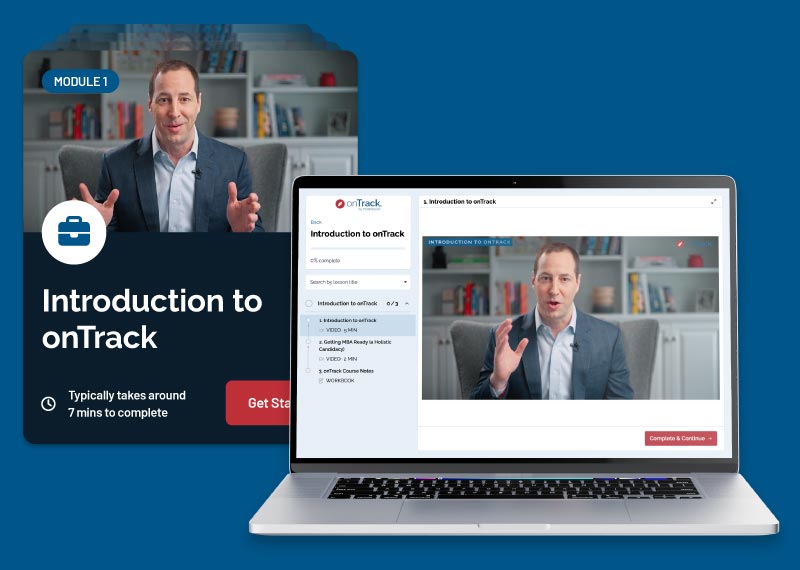
A first-of-its-kind, on-demand MBA application experience that delivers a personalized curriculum for you and leverages interactive tools to guide you through the entire MBA application process.